Viral video prompts new scrutiny of alleged fraud, draws quick reaction from Minnesota regulators

The claims of a right-wing influencer are prompting questions about whether fraud has proliferated in a program that was flagged for deficiencies a decade ago.

December 29, 2025 at 10:27PM
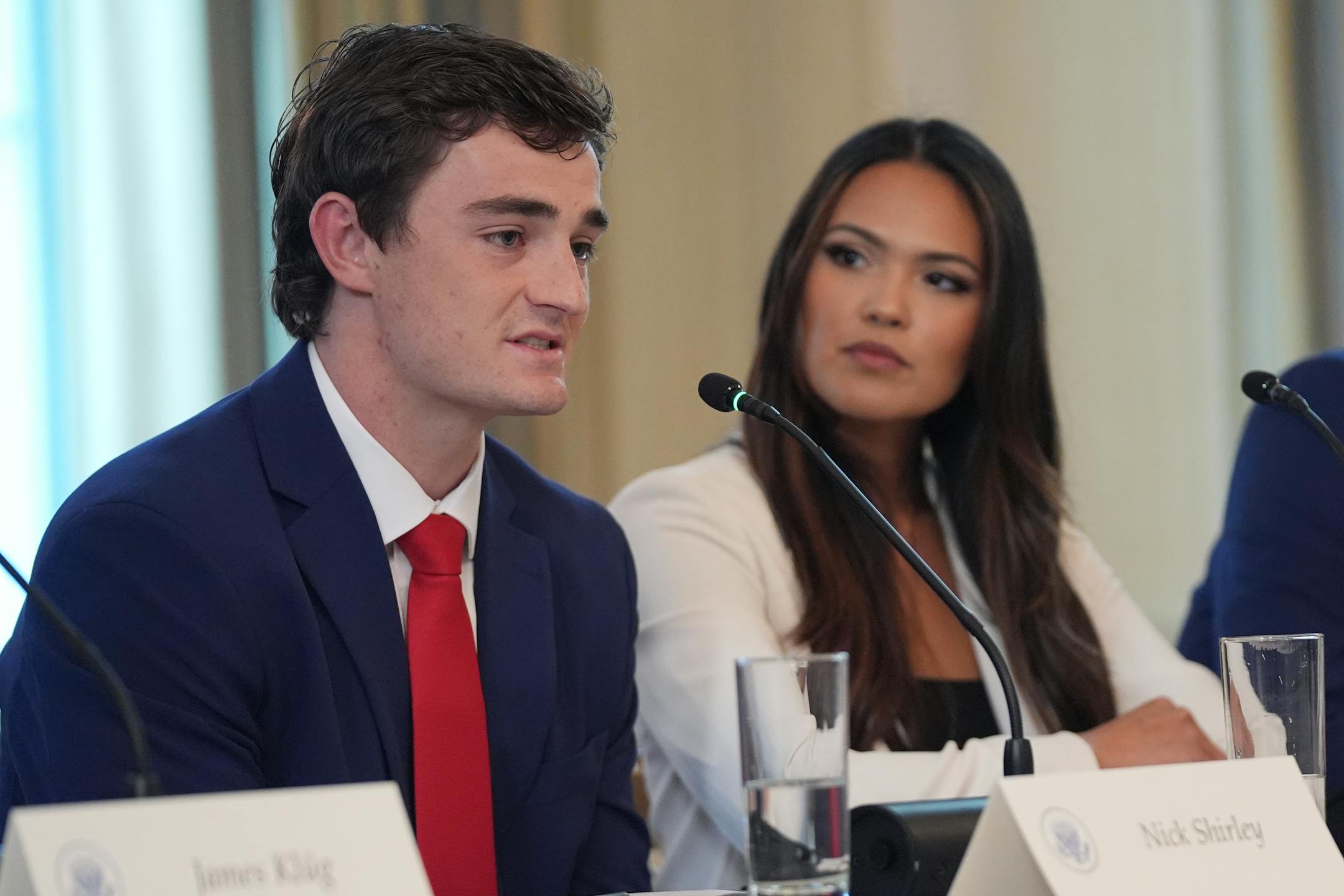
Nick Shirley speaks during a roundtable meeting with President Donald Trump on antifa in the State Dining Room at the White House, Wednesday, Oct. 8, 2025, in Washington, as Savanah Hernandez listens. (AP Photo/Evan Vucci)
Nick Shirley speaks during a roundtable meeting with President Donald Trump on antifa in the State Dining Room at the White House on Oct. 8. A recent video by Shirley has gone viral. (Evan Vucci/The Associated Press)

A video that surfaced on YouTube this past weekend contained explosive allegations about Minnesota’s child care assistance program, raising new concerns about fraud and triggering a quick reaction from state regulators.

In the 43-minute video, which went viral on social media and has more than 1.4 million YouTube views since it debuted Friday, right-wing influencer Nick Shirley alleges that a group of day care centers operated by Somali residents in Minneapolis has misappropriated “upwards of $100 million.”

In 2024, the program — which provides financial assistance to help low-income families pay for child care so parents can work — cost $306 million.

Despite registering concerns about the accuracy of the report, state regulators responded by sending inspectors to each of the centers featured in the video to see if there were licensing issues or other problems.

Tikki Brown, commissioner of the Minnesota Department of Children, Youth, and Families, said at a Dec. 29 afternoon news conference that two of the Minneapolis centers closed this year, including Quality Learning Center in Minneapolis just last week. Quality featured prominently in the video.

“While we have questions about some of the methods that were used in the video, we do take the concerns the video raises about fraud very seriously,” Brown said.

The video has amplified national scrutiny on Minnesota over Medicaid fraud, which federal investigators say has swamped state programs, while also raising concerns that fraud has continued to proliferate in a program flagged for issues 10 years ago.

Shirley’s video prompted a response from Vice President JD Vance and FBI Director Kash Patel over the weekend. On Dec. 29, Department of Homeland Security Secretary Kristi Noem posted on X that ICE agents were knocking on doors in a “massive investigation on childcare and other rampant fraud.”
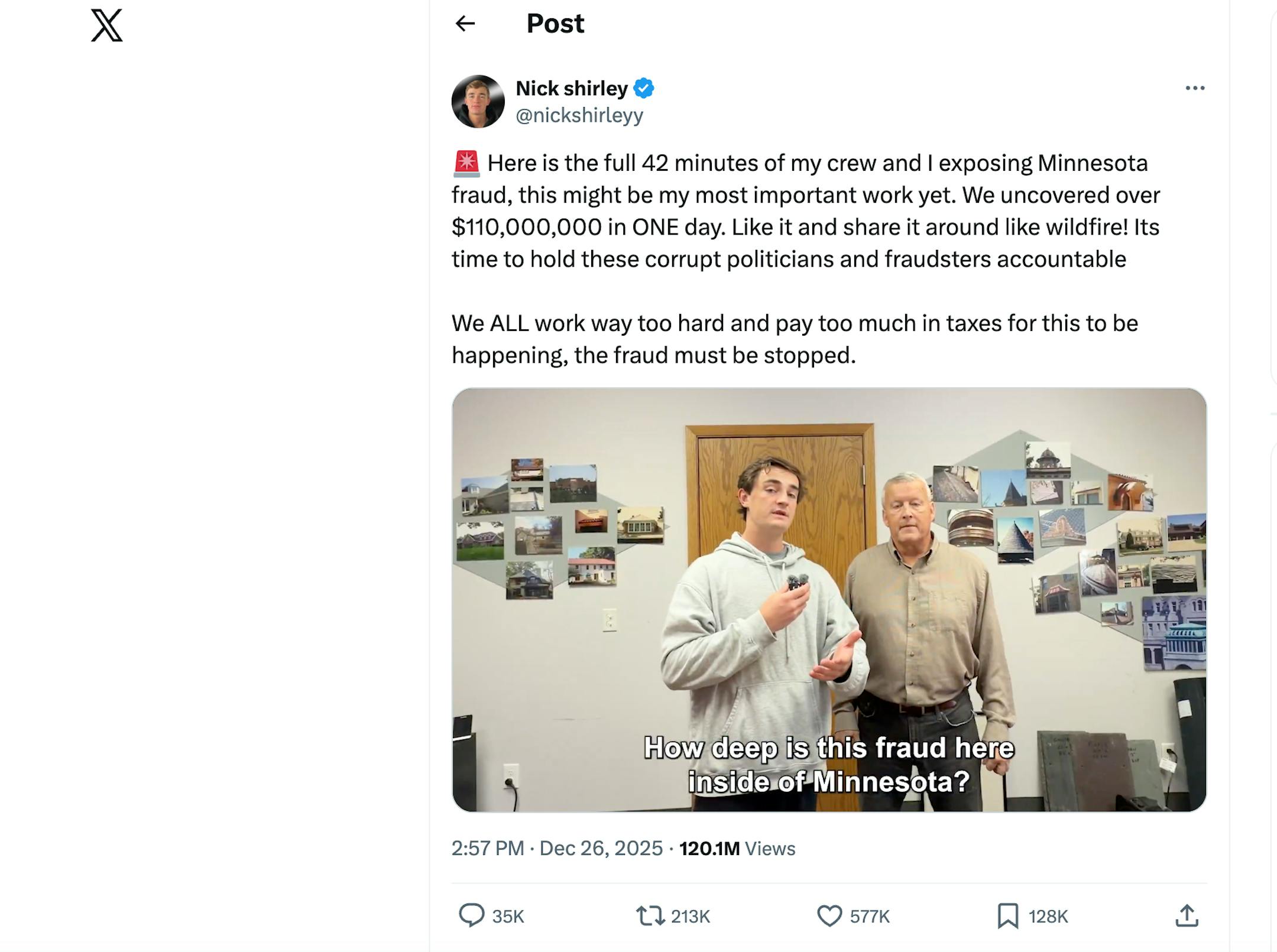
The video shows Shirley and a man identified as “David” as they visit 10 day care centers that allegedly received public funding to see whether the businesses are actually taking care of children.

In most cases, Shirley and his partner are either unable to get anybody to answer the door or are refused entry. A few employees or clients of the centers challenged their claims, but it’s not clear if any of those individuals were the facility owners.

Caption: A screenshot from Nick Shirley’s X account shows a clip from a 43-minute long video he posted, alleging that a group of day care centers in Minneapolis have misappropriated “upwards of $100 million.”
A screenshot from Nick Shirley’s X account shows a clip from a 43-minute video he posted, which has gone viral, alleging a group of day care centers operated by Somali residents in Minneapolis has misappropriated “upwards of $100 million.” (Screenshot via X)

Brown said it is hard to draw solid conclusions from the video because it’s not clear whether Shirley visited the day care centers during the week, when they would likely be full of children, or on a weekend or holiday, when they would likely be empty.

Brown said each of the centers has been visited in the past six months, but none of those unannounced visits turned up evidence of fraud. She said the department has not yet found problems that warrant pausing payments to any of the centers.

Brown declined to provide information about the recent closings of Quality Learning Center on Nicollet Avenue or Mako Childcare on 25th Avenue S.

“We generally don’t disclose information if we have a current, open investigation,” she said.

Shirley’s video provoked a fast response from Minnesota Republicans, including several candidates who are running for governor.

“The amount of attention and outcry that you are seeing is a direct result of the massive frustration from Minnesota taxpayers who are tired of being ripped off by fraudsters,” said Minnesota House Speaker Lisa Demuth, who’s among those vying to unseat Gov. Tim Walz in his bid for a third term. “The Walz administration had years to address these issues but has frequently ignored or downplayed the issues at every turn.”

A spokeswoman for Walz said he “has worked for years to crack down on fraud and asked the state Legislature for more authority to take aggressive action.”

“He has strengthened oversight — including launching investigations into these specific facilities, one of which was already closed," spokeswoman Claire Lancaster said in a statement to the Minnesota Star Tribune, adding that he shut down a high-risk program and hired an outside auditor and a new statewide program integrity director.

House GOP floor leader Harry Niska said it’s hard for Republicans to trust what the Walz administration says about fraud after the issue has continued to fester.

“We have a governor and an administration that has totally broken its trust with the people of Minnesota,” Niska said.

Niska said the Minnesota House Republican Caucus provided information about fraud to the man named David who appeared in Shirley’s video.

Shirley’s YouTube channel has amassed more than 1 million followers. He was one of several influencers who were invited to the White House in October to participate in an “antifa roundtable” — a discussion about left-wing groups and the anti-fascist movement — with President Donald Trump.

He previously faced criticism for a video he filmed in Kyiv, Ukraine, where he falsely implied that American tax dollars were used to buy luxury cars and install a Ferris wheel in the city.

When another journalist questioned him about the video, Shirley responded that he was “making satire on the internet.”

Shirley, 23, also filmed content at the Jan. 6, 2021 riot at the U.S. Capitol. He interviewed a man who participated in the riot and took a piece of mail from then-House Speaker Nancy Pelosi’s office. “That’s from Nancy Pelosi’s desk!” Shirley repeated as he spoke to Richard “Bigo” Barnett. “Bigo’s here! The man’s a savage.”

Shirley’s media company is based in Utah, records show. He did not respond to requests for comment.

Zak Osman is manager of the Minnesota Child Care Center, which Shirley visited last on his video. Osman said the doors are always locked for safety, and the staff was on high alert due to the Trump administration’s actions against Somalis for the past month.

He said they don’t do “walk-in appointments” but there were children inside at the time and their cameras prove it. “You cannot see anyone from outside,” Osman said.

Shirley was there for about 40 seconds before a shift supervisor heard what he was saying and tried to close the door but Shirley was holding onto it, so she had to pull it shut hard.

Since the video went viral, the center has been bombarded with phone calls from across the country, with people talking about congresswoman Ilhan Omar and saying things like “give us our money back,” he said.

State workers visited the center Dec. 29, in what Osman said was the fifth audit this year.

Day care fraudsters received light punishment

But the new allegations are raising questions about whether fraud has proliferated in a program that was flagged for deficiencies a decade ago.

One of the first major scandals involving fraudsters in the Somali community started in 2015 when three Minneapolis day care centers were raided by police and accused of overbilling the state’s Child Care Assistance Program (CCAP).

The program was aimed at helping low-income families with child care costs, but investigators discovered some day care operators billed the state for more children than were actually present.

By 2017, investigators filed charges against 10 day care operators, but the penalties were modest compared to the more recent fraud cases involving a meals program overseen by the state Education Department.

Though some of the individuals convicted in the Feeding Our Future scandal have received federal sentences of up to 28 years, none of the people convicted in the day care scheme were sentenced to more than five years in prison, according to a Minnesota Star Tribune review of the cases. Two of the convicted fraudsters received sentences of 30 days or less.

In half of the cases, records show, nobody was sent to jail. Prosecutors either dismissed the charges when the owners agreed to repay the stolen funds or never pursued criminal charges against individual owners after the companies pleaded guilty and were ordered to make restitution.

The cases drew public outrage after a Fox 9 report alleged in 2018 that as much as $100 million annually was being misappropriated and possibly diverted to terrorist groups in East Africa.

A 2019 report from the Legislative Auditor found “no evidence” to support those claims. State and federal prosecutors filed charges over $5.4 million in misappropriated funds, but the auditor concluded the actual amount of fraud was likely higher.

But investigators also concluded that internal controls at the state DHS were “insufficient to effectively prevent, detect, and investigate fraud.”

Temporary DHS Commissioner Shireen Gandhi told a panel of state lawmakers in February that Minnesota has about 1,800 licensed child care centers and about 5,800 licensed family child care providers.

She said about 3,600 providers are enrolled in the state’s Child Care Assistance Program. Every year, Gandhi said, state licensers make unannounced site visits to child care providers.

They report any violations or conditions that could be suggestive of fraud to CCAP investigators, she said.

Since 2021, the Child Care Audits and Investigations unit has referred about five cases a year to law enforcement for criminal investigation. She said the unit also stopped payments to 79 child care providers since 2021.

In response to previous questions from the Star Tribune, DHS said that it has taken numerous steps since 2019 to beef up anti-fraud efforts, including using data to flag improper billing requests, enhanced attendance requirements, increased use of video surveillance, a formal system for fraud referrals and more frequent inspections of new providers.

However, the department has not implemented one of the Legislative Auditor’s chief recommendations: replacing handwritten sign-in sheets with an electronic attendance system.

The auditor noted that most child care fraud involved providers who submitted inflated attendance records to obtain extra money, similar to what federal authorities have documented in the meals program.

In 2019, 22 states required some automated way of collecting attendance, while eight other states were developing those systems, according to the legislative auditor.

Allison Kite of the Minnesota Star Tribune contributed to this story.

about the writers

about the writers

Jeffrey Meitrodt

Reporter

Jeffrey Meitrodt is an investigative reporter for the Star Tribune who specializes in stories involving the collision of business and government regulation. 

See Moreicon

Deena Winter

Reporter

Deena Winter is Minneapolis City Hall reporter for the Star Tribune.

See Moreicon

Ryan Faircloth

Politics and government reporter

Ryan Faircloth covers Minnesota politics and government for the Star Tribune.

See Moreicon

More from News & Politics

See More
Nick Shirley speaks during a roundtable meeting with President Donald Trump on antifa in the State Dining Room at the White House, Wednesday, Oct. 8, 2025, in Washington, as Savanah Hernandez listens. (AP Photo/Evan Vucci)
Evan Vucci/The Associated Press

The claims of a right-wing influencer are prompting questions about whether fraud has proliferated in a program that was flagged for deficiencies a decade ago.