This suburban district opted to serve its highest needs special education students in-house

Since the Fridley school district opened a new program last year that’s an unusual model in Minnesota, it’s already proving popular.

The Minnesota Star Tribune
November 27, 2025 at 12:00PM
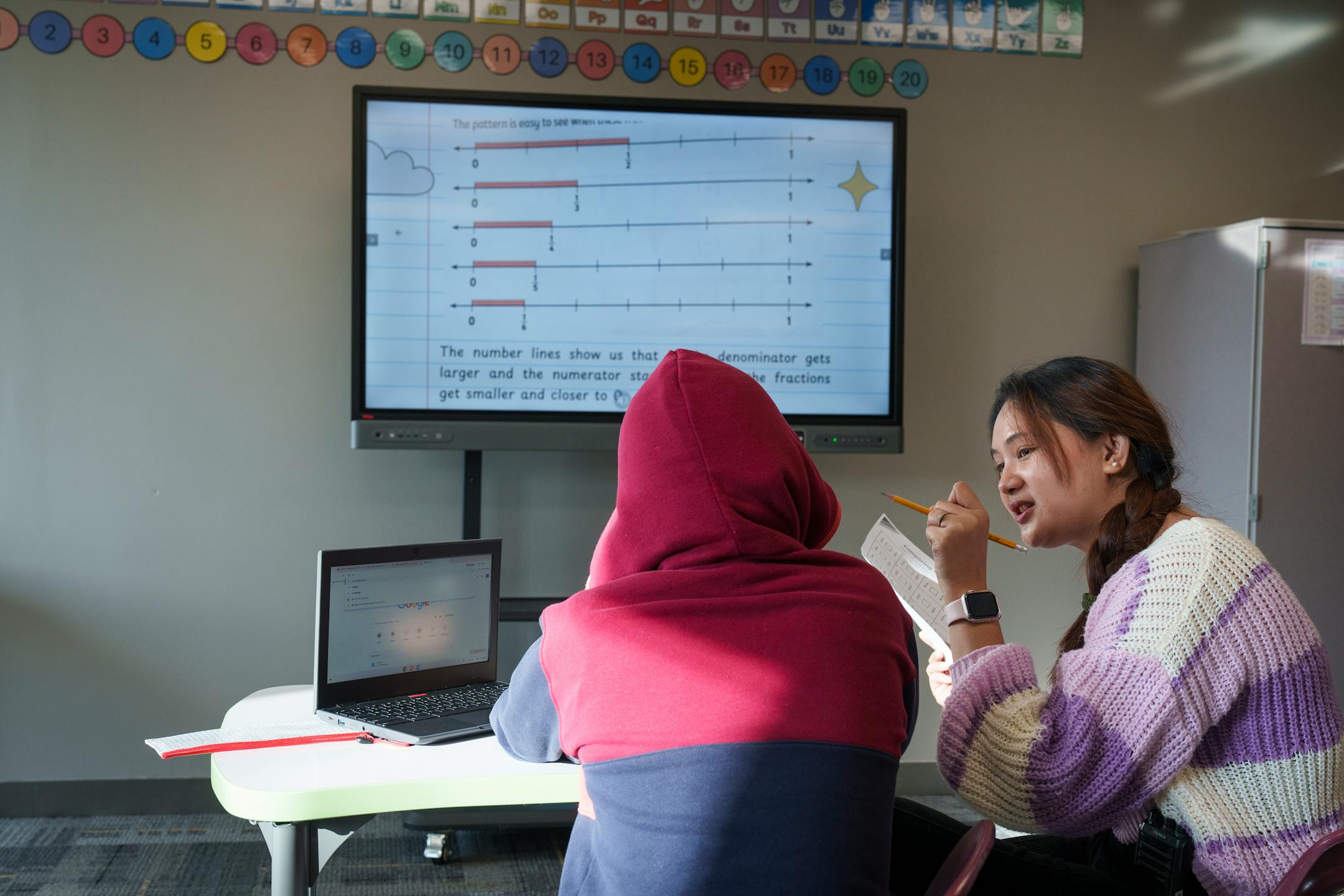
Math teacher Ana Mae Legaspi works with a student at VISTA Education Center secondary school in Fridley. (Leila Navidi/The Minnesota Star Tribune)

In a quiet wing of Fridley High School, a group of educators is reimagining what a school day can look and feel like for teenagers who need the most special education services.

Classrooms are intentionally flexible, with whiteboard tables, sensory tools and individualized workstations that, for at least one student, look like a stack of bean bags in a cozy corner.

Fridley’s model is unusual in Minnesota, where most districts rely on intermediate districts, which function as special education service cooperatives, to serve the highest-needs special education students.

But in Fridley, the vision for VISTA Education Center was to offer a space that feels calm and welcoming for students with an in-district special education program that meets requirements for a restrictive placement known as Federal Setting IV.

The VISTA center, which stands for “valuing individual student talents and abilities,” offers intensive services and high student-to-staff ratios for children who need to spend more than half of their school day in the separate setting.

The program opened to a small group of elementary students last year in a separate district building and this year, it expanded to serve teenagers in a section of the high school. The middle school site is set to open in the fall.

So far, Fridley’s model is proving popular. The program is at capacity, serving students from Fridley and nine other districts. Districts from across Minnesota have toured the VISTA program and are considering trying to replicate the program, Superintendent Brenda Lewis said.

“They have been eyeing us,” she said. “It’s exciting to see.”

Its success, Lewis said, is due in large part to the district’s international recruiting — a strategy that has helped Fridley ensure its special education department stays fully staffed. Building an in-house Setting IV program requires both significant staffing and sustained funding because of high student-to-staff ratios.

Recent fee hikes for H1-B visas — which allow U.S. employers like Fridley Public Schools to hire foreign workers in specialty occupations — as well as ongoing uncertainty about federal cuts to special education funding, could make such a move harder.

“Without the international visa programming, we wouldn’t be able to operate this facility, period,” Lewis said. “Full stop.”

‘Typical school experience’

The goal for the VISTA space was to provide safety and accommodations for students while preserving the feeling of a learning environment.

“We want to provide students with the most typical school experience they can have,” said Principal Matthew Engelhardt.

Housing the secondary program in a wing of high school does just that. The program is self-contained and separated from the high school by locked doors but the location offers chances for students to join general education students in ways that similar programs’ students wouldn’t easily get in an isolated building.

VISTA students, for example, can practice walking through hallways or standing in the lunch line with their peers. And if they get overwhelmed, they can quickly return to the privacy, safety and flexibility of the VISTA classrooms.

“It’s all about that adaptability and skill-building,” Assistant Superintendent Rochelle Cox said.

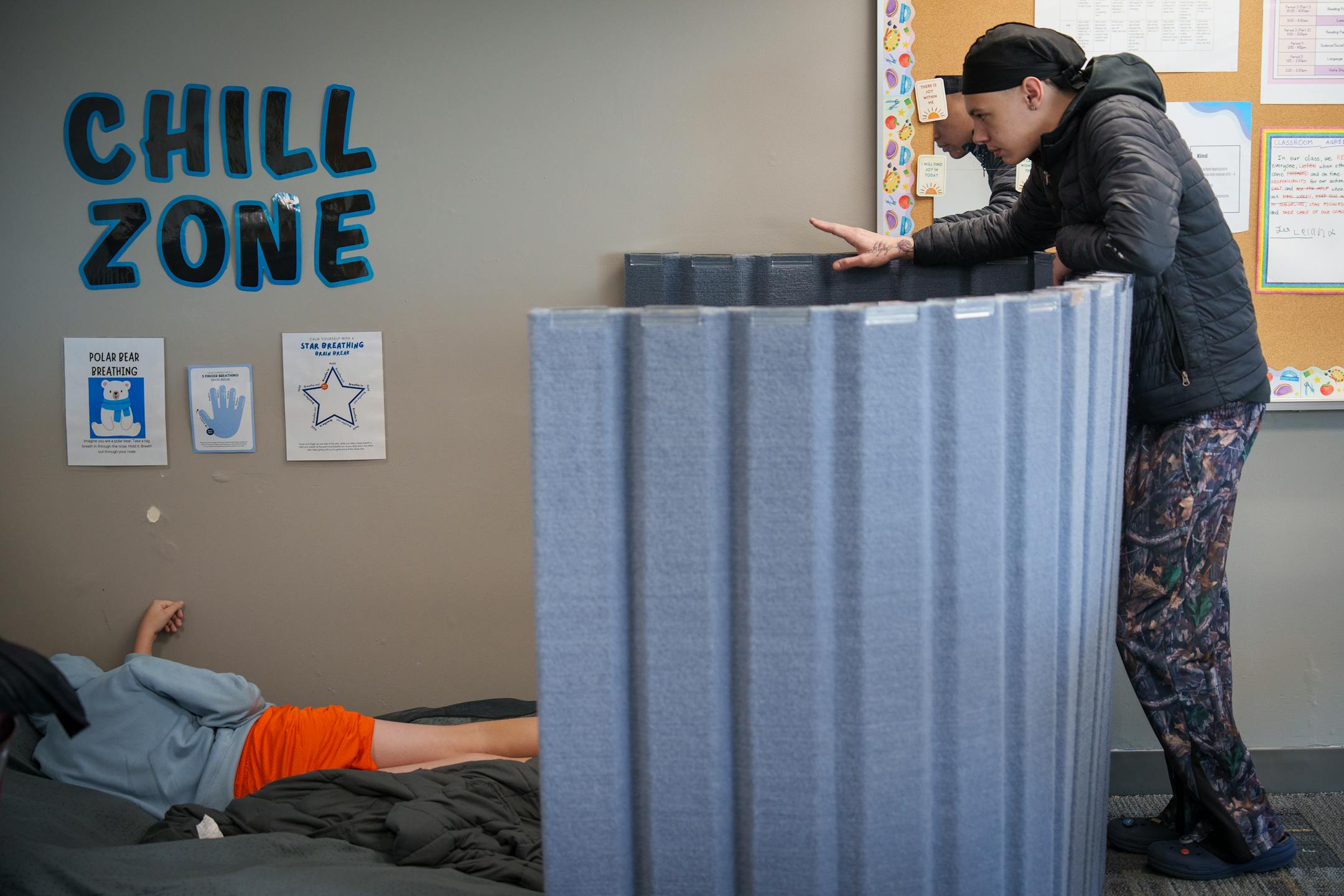
Devon Vernier, a para educator and graduate of VISTA, checks on a student who is resting in the “Chill Zone” at VISTA Education Center secondary school. (Leila Navidi/The Minnesota Star Tribune)

A sense of community

Engelhardt said his priority is to create a sense of belonging with students and their families. Family fun nights at VISTA involve considerations about safety and how to split students up based on who they’re comfortable with and what might overstimulate them, but such gatherings are important parts of the school experience, Engelhardt said.

At a recent event, a mom came up to Engelhardt with tears in her eyes.

“She told me ‘My son has never felt this before,’” Engelhardt said. “It was the first time, she said, that he’d really felt part of a community.”

Students have expressed their own surprise at the program’s approach and expectations. One new student, familiar with restraint-heavy environments, asked staff, “Where’s your padded room?”

The school intentionally moves away from isolation rooms or restraint tactics that many students experienced elsewhere. Staff are trained in the Ukeru approach, which relies on padded shields, breathing tools and visual supports rather than physical holds.

“We have a lot of students who come to us from other settings who very openly talk about feeling like they were just stuck in rooms all day,” Engelhardt said. “We don’t want our students to feel that way.”

Suspensions are also avoided, as is sending students home for behaviors. Instead, teachers are trained in de-escalation tactics and work to help students reflect on their behavior and talk through ways to regulate in the future.

“It doesn’t make you feel a part of the community if we’re just kind of kicking you out,” Engelhardt said. “That’s a game changer for a lot of our students.”

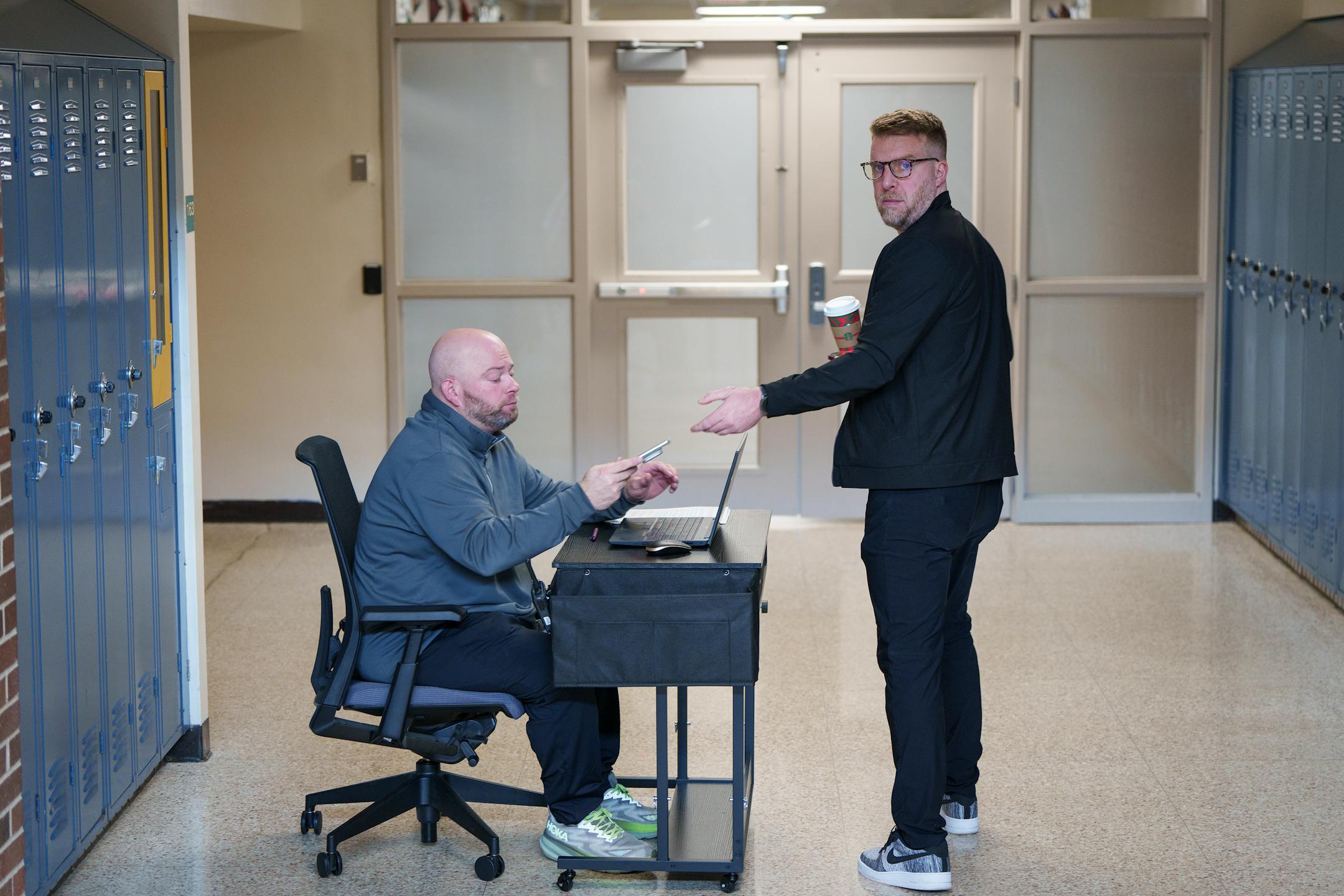
Matthew Engelhardt, right, principal of VISTA Education Center and the Transitions Program talks with special education coordinator Mike Deschneau, left, at the entrance to VISTA Education Center’s secondary school. (Leila Navidi/The Minnesota Star Tribune)

Future plans

Even with its successes, staff say the work of VISTA requires constant reinvention. “The strategies we use today might work for a week, but then we’ve got to come up with something new,” Cox said.

The school leaders are also working to adapt the space.

Plans for more renovation to the high school wing are underway. The lockers lining the hallways will be removed for more calming spaces, and entrances and classrooms will be redesigned for added safety and flexibility.

“The dream was that students walk in and feel like they deserve to be part of a learning environment made for them,” Lewis said.

about the writer

about the writer

Mara Klecker

Reporter

Mara Klecker covers suburban K-12 education for the Star Tribune.

See Moreicon

More from Twin Cities Suburbs

See More
card image
Dakota County Sheriff's Office

The shooting near Farmington is under investigation, but officials say there is no danger to the public.

card image