
Editor's Pick

Editor's Pick

These Minnesota schools serving low-income students are beating the odds

November 10, 2025
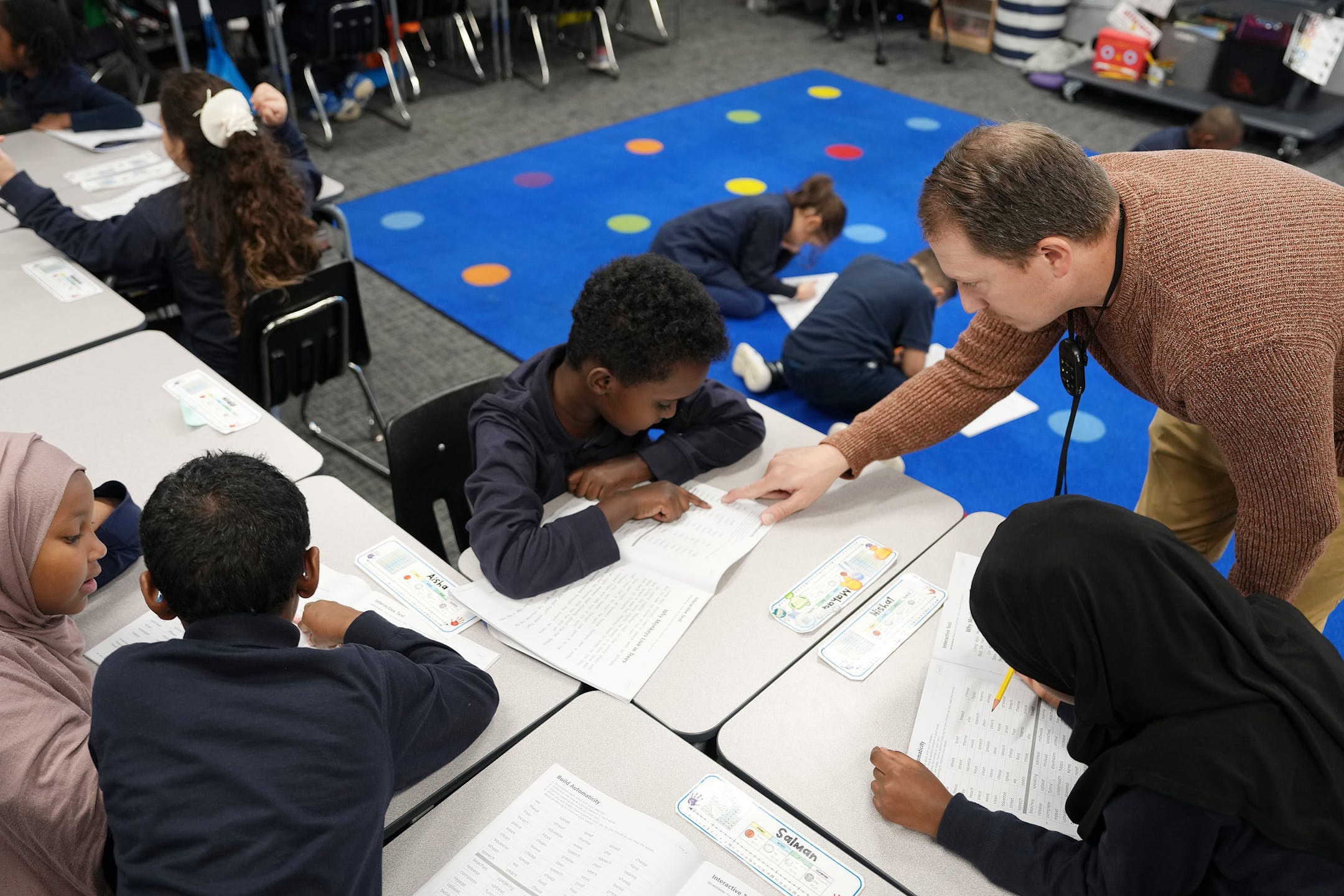
Second-grade teacher Eric Langsev helps a student with a reading lesson at Global Academy in New Brighton. More than half of the students there are English learners, and many are new to the U.S. (Anthony Soufflé/The Minnesota Star Tribune)

A Minnesota Star Tribune analysis of test scores shows which of the state’s public schools have exceeded expectations.

The waitlist at Global Academy has, at times, topped 900 students — proof that families see something special in the New Brighton charter school.

Drawing students from as far as Blaine and Eagan, the K–8 academy serves about 470 children this year and is known for its academic rigor and strong sense of community.

More than half of the students there are English learners, and many are new to the U.S. Over 90% of the kids come from low-income families — a main reason school leaders provide free uniforms and school supplies each year.

Students living in poverty typically face greater academic challenges, with Minnesota’s achievement gaps by race and income among the widest in the nation. It’s a “statewide crisis,” according to the Federal Reserve Bank of Minneapolis, that hampers the state’s workforce and economy.

Global Academy stands out as one of 50 Minnesota high-poverty schools the Minnesota Star Tribune identified through an analysis as “beating the odds,” meaning its students performed far better than expected on state math or reading tests last year.

Many of the other schools on the list are charter schools, while most of the traditional public schools, with the exception of Jie Ming Mandarin Immersion Academy in St. Paul, are located in greater Minnesota.

“We are proud of what we’re doing for Black and brown students and really helping to close that gap,” said Melissa Storbakken, the executive director of Global Academy, adding that there’s still more to do to raise her school’s scores.
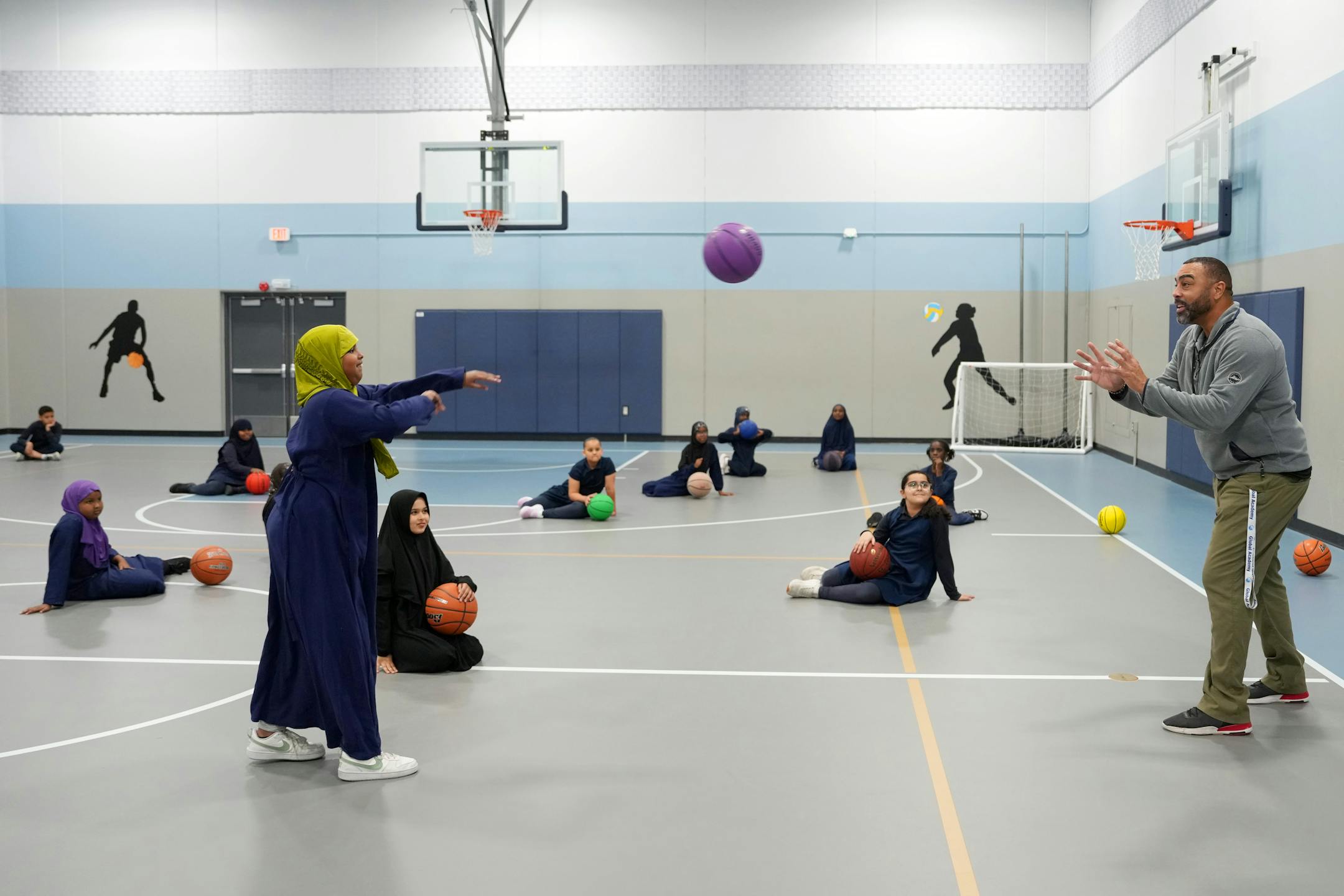
Physical education teacher Matt Lang shows his students how to pass a basketball on Oct. 29 at Global Academy in New Brighton. (Anthony Souffle/The Minnesota Star Tribune)

Global Academy’s ‘collaborative community’

Global Academy was founded in 2008 and designed around the goals of the International Baccalaureate (IB) program, which encourages curiosity and connections across subjects and asks students to learn an additional language. At the New Brighton charter school, students study Arabic.
Nearly half of the school’s students were reading at grade level last school year, according to the state test data. That’s comparable to proficiency rates statewide.

In addition to a strong focus on academics, school leaders credit the success to an approach to discipline and classroom management that relies on nonverbal cues and calm interactions. That, they say, helps maintain strong relationships and minimizes classroom disruptions.

Staff consistency and clear norms underpin the culture. Every teacher follows shared “essential agreements” that guide everything from lessons to student behavior in the hallway.

“There’s high buy-in into the mission from everyone here — staff, students and families,” said Emily Fisher, the school’s art teacher. “Having that collaborative community is what makes us successful.”

A second-grader named Hala agreed. “The teachers here know how to help us learn,” Hala said before listing the classroom routines and the goal of the lesson she was working on. “But they also are fun and know how to make us laugh, too.”

Ariel Karnuth helps a first-grader in her classroom at Global Academy. The K–8 academy serves about 470 children and is known for its academic rigor and strong sense of community. (Anthony Soufflé/The Minnesota Star Tribune)

Increasing popularity of Jie Ming

St. Paul Public Schools launched Jie Ming Mandarin Immersion Academy in 2011-12 with just a kindergarten class. Now, it’s expanded to grades K-5 with 430 to 440 kids, and four sections of kindergarten, because Principal Bobbie Johnson doesn’t want to turn anyone away.

Students take their learning and their fun seriously at the school, and that means they’re already practicing dance moves for a Chinese New Year celebration — four months from now.

In classrooms, too, they shine, posting test score results well above what would be expected based on the magnet school’s poverty rate.

Three-fourths of students are proficient in reading despite speaking and writing exclusively in Mandarin between kindergarten and second grade. Nearly two-thirds of kids hit grade-level benchmarks on a new science test while statewide results plummeted.

But it’s the school’s math results that traditionally have been Jie Ming’s greatest source of pride, and in 2025, nearly 84% of students met grade-level standards. That’s compared with 45% statewide.

Johnson credits the work of veteran teachers — each of whom is fully tenured, which they qualify to receive after at least three years of classroom experience. Data drives the instruction.

Stacked on a table in her office are folders documenting where each student stands academically at various times during the year. She will get help for those falling behind, and ask teachers about high-achievers who are not showing progress.

Johnson aims, too, for Jie Ming to be joyful, a school where students hate to take a sick day or family vacation, and the attendance rates, in turn, are high.

“They love to come,” she said. “They love to achieve. Every kid wants to do well in their little hearts.”

about the writers

about the writers

Mara Klecker

Reporter

Mara Klecker covers suburban K-12 education for the Star Tribune.

See Moreicon

Anthony Lonetree

Reporter

Anthony Lonetree has been covering St. Paul Public Schools and general K-12 issues for the Star Tribune since 2012-13. He began work in the paper's St. Paul bureau in 1987 and was the City Hall reporter for five years before moving to various education, public safety and suburban beats.

See Moreicon

Tom Nehil

Newsroom developer

Tom Nehil is the Minnesota Star Tribune’s newsroom developer, using code to help find and tell stories.

See Moreicon

MaryJo Webster

Data Editor

MaryJo Webster is the data editor, overseeing a team of data journalists and working with reporters to analyze data for stories across a wide range of topics.

See Moreicon