
Minnesota students’ science test scores drop

The drop comes after new state science standards were implemented last school year.

The Minnesota Star Tribune
October 1, 2025 at 5:01AM
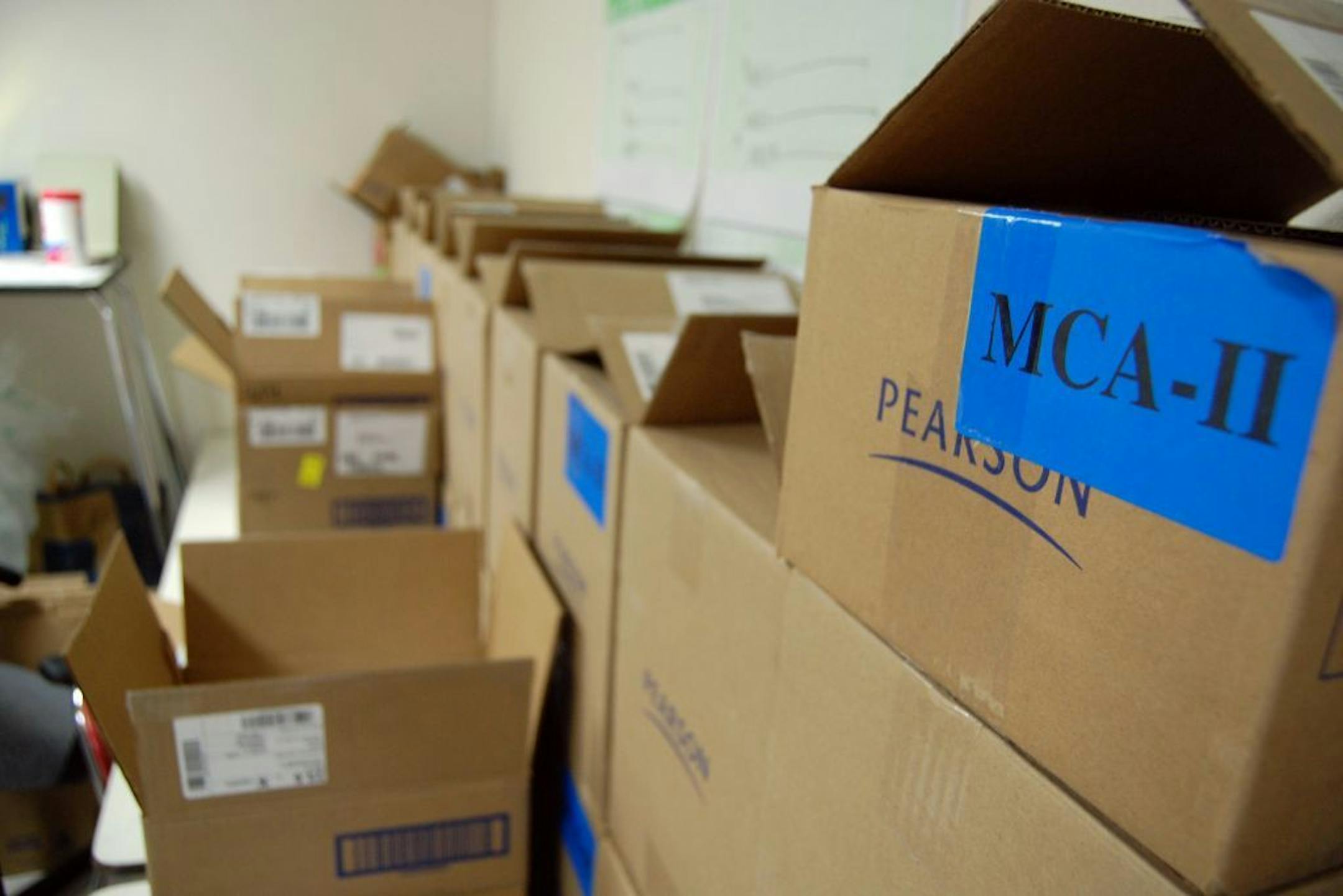
In this April 9, 2010 photo, boxes of MCA tests sit in a locked room at Richfield Middle School, Minn.
In this 2010 photo, boxes of MCA tests sit in a locked room at Richfield Middle School. (Associated Press - Ap/The Minnesota Star Tribune)

Minnesota students’ science test scores dropped this year amid new science standards, according to the state Department of Education.

Overall, 25.7% of students met or exceeded the new standards. Among fifth-graders, 26.1% of students were proficient, compared to 16% in eighth grade and 36.2% in high school.

In 2024, 39.6% of students were proficient in science, according to state data. The two scores, however, are not comparable because the two exams had different criteria, officials said.

The new state standards, which shifted the focus to the application of scientific methods instead of memorization, were implemented this year. The change represents a national shift in science education to “include the importance of learning larger concepts rather than the isolated facts,” according to the Department of Education.

“The why behind [the national change] had to do with hearing from businesses and industry across the nation about what was needed for post secondary employment,” said Jennifer Dugan, Department of Education director of academic standards, instruction and assessment.

The drop in science scores, Dugan said, was to be expected since students are seeing new kinds of questions. Constructed response questions — which ask students to build their own hypothesis based on information — were new to this year’s test.

Minnesota Science Teachers Association President Haley Kalina, an instructional coach in the Alexandria public school district, said this year’s scores serve as a “starting line” for the new standards.

“These new standards have very different content, style and pedagogy within them,” she said. “These benchmarks are brand new.”

Craig Anderson, executive director for the Office of Teaching and Learning at St. Paul Public Schools, said scores drop every time standards change.

In 2013, when reading standards changed, there was a drop from 80% proficiency in Minnesota to 57%.

“The proficiency levels are lower than we want, but you can’t compare the tests,” Anderson said. “It takes us a while to catch up.”

He said St. Paul science teachers have told him that the concepts are becoming “sticky,” meaning students are retaining more year to year across coursework.

The Minnesota Comprehensive Assessment, or MCA, is given to students in grades 3-8 and grade 10 in reading and in grades 3-8 and 11 for mathematics. Science tests are given to students in grades 5, 8 and in one year of high school.

The science scores fell below both math and reading, where students statewide tested 45.2% and 49.6% proficient, respectively. Neither math nor reading changed standards this year. Science tends to be the subject with the lowest proficiency, according to past results.

Difficulties implementing new standards

One issue science teachers are running into with the changing standards is their licenses, Dugan said.

In the 2009 standard, earth science was taught in eighth grade and physical science in sixth. The two swapped this year, causing issues for some educators who were not licensed to teach certain grades.

“Not all grade 8 teachers have a license to teach sixth grade,” Dugan said. “It’s impacted licensure as well as the quantity of years of experience teaching that content. We’ve got some teachers teaching content for the first time.”

Kalina said the changes were based on feedback as well as high school graduation standards.

“It was helpful developmentally,” she said. “Where a sixth-grader is and where an eighth-grader is are different. Our students are now able to lean on more math skills in that eighth-grade year to dive into physics and chemistry concepts than they would have previously had in sixth grade.”

Kalina said the Professional Educator Licensing and Standards Board, which oversees enforcement of the state’s teacher licensing requirements, supported the change and allowed districts to make staffing shifts without penalty. Some educators, she said, chose to stay with their content area, others with the grade they taught.

Textbooks and instructional materials are also becoming outdated with the change. Some districts are buying new materials as a result, Dugan said.

Josh Crosson, executive director of the advocacy group EdAllies, said educators have told him about the lack of materials that meet the new standards. If it continues, he said, he’s nervous about access for certain students.

“We don’t really have a statewide plan for getting districts the materials and the resources they need to get teachers to be able to teach the new science standards,” he said.

Crosson said he’s also concerned about how families may react to the results.

“It’s not a sign of kids of color and kids with disabilities not being able to do science or math or not being able to read. It’s a sign that certain kids have access to the standards and other kids don’t,” he said.

What the test scores mean for families

When it comes to individual students’ scores, both Dugan and Anderson said that’s a conversation for parents to have with teachers and principals.

Educators are the best place to start, Dugan said, to understand how students are doing and how a district or school is implementing the new standards.

“I would encourage families to talk directly to their educator or their principal, and talk about the standards implementation plan,” Dugan said. “And, most importantly, how is their individual student participating in those conversations and what is that educator observing for their individual students’ interactions in science class.”

Anderson said teachers are “excited about bringing science to life for kids” and can help parents and students better understand how well they are grasping the material.

“It’s a snapshot in time,” Anderson said. “The scores help us know things about how we [teachers] did as a group, and it helps kids know how they did as an individual. If they have questions about the scoring, that conversation can go to the school and should be with the teacher.”

Crosson said he believes the test scores come too late, since parents can’t enroll children in summer school or get tutors until two months into the school year. Still, the scores serve as a “permission slip to ask” educators to create plans to move students forward.

“This data is more of a conversation starter than an end,” he said. “We should see this as an opportunity to expand learning going into the future.”

about the writer

about the writer

Eleanor Hildebrandt

Reporter

Eleanor Hildebrandt is a reporter for the Minnesota Star Tribune.

See Moreicon

More from News & Politics

See More
card image
Leila Navidi/The Minnesota Star Tribune

Friday’s morning commute and weekend travel could be impacted by the snow.

card image
card image