

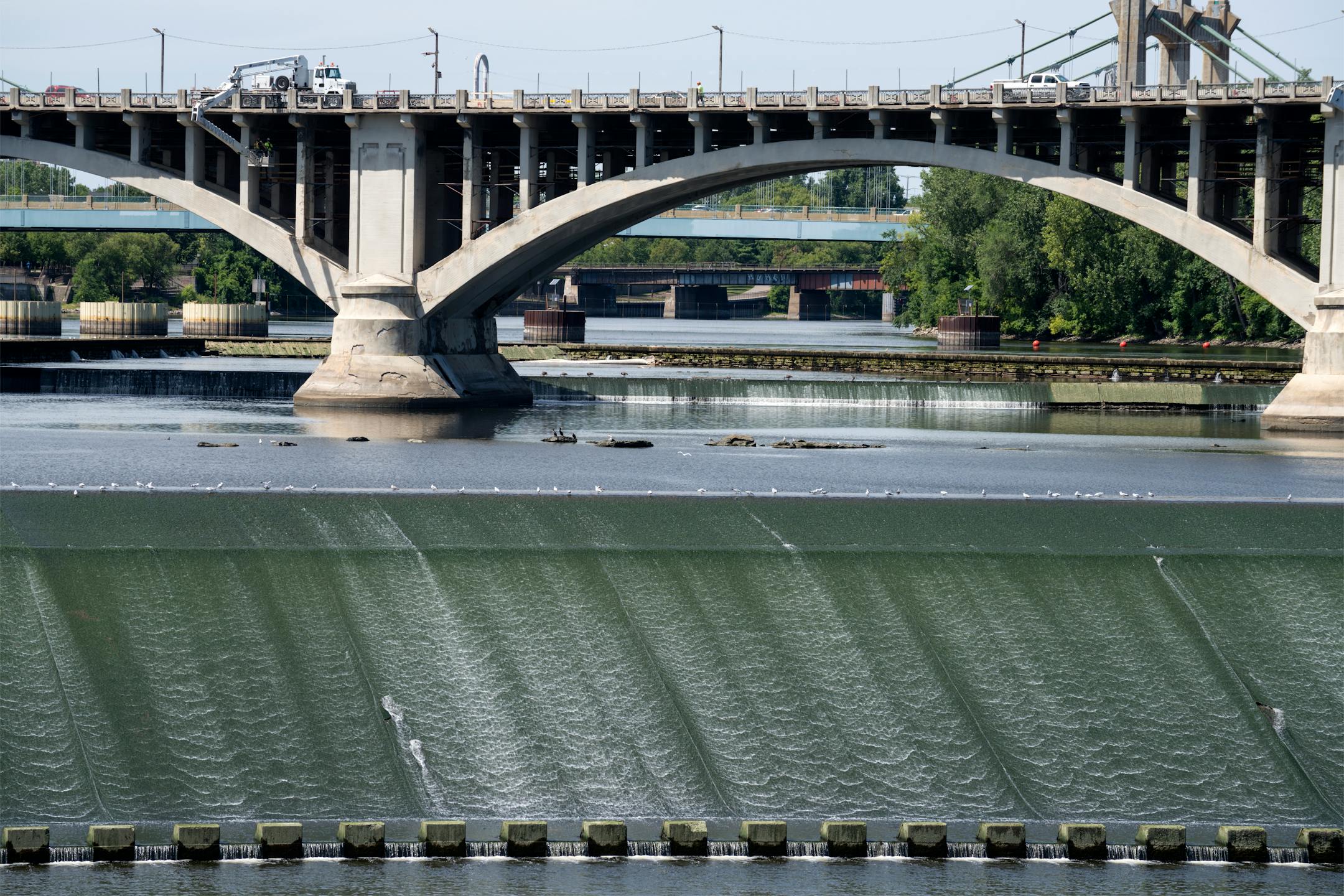
Scientists are in the middle of inspecting — for the first time in decades — an unseen but critical piece of infrastructure holding up St. Anthony Falls in downtown Minneapolis.
But as that project nears completion, the federal government and the state of Minnesota have exchanged the first volley of disavowals, each saying a neglected “cutoff wall” beneath the falls isn’t theirs — and neither is the cost for any repairs that might arise from the inspection.
That 150-year-old wall has literally kept St. Anthony Falls from disintegrating. Were it to fail, the resulting flood would be disastrous.
This summer the Army Corps of Engineers released a draft disposition study for the Upper St. Anthony Lock and Dam, which the feds have been trying to unload ever since the lock closed to barge traffic a decade ago as part of an effort to stop the spread of invasive carp. (No one’s taken up the Corps’ offer to assume responsibility for a whole lock and dam.)
But buried in that study was a declaration about the cutoff wall that has been rankling Minnesotan environmental organizations and the Department of Natural Resources (DNR):
“USACE constructed a cutoff wall in the channel [of the Upper Mississippi River] between 1874 and 1876 to stabilize the Upper St. Anthony waterfalls,” according to the federal study. “The channel remains the property of the State of Minnesota; therefore, any maintenance of the cutoff wall is subject to state appropriations.”
Colleen O’Connor Toberman, land use and planning program director of Friends of the Mississippi River, said she was taken aback by the Corps’ assertion that the wall was Minnesota’s headache just because they built it in state waters.
“Wait, where’s your proof? You can’t just say that in a sentence and assume everyone’s gonna let that go by,” O’Connor Toberman said.


