
‘Fascinating’ freshwater jellyfish surface in Twin Cities suburban lake

The quarter-sized creatures briefly surfaced during a water-quality survey, offering a fleeting glimpse of a species that rarely shows itself in Minnesota lakes.

The Minnesota Star Tribune
December 1, 2025 at 12:00PM
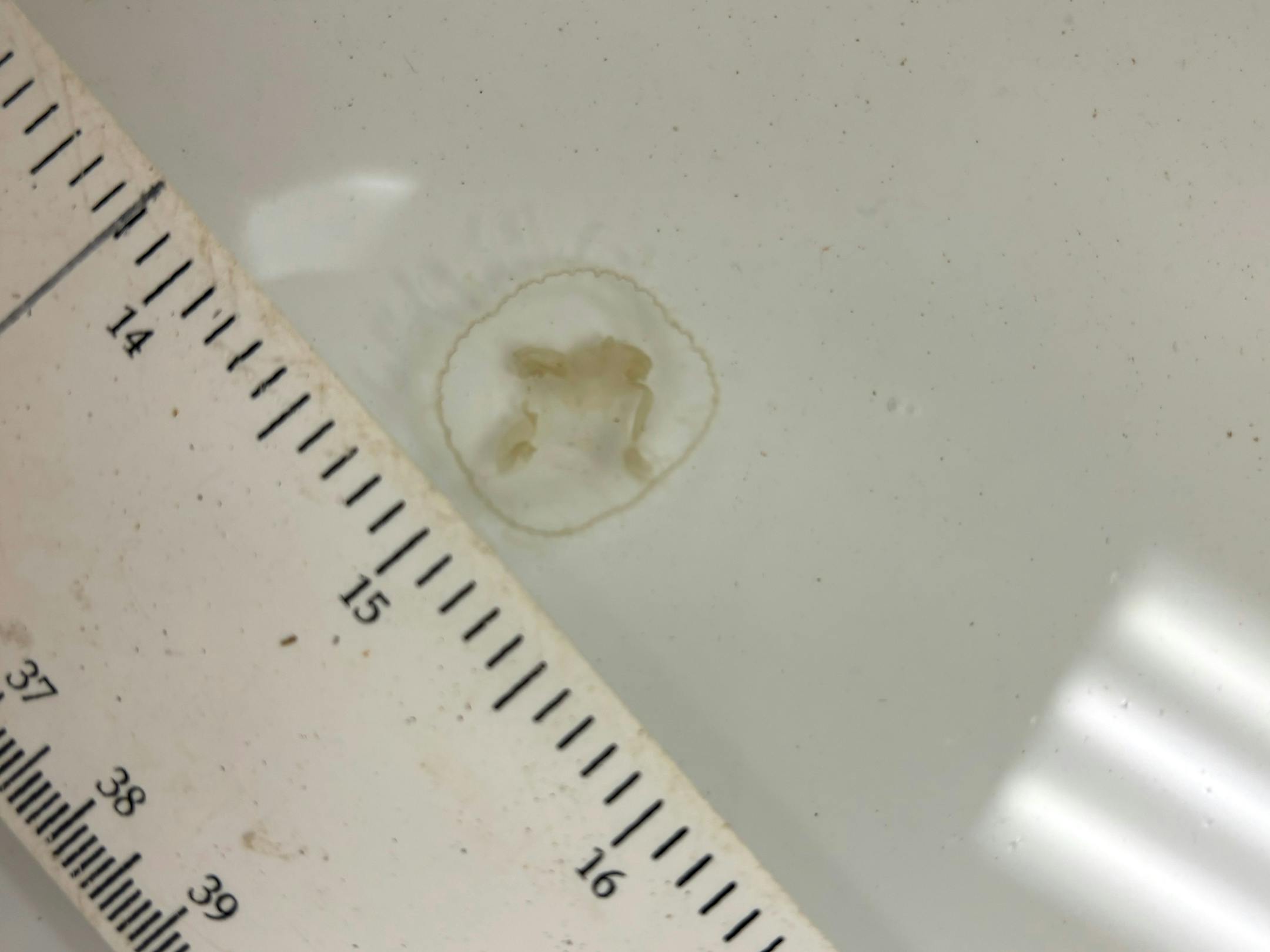
A freshwater jellyfish found in Taft Lake in Richfield is about the size of a coin. (Kevin Menken )

It pulsed like a tiny heartbeat — a clear, quarter-sized jellyfish rising through the calm water of Taft Lake, sunlight flickering through its translucent body.

The sight stopped Kate Lucas mid-paddle.

Lucas, a water resource scientist at Barr Engineering, was out on the Richfield lake in late October with colleague Kevin Menken during a routine water-quality survey for the city. As their canoe glided between sampling points on the lake just south of Highway 62 and west of Cedar Avenue, she saw a flicker of light as the jellyfish rose to the surface.

“I just saw it float past our canoe,” Lucas said. “I yelled. It was very exciting.”

Freshwater jellyfish, Craspedacusta sowerbii, are rarely seen in Minnesota — not only because their swimming “medusa” stage is short-lived, but because the species itself is generally uncommon in the state. According to the DNR, most years pass without a single verified sighting.

“They’re not that common,” said Don Eaton, an aquatic invertebrate biologist with the Minnesota Department of Natural Resources. “The medusa stage is so short-lived, so most records are from observant folks who just happen to encounter them.”

Lucas was in exactly the right place, eyes on the water. The jellyfish hovered just below the surface, its bell as thin as soap film, its edges sharpening only when sunlight caught them.

Menken, a staff engineer at Barr Engineering, acted quickly.

“I had seen stories before that there were jellyfish in some Minnesota lakes,” he said. “So I reached for my phone, then grabbed an empty bottle. It was only about the diameter of a quarter.”

He eased the bottle beneath the jellyfish and watched it drift inside. Over the next hour and a half, as they continued collecting samples, they found only one more — two jellyfish total in the entire lake.

Freshwater jellyfish are native to China and likely reached North America through the aquarium trade, Eaton said. They are not considered invasive and pose no known risks to swimmers or pets.

The conditions that trigger the medusa form remain an area of active research. In warmer parts of the world, blooms are linked to summer water temperatures of 84 to 86 degrees Fahrenheit. Minnesota sightings suggest the species may tolerate a wider range. High zooplankton levels — a key food source — also seem to play a role.

Ecologically, Eaton said medusae may briefly reduce food available for zooplankton-eating fish, such as perch, but there is no evidence they disrupt lake use or cause broader harm.

For Lucas and Menken, the find wasn’t alarming — just a surprise.

“It looked like a marine jellyfish, but in a lake,” Lucas said. “It was fascinating.”

After returning to shore, they preserved the jellyfish in ethanol and took it to the DNR so it could be measured and added to state records.

The city of Richfield later shared a video from the encounter, noting that Taft Lake continues to meet state water-quality standards and that freshwater jellyfish have no known negative effects on the ecosystem.

Lucas didn’t expect anything unusual that day. She was focused on water chemistry readings and sample bottles. But the image of that small, translucent pulse drifting up through a city lake stayed with her.

“It’s just not something you expect to see in Minnesota,” she said.

about the writer

about the writer

Sofia Barnett

Intern

Sofia Barnett is an intern for the Minnesota Star Tribune.

See Moreicon

More from Twin Cities Suburbs

See More
card image
Alex Kormann

Most grocery, liquor and other stores will be closed, parking meters are free, and buses will run on limited schedules, if at all.