Denker: What a Black presiding bishop means for the whitest denomination in America

The election of the Rev. Yehiel Curry to lead the Evangelical Lutheran Church in America has given me a renewed sense of hope.

Columnist Icon
The Minnesota Star Tribune
August 2, 2025 at 9:00PM
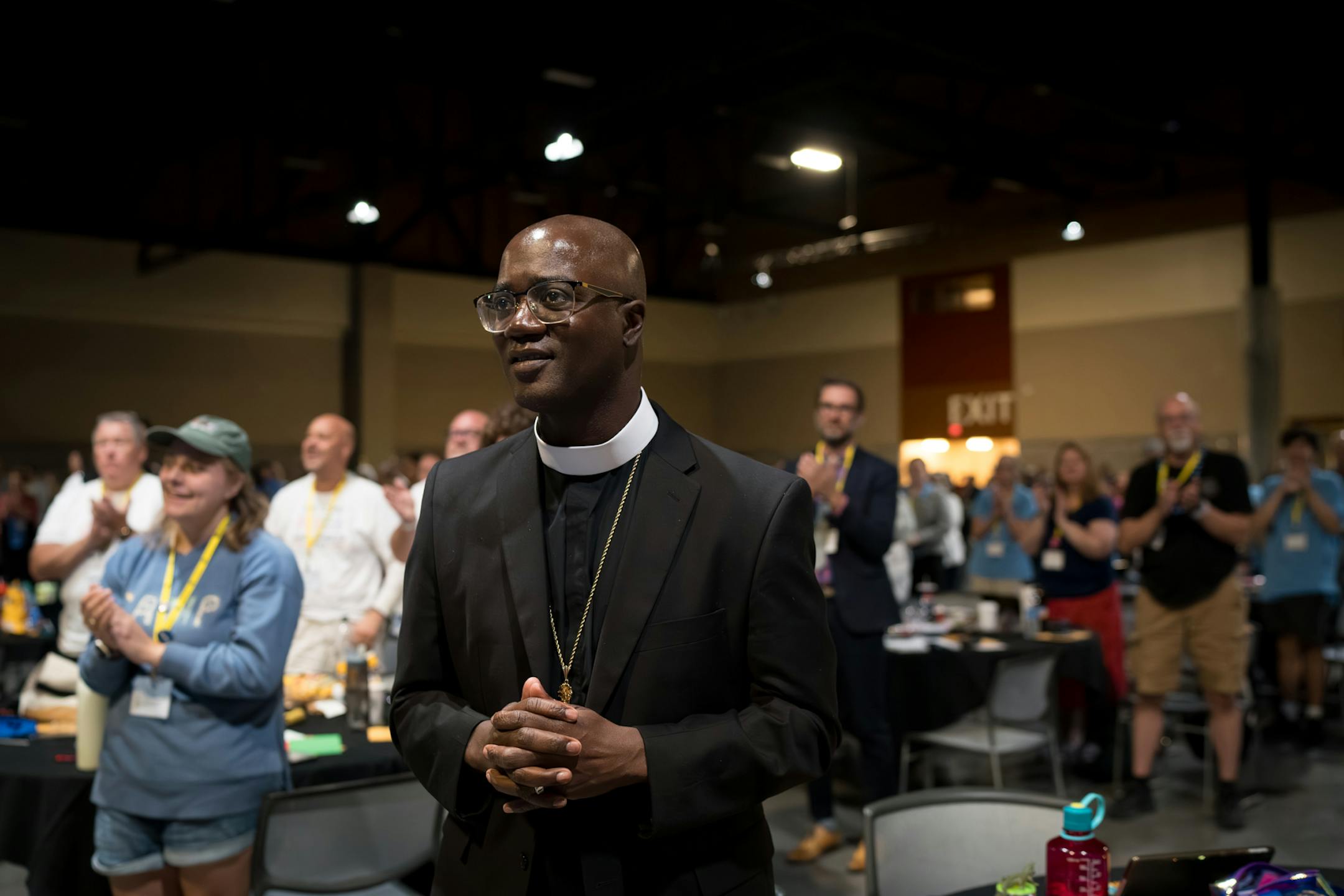
Rev. Yehiel Curry immediately after being elected as presiding bishop to the Evangelical Lutheran Church in America. (ELCA)

Opinion editor’s note: Strib Voices publishes a mix of material from 11 contributing columnists, along with other commentary online and in print each day. To contribute, click here.

•••

In April, I sat down with the Rev. Yehiel Curry at a Caribbean restaurant in Chicago and asked him if he was considering being nominated as the next presiding bishop of the Evangelical Lutheran Church in America (ELCA).

He told me he hadn’t added his name to the list of “pre-identified” candidates, and he wasn’t sure if the role was right for him. He’d just been re-elected as bishop of the ELCA synod in Chicago and felt there was so much more work to be done there, in the city where he grew up.

I told Curry that so many of us wanted him to lead us. And also that I knew what standing for that role could mean for him and his family.

He looked at me, keeping it real as he always did.

“My family is OK with leaving it up to me,” I remember him saying. “They will support me if I decide to leave my name in. I don’t want to be pre-identified. But if the Spirit calls me on that day, then I will leave it up to the Spirit.”

Today, almost four months after that dinner, Curry is the presiding bishop-elect of the ELCA after a historic vote held on Wednesday. He will be the first Black person to lead America’s whitest denomination, one that has been declining rapidly in membership alongside most mainline Protestant churches, but also one that remains the largest Protestant denomination in a number of Upper Midwestern states, including Minnesota.

I first met Curry more than a decade ago when we were both serving as Lutheran pastors in the Chicago area. I liked him immediately, partly because he was everything that Lutheranism wasn’t, at least in my limited experience growing up white, Scandinavian, German and Minnesotan. While studying Lutheran theology in seminary, I’d been told that historically, Lutherans had been suspicious of the role of the Holy Spirit.

“Too experience-based,” said a visiting student from the Norwegian church. “Not academic enough.”

Curry, a Black pastor who led a predominantly Black congregation on Chicago’s Far South Side, didn’t grow up Lutheran. He was raised Catholic and came to the denomination through a ministry program for young Black men. All the church debates that had long shaped Lutheranism in the U.S. — the arguments among the Swedes, the Norwegians, the Germans, the conflict over new hymnals and changing melodies in the liturgy, or even switching services to English — none of that mattered to him.

Frankly, even though my great-great-grandfather had come from Germany to the U.S. as a Lutheran pastor, none of those internecine battles mattered much to me, either. I loved the Lutheran church where I grew up in the Twin Cities, but I was also drawn to the free-flowing worship styles and music of the nearby evangelical congregations. While working as a sportswriter in Florida, I attended a Southern Baptist youth group, and when visiting my then-boyfriend in Chicago, we worshiped at Trinity UCC, the former church home of President Barack Obama and home to the social-justice activist, fiery gospel of the Black Church.

I was captivated and inspired by the way the Black Church in America took our grace-focused theology and brought it to life. Where was the Lutheran theology of the cross if not in the spirituals sung by enslaved people, who understood Jesus’ gospel of liberation in ways we perhaps never could? How could we claim that the freedom given to Christians by grace is countered by an equal responsibility to ensure our neighbor’s freedom if we did not reckon with the subjugation of Black Americans by white Christians throughout America’s history?

And so the Spirit, by way of a youth pastor who led the mission trips I went on growing up, led me to Curry and to his church, Shekinah Chapel, where my younger brother would later become an active member and lay leader. Over the next decade, I saw a Holy Spirit fire burning within his ministry, a fire I longed might ignite our church, but one I also feared would be put out by fear, complacency and white supremacy.

The truth is that, while national ELCA leadership longed to be seen as diverse, progressive, liberal and inclusive, inside the doors of our churches we remained white and staunchly inoffensive. Quietist. Despite headlines about LGBTQ acceptance and bishops who held marginalized identities being elected to lead ELCA synods, more than 50% of ELCA Lutherans voted for Trump in 2024. And in my view, church leaders had long focused more on their “brand,” hiring pricey corporate consultants for “diversity initiatives” and “innovation” while too often casting aside dynamic nonwhite leaders and anyone who challenged the status quo.

Less talked about but no less important was the emerging class divide between denominational leadership and ordinary clergy and parishioners, many of whom lived in rural areas. While current Presiding Bishop Elizabeth Eaton made history as the ELCA’s first-ever female in that position, she represented continuity with elite institutions with her degree from Harvard Divinity School.

Curry, who made his way to ordination through the Lutheran School of Theology in his native Chicago, by way of the TEEM program (Theological Education for Emerging Ministries), represented a very different backstory. Yes, he is from Chicago, and he is Black. But his background, through a class lens, is likely much more relatable to many of the ELCA’s rural congregants.

One of 11 children, Curry first worked as a social worker and then as a public school teacher in Chicago. As a church planter on the Far South Side, he never took home a reliable or lucrative paycheck. He and his wife, an assistant principal at a Chicago public school, made ends meet with ingenuity, frugality and prayer as they raised their three daughters.

As an ELCA pastor for more than a decade, I have long hungered for the kind of authentic, courageous, Spirit-filled leadership that Curry offers our denomination. For too long, white Lutheran leaders have been too measured, too risk-averse, too willing to sacrifice truth for trying to please everyone. Our social statements have been overly academic, mired in theological language indecipherable to the general public. Our witness and resistance to Christian nationalism has been compromised by our unwillingness to repent of our own tradition of white supremacy.

It is far too much to ask Curry to shoulder this burden alone. He will have immensely high expectations, and I fear for my friend as I know he will face threats and racism that I cannot even fully imagine. I know enough to have a small idea of what he will experience (and already has) by the responses I get to columns like this one.

My hope, then, as a white Minnesota Lutheran pastor serving under Bishop-elect Curry’s leadership, is not merely for him, but for the ways we all might grow and change and serve with him.

A year and a half ago, I interviewed Curry for my book on masculinity and right-wing Christian radicalization. His story comes at the end of a chapter-long examination of white supremacist mass shooter Dylann Roof, who was a confirmed member of an ELCA congregation in South Carolina.

We “nice” white Lutherans must reckon with the legacy of our church represented by Roof. And also, as I wrote in my book, because of leaders like Curry, I have a renewed hope for a more honest and powerful American Lutheranism grounded in hard-won truth and justice, a different form of Christian masculinity grounded in vulnerability, love and a mothering God.

But that will happen only if all of the ELCA’s members — 96% of us non-Hispanic white Christians — authentically and honestly follow his lead.

about the writer

about the writer

Angela Denker

Contributing Columnist

The Rev. Angela Denker is a contributing columnist for the Minnesota Star Tribune. She is a pastor, author and journalist who focuses on religion, politics, parenting and everyday life.

See Moreicon

More from Contributing Columnists

See More
card image
Jeff Wheeler/The Minnesota Star Tribune

The loss of more than a billion dollars that’s occurred on the governor’s watch makes him unfit for further service to the state.

card image