
Readers Write: The future of Minneapolis, shipwreck songs

Recognize public safety reality: Minneapolis is no ghost town.

The Minnesota Star Tribune
November 14, 2025 at 1:00AM
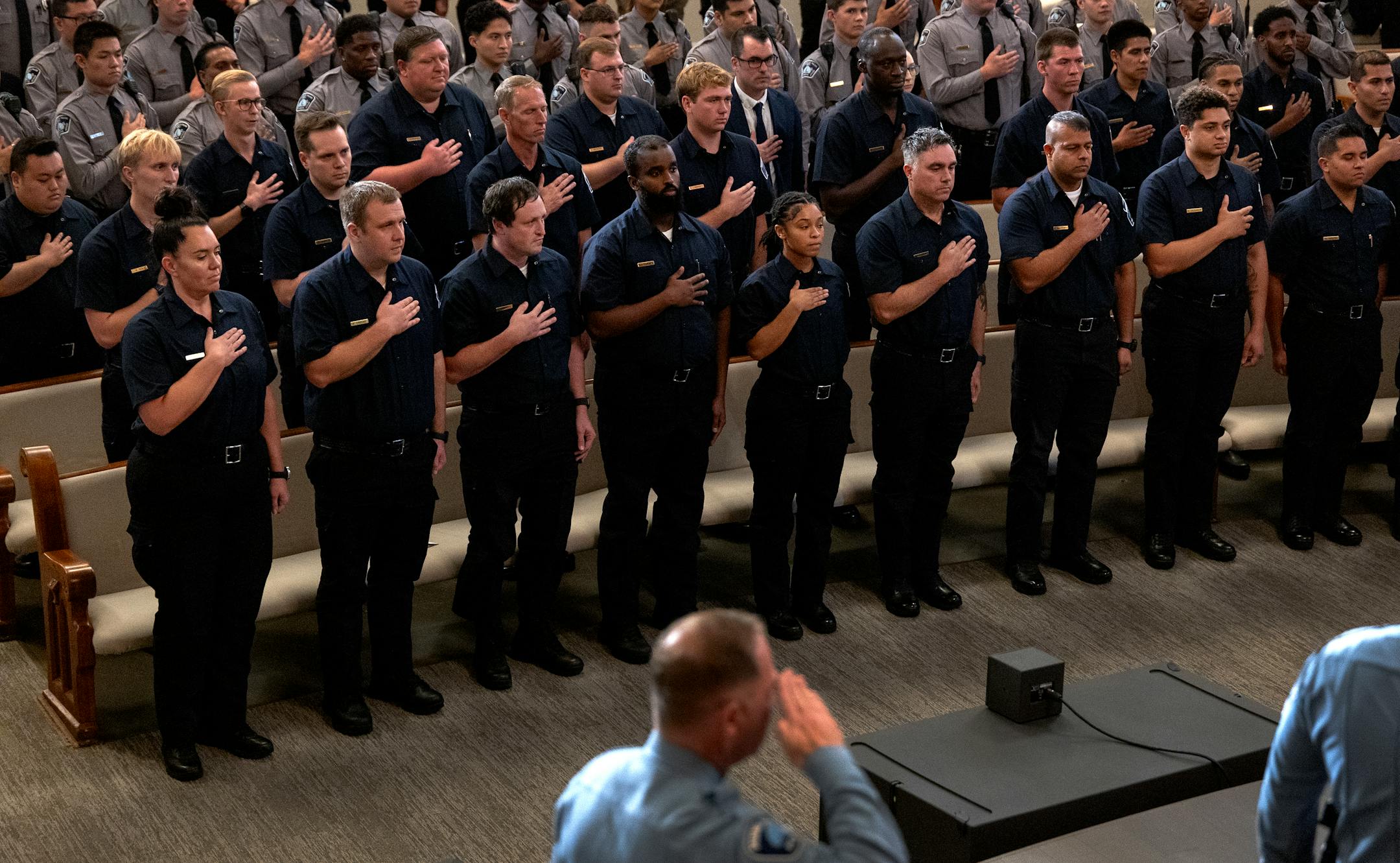
Minneapolis Police Department cadets and Community Service Officers stand for the national anthem at a welcoming for the new class of recruits on Sept. 10 at Eagle Brook Church in Minneapolis. (Carlos Gonzalez/The Minnesota Star Tribune)

Opinion editor’s note: Strib Voices publishes letters from readers online and in print each day. To contribute, click here.

•••

I truly don’t understand why Star Tribune opinion editor Phil Morris gives a prominent voice to someone who clearly doesn’t know what he’s talking about (“Fear is the narrative the city can’t shake,” Strib Voices, Nov. 13). Morris starts his editorial quoting Richard Wolleat: “My wife and I haven’t stayed downtown for five years,” he wrote. “Simply put, we are scared stiff. ... [D]owntown has become a ghost town, with the only folks walking about gangs of kids with seemingly nefarious intentions. This is not just what I’ve read, it’s what I have observed.” As a 30-year downtown resident, allow me to challenge those erroneous statements.

Ghost town? There are 60,500 residents downtown and 160,000 people come downtown daily for work. The Minneapolis Downtown Council reported that 9.75 million people came downtown in 2023 for sports, theater, concerts, arts and convention events. That number is higher than 2019 pre-pandemic visits.

Gangs of kids? I walk the sidewalks and skyways in the center of downtown almost daily and have never seen “gangs of kids.” The only gangs are Target employees walking to lunch en masse.

I understand that perception is reality for some people, but Wolleat can’t claim to have observed downtown’s current state and at the same time admit it’s been five years since he stayed downtown. Shame on Morris for perpetuating a false narrative about downtown by allowing Wolleat’s statements to go unchecked.

Steve Millikan, Minneapolis

•••

I agree with Star Tribune opinion editor Phil Morris that “Minneapolis must continue to search for ways to tell its public safety story truthfully.” Maybe we begin by recognizing that having a hopelessly understaffed and demoralized police force has been great for criminals and disastrous for our citizens. For example, 200 more people were murdered in Minneapolis during the five-year period after 2020 than the five years before. And how about being honest about who the overwhelming majority of the victims have been? Hint: They’re not wealthy, white senior citizens like me.

As a downtown resident, I walk, bike and take transit all over the city without fear, aware that I am a member of a demographic group almost never victimized by violence in Minneapolis. It’s tragic that the Minneapolis City Council members who continue to demonize police and enable criminals don’t seem to know who is paying the price for their misguided policies.

Jerry Anderson, Minneapolis

•••

During this election cycle, we heard accusations that Mayor Jacob Frey is too focused on downtown and the North Loop. I’m not going to challenge that perception. But, if it’s true, there is a way forward.

Minneapolis has 83 official neighborhoods, grouped into 11 communities. I suspect that at least most of them have their own associations with elected presidents. I propose that these communities offer delegates that would meet on some regular basis to share histories, challenges and success stories. They might find enough common ground by which they could present, as one group, to our City Council and/or mayor, concerns and proposals with the idea that we all do better, when we all do better. It might even result in “sister neighborhoods” (not simply geographically) that can brainstorm ways to work together, diffusing the “us and them” competition for city investment.

I don’t have the connections or agency to make this happen. But I venture a bet that All of Mpls does. Is it listening?

David Ritsema, Minneapolis

•••

As someone who has paid close attention to housing policy for the past two decades, something jumped out when I was reading Deena Winter’s profile of Frey before the election (“Can Jacob Frey triumph over his critics one more time?” Oct. 25). The article claimed one of Frey’s wins was that the number of affordable units built annually in the city had “nearly tripled” from 2018 to 2022.

This choice of years seemed odd to me given that it’s now 2025, so I dug a little deeper into the city’s official reports on this issue, which are titled “The Way Home.”

2018 saw 593 affordable units closed, 2022 had 919. How could that be considered a “tripling” in any sense? Well, it turns out some misleading math was deployed here.

Instead of comparing 2018 to 2022 directly, the average from 2011-2018 was used, needlessly dragging down the baseline with years where we were still recovering from the housing crisis.

On top of that, by choosing the 919 units in 2022 as the endpoint, this talking point conveniently leaves out that 2023-24 only saw 992 units combined — for an annual average of 496 affordable units closed.

Instead of our current state of affordable housing production being a near-tripling of 2018, we have seen a 16% decline.

We should absolutely celebrate wins when they happen, but misrepresenting data to turn clear struggles into victory laps does a disservice to all of us still focused on finding solutions.

Ryan Kennedy, Minneapolis

•••

Cities that are reducing unsheltered homelessness do everything it takes to connect people with housing. They don’t clear encampments and hope people figure it out later. They end homelessness person by person. Houston did exactly that. Every person living in an encampment was moved into real housing — an apartment, not down the block — before the site was closed. Major encampments were permanently closed, and most of those residents remain housed today.

Frey is doing the opposite. Minneapolis has spent millions moving people instead of housing them. The city bulldozes encampments, pushing the public health crisis down the block, worsening it, not solving it. The city auditor confirms what residents already know: Money meant for housing was misused, contracts were mishandled and oversight collapsed. Public trust has been destroyed along with people’s lives.

People living outside right now already have housing referrals but remain unsheltered because every time the city clears an encampment, people are displaced. Moving them means losing contact with their case managers. IDs, phones, medications and personal papers are thrown away by city staff during clearings, and sometimes people lose the housing units that were supposed to be theirs.

When people are actually housed, neighborhoods stabilize, businesses recover and confidence in the city begins to return.

Frey, in his next term, must measure success in people housed, not in tents removed.

Sheila Delaney, Minneapolis

SHIPWRECKS

Many more tributes to hear

Writing about the song “The Wreck of the Edmund Fitzgerald,” the writer of the Nov. 12 letter “Lightfoot was a bard, not a historian” stated, “Maybe I’m wrong, but it’s the only song I know of that has made people aware of a historical sinking of a ship.”

The writer apparently has never heard any of the multiple songs about the sinking of the Titanic after that ship struck an iceberg in 1912. Or “Sink the Bismarck,” as sung by Johnny Horton, about the British attack on that Nazi battleship in 1941. Also from 1941 was “The Sinking of the Reuben James,” written by Woody Guthrie, concerning the first U.S. naval escort torpedoed by the Nazis even before Pearl Harbor. And, in 1962, singer Jimmy Dean had a nationwide hit with the song “PT-109,” which told the true story of the 1943 sinking of a U.S. Navy PT-boat, and the bravery of its commanding officer, Lt. John F. Kennedy, who in 1960 was elected president of the United States. A year later, in 1963, the Kingston Trio released the song “Ballad of the Thresher,” a tribute to the crew of the U. S. atomic submarine that had imploded in the depths of the Atlantic Ocean.

And there are many, many more — some just as famous as Gordon Lightfoot’s song, but many unfortunately only known to a few. But all it takes is a little digging to discover that the “The Wreck of the Edmund Fitzgerald” is not alone in the catalog of songs about “a historical sinking of a ship.”

Check out any of the above songs, and you’ll probably see that the Edmund Fitzgerald is in good company with its earlier shipmates.

D. Kingsley Hahn, St. Paul

about the writer

about the writer