
Readers Write: Rural medicine, UCare, the justice system, presidential power

Rural health care is withering away. Does anyone in power notice?

The Minnesota Star Tribune
November 20, 2025 at 1:00AM
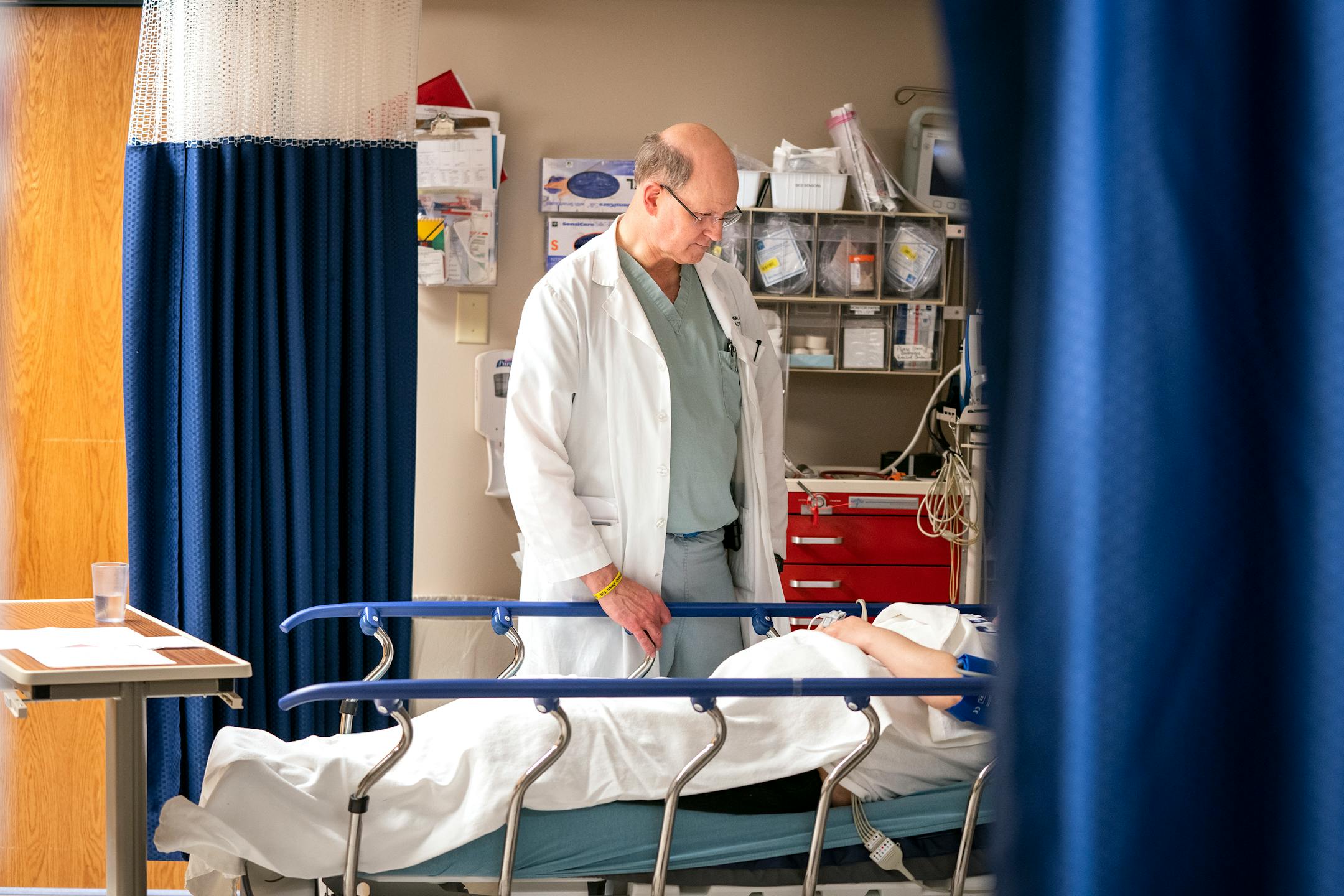
Dr. Bruce Rorem talks to a patient in the emergency room of Madelia Community Hospital and Clinic in 2019. (Leila Navidi/The Minnesota Star Tribune)

Opinion editor’s note: Strib Voices publishes letters from readers online and in print each day. To contribute, click here.

•••

The Minneapolis-based paper and St. Paul leaders are failing the very citizens they claim to serve. For 1.26 million rural Minnesotans, hospitals, clinics and labor-and-delivery units are vanishing — forcing families to drive hours for unaffordable care. The message is unmistakable: Rural lives matter less.

Recently, the Star Tribune ran more than 10 stories dissecting every twist in the University of Minnesota–Fairview conflict. Yet “Minnesota’s paper” has avoided digging into the human toll in rural communities or investigating why providers — most notably Mayo Clinic — continue dismantling essential services. Mayo reported a record $19.8 billion in revenue in 2024, and spent it on vanity projects — gutting rural economies and hiding behind a false “physician shortage.”

State leaders and the Minnesota Department of Health have also turned their backs on the crisis. Nearly half of rural hospitals no longer offer labor-and-delivery services, forcing mothers to give birth far from home and in emergency rooms. Mayo pushes patients to critical-access hospitals for higher reimbursements. In Freeborn County, patients pay 30% more because of Mayo.

For 65,000 people in south-central Minnesota and northern Iowa, Mayo closed its hospital, gutted services and left them with soaring costs and no access — while state officials ignored it.

In Albert Lea, patients are waiting 12 hours in the emergency room, traveling 100 miles for urgent surgery and suffering as ambulance delays become life-threatening.

Rural Minnesota deserves more than blips on closure. It deserves coverage, accountability and leaders who won’t abandon patients.

Martha Sichko, Albert Lea

•••

Recent news about UCare’s shutdown is the tip of the iceberg of deeper problems facing the health care marketplace (“Insurer UCare to shut down next year,” Nov. 18, and “UCare’s red ink follows trend,” Nov. 19). As the Nov. 18 article notes, UCare’s challenges stem in part from “a mismatch where government payments don’t fully reflect the medical needs of the pool of remaining enrollees.”

As the largest network of primary care providers in the U.S., community health centers in Minnesota and across the country are all too familiar with this mismatch. Of the $5.2 trillion spent annually in the U.S. health care system, only five to seven cents of every dollar go toward upstream, preventive care.

This chronic underinvestment in prevention drives significant downstream costs: rising rates of chronic disease, avoidable emergency department visits and preventable hospitalizations — some of the very challenges UCare cited in its decision. Put simply, a meaningful portion of the 95 cents spent on acute and specialty care could be avoided with stronger investment on the front end.

It’s also important to recognize that many recent health policy reforms — such as changes to Medicaid and expanded financial assistance for purchasing insurance — focus primarily on coverage. Coverage is essential to a person’s health and well-being, but coverage alone does not build a strong primary care system and healthy people.

Our current financial incentives do little to support robust, accessible primary and preventive care. A recent study found that 31% of U.S. adults either lack a usual source of care or rely on the emergency department as their main access point: clear evidence of systemic underinvestment in accessible primary medical, dental and behavioral care services.

To prevent further disruption in our health care system, policymakers should pursue solutions that at least double our investment in primary and preventive care to 10 cents of every health care dollar. This upstream investment will generate downstream savings — and improve the health and well-being of Minnesotans.

Jonathan Watson, St. Paul

The writer is CEO of the Minnesota Association of Community Health Centers.

PROGRESSIVE PROSECUTORS

Thanks for highlighting how it’s done

Thank you to the Minnesota Star Tribune for printing Rochelle Olson’s column “Choi provides the blueprint for progressive prosecution” (Nov. 18). This is the kind of news that I am looking for, reporting on positive relationships and policies happening in our community. I know that violence and conflict get easier attention, but there are lots of us looking for the good that is being done by our elected officials. This level of writing takes more research and time, but it is worth it for us who read the newspaper. The account of Ramsey County Attorney John Choi and Sheriff Bob Fletcher finding common ground amid their differences is inspiring and a model for us all to follow.

Sharon Borg, Shoreview

JAMES COMEY CASE

Separation of powers, anyone?

After reading the article about the James Comey case (“Judge blasts DOJ over Comey case,” Nov. 18), it appears that the blindfold was removed from Lady Justice’s eyes and a heavy thumb placed on her scales before the indictment was even presented to the court.

The rebuke from the judge regarding the apparent errors committed by the prosecutor before the grand jury is quite extraordinary.

In the president’s haste to go after his perceived political enemies using the levers of government, in this case, it appears haste does make waste.

A seasoned prosecutor had declined to bring the case due to lack of evidence, but the president, with his obsession about retribution, decided to fire that prosecutor and replace him with a lawyer who has no prosecutorial experience. Since Attorney General Pam Bondi is eager and willing to do this president’s bidding, the appointment was made. It looks like the new prosecutor stumbled right out of the gate. Because of the hasty decisions and the ineptitude, the case against Comey may very well be tossed, and rightly so.

This is a good example of what happens when the attorney general of the U.S. (the people’s lawyer) is eager to please a president determined to exact revenge. She is bound to end up getting egg on her face, probably an entire omelet.

We are seeing an excellent example of the reason the founding fathers saw a need for the separation of powers.

Ron Bender, Richfield

PRESIDENTIAL POWER

Pardons can no longer be unilateral

The power of the president to issue unilateral pardons is, and has been, much abused by presidents of both parties (“Well, that was a mistake,” Readers Write, Nov. 17). Granted, amending the Constitution is extremely difficult, but this may be an issue in which all sides of the political divide can find agreement. This power should reside with a more balanced panel of people — perhaps something like the president and the majority and minority leaders in Congress. The current situation makes a mockery of the rule of law.

Dan McInerny, Victoria

•••

The congressional power of the purse is being threatened. It seems no program is off limits. The Supreme Court recently ruled that the Trump administration could withhold $4 billion in foreign aid that had been appropriated by Congress. This includes money appropriated for global health programs such as PEPFAR and the Global Fund to Fight AIDS, Tuberculosis and Malaria. Global health funding greatly strengthens national security, promotes economic growth and advances the U.S.’ diplomatic influence. The president should not be able to have the executive power to cut foreign aid without the approval of every branch of government, especially with how much money the order is cutting. Article 1, Section 9, Clause 7 of the U.S. Constitution states that “No Money shall be drawn from the Treasury, but in Consequence of Appropriations made by Law.” The disbursement of funds is a power that only Congress has.

As University of Minnesota students, we have seen firsthand the impact that these funding cuts have had on our school, from university budget changes to the elimination of some lifesaving research. We urge Sens. Amy Klobuchar and Tina Smith, and Reps. Brad Finstad, Angie Craig, Kelly Morrison, Betty McCollum, Ilhan Omar, Tom Emmer, Michelle Fischbach and Pete Stauber to demand that power back and hold this administration accountable for their overreach of constitutionally given powers.

Ewan Kahnke, Jack Lawson, Sydney Iverson, Taylor Mosakowski, Paige Anderson, Mia Marin-Mera, Rachel Kopet and Anuk Dias, Minneapolis

about the writer

about the writer