
Readers Write: Border Patrol in the Boundary Waters, mining, high school commencement at the U

There is no migrant surge up here.

The Minnesota Star Tribune
November 5, 2025 at 1:00AM
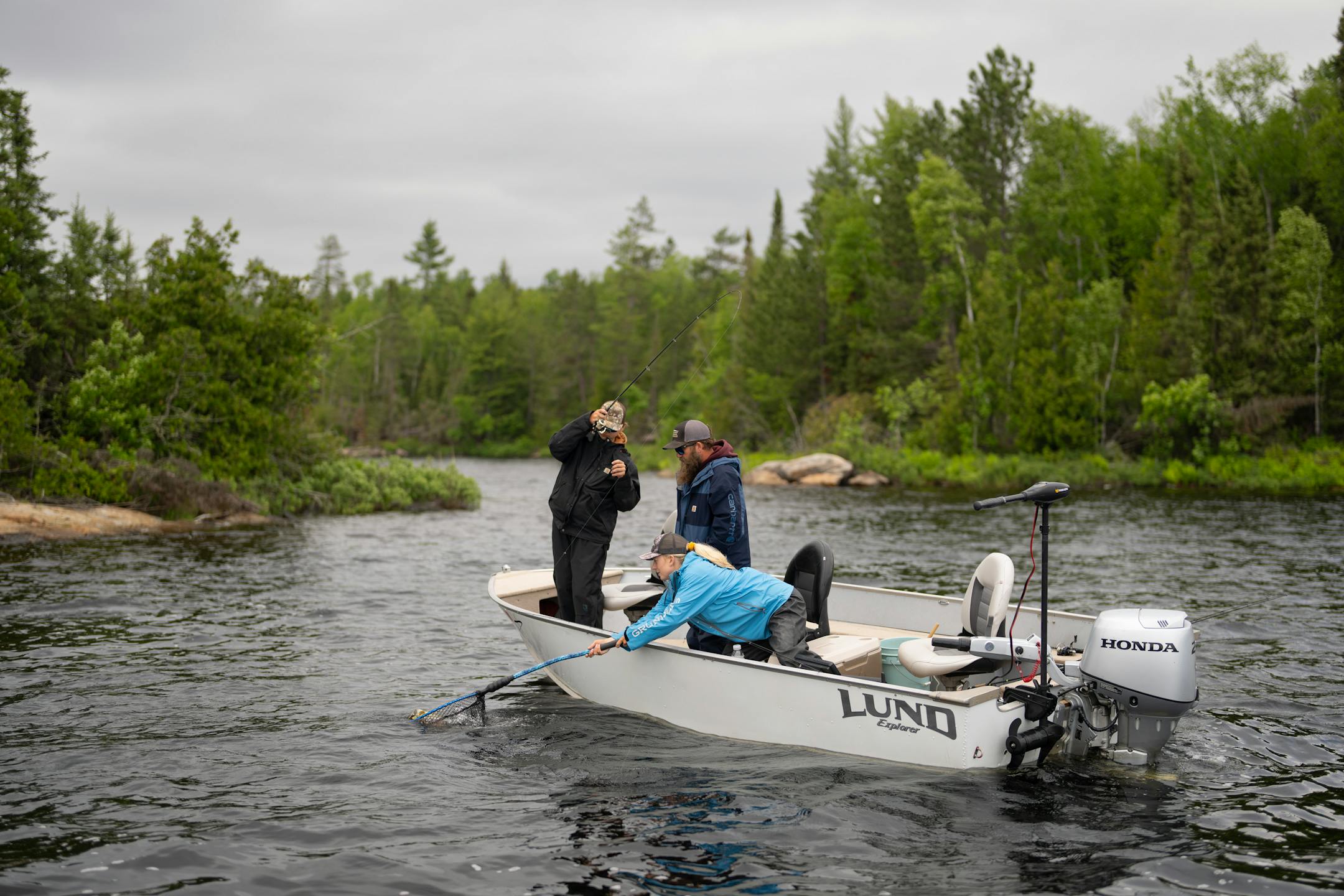
Fishing guide Jessica Berg-Collman reaches to net a walleye for clients on Saganaga Lake in the Boundary Waters Canoe Area Wilderness. Saganaga is one of the largest lakes in the BWCAW and straddles the Minnesota-Canada border. (Jeff Wheeler/The Minnesota Star Tribune)

Opinion editor’s note: Strib Voices publishes letters from readers online and in print each day. To contribute, click here.

•••

Rep. Pete Stauber’s justification for inserting the Border Patrol on the border in the Boundary Waters Canoe Area Wilderness borders on the absurd (“Republican bill would allow Border Patrol to roam in BWCAW,” Nov. 1). Clearly, Stauber has never ventured into the Boundary Waters wilderness. If he had, he would know how challenging the weather conditions and navigation can be on these big border lakes. The idea that swarms of migrants are going to cross the U.S. border there is just ridiculous. Even more ridiculous is his blaming migrants for the uptick in “left-behind trash, human waste, illegal trails and abandoned campfires” that the BWCAW experienced during and after the pandemic. It is much more likely that this was the result of the Forest Service eliminating the requirements for in-person check-in and training before entering the wilderness, and increasing the number of entry permits during that time. The mess was caused by careless Americans, not migrants. The Forest Service has since reasserted its controls.

We don’t need the Border Patrol to protect our wilderness, as Stauber suggests. Maybe just a few more valued, dedicated and well-paid Forest Service officers.

Tom Plocher, Hugo

•••

The only reason there’s any increase in left behind trash or human waste, as cited by Stauber, is because he and his party have indiscriminately cut the U.S. Department of Agriculture’s Forest Service employees, including law enforcement personnel, in the name of government efficiency. Civil servants working for the USDA have been charged to protect the BWCAW and other resources on the Superior National Forest since 1978 and many years prior, but ever since the Department of Government Efficiency came around, many have lost their jobs or have extremely low morale with threats from the current administration to continue to reduce their numbers.

Ever since 9/11 and the creation of Homeland Security, Border Patrol has had agents in Ely and Grand Marais who already patrol at will. Have these agents brought up an increase in illegal alien activity in the wilderness? Soon after the Border Patrol began a larger presence on the forest because of its proximity to the northern border, their agents and Forest Service employees met to discuss and gain an appreciation of each agencies’ mission. There was a field trip into the BWCAW so that the Forest Service could share about their mission to protect wilderness values. This was a reasonable approach, unlike the current one cited in the Star Tribune article that mentions the installation of tactical infrastructure in the wilderness. Stauber mentions illegal trails and abandoned campfires. Someone should inform him that ne’er-do-well U.S. citizens have been doing those things on public land ever since it was created, which is why when the Forest Service has anything like near normal agency funding, these violators are caught and required to pay their dues one way or another.

We don’t need an increase in Border Patrol agents, most of whom probably have no wilderness ethic or experience and will never be able to name a single border lake between Pigeon River and International Falls. They’d probably do a two-year stint on the northern border for some type of promotion, then go back down south where the action is.

A reasonable approach would include fully funded federal agencies whose mission includes the protection of wilderness character and collaboration wherever possible with the agency charged with protecting our borders from illegal cross-border activities.

John Pierce, Ely, Minn.

The writer is a retired USDA employee.

•••

With the support of Stauber, Utah Sen. Mike Lee has introduced a bill in Congress that would do immeasurable harm to the Boundary Waters and to our Ely community. Lee’s Border Lands Conservation Act has nothing to do with international border security and everything to do with gutting protections for our public lands. Dishonestly presented as safeguarding public lands from damage by illegal immigrants, the bill in fact would give free rein to the Department of Homeland Security in some of America’s greatest wild places. Section 4 of Lee’s bill expressly overrides the Wilderness Act for the Boundary Waters (and other national wilderness areas touching the international border) to allow the construction of roads, bridges, surveillance systems and physical barriers, among other things. It would allow motorized vehicles and aircraft manned by Homeland Security agents.

There is no illegal invasion flowing south from Quetico Park. Lee’s bill is an ill-intentioned assault on the Boundary Waters and other public lands of the American people. It is a waste of resources and a not-so-subtle attempt to ruin the wilderness character of the Boundary Waters.

A day trip to Basswood would have a whole different vibe if it involved being buzzed by DHS helicopters and going through an ICE checkpoint of masked agents carrying assault rifles.

Becky Rom, Ely, Minn.

The writer is national chair of Save the Boundary Waters.

MINING

Don’t look to companies for straight talk

Columnist Aaron Brown has always been one of my favorite journalists, but his Nov. 2 column, “Hungry tech sector will force tough choices over critical minerals,” presents an example of how difficult it is to get full disclosure from a mining company.

His article states, “Waste rock is distributed back underground, greatly reducing environmental risk.” As a boots-on-the-ground miner, I know that when solid rock is crushed, its volume expands. It will be physically impossible to put all of Minnesota’s copper-nickel waste back in the mine. We should demand an honest accounting of the disposal of all mining company waste.

Robert Tammen, Soudan, Minn.

HIGH SCHOOL COMMENCEMENT AT THE U

‘Limited resources,’ or new priorities?

This past spring two dozen high schools held commencement ceremonies on the University of Minnesota campus. The schools paid a total of $200,000 for the use of the facilities. Now the university administration tells us that this “represents a significant strain on the university’s limited resources that is no longer sustainable” (“University of Minn. will no longer host high school commencements,” Oct. 31).

This same administration spent almost $273,000 of its “limited resources” for the inauguration ceremony for its president last year.

The most important resource of the university is the support of the citizens and its representatives in state government. The university administration can regain the good will it just tossed away by reversing its decision on hosting high school graduations.

This should lead to an even more significant deliberation on the need for substantial changes in the allocation of the “limited resources” of the university.

Michael W. McNabb, Lakeville

•••

You would think that an institution that credited itself as being a center of intelligence and creativity could do a little better in problem-solving than, “Nope, too expensive.” What about looking for help and sponsors, or volunteers? At least show us the receipts. Too expensive compared to security for homecoming?

John Crivits, St. Paul

HIGHER EDUCATION

Cheers to academic independence

As a graduate of the University of Minnesota, I was very happy when at the meeting of the University Senate on Oct. 23 (which I attended as an observer), the Senate by a vote of 123 to 18 passed a resolution to reject the “Compact for Academic Excellence in Higher Education” proffered by the Trump administration (“U Senate to reject Trump ‘compact,’” Oct. 24). So why am I happy with that? Because the compact would require the U to recognize that “academic freedom is not absolute” and commit to abolish institutional units that “belittle ... conservative ideas.” It would require the U to “commit to defining and otherwise interpreting ‘male,’ ‘female,’ ‘woman,’ and ‘man’ according to reproductive function and biological processes.” It would require the U to limit foreign student enrollment to 15% of the student body, screen out students who demonstrate hostility to the United States, and provide all known information about foreign students to the Department of Homeland Security.

It would require “all university employees, in their capacity as university representatives” (presumably including professors teaching sociology, public affairs or political science, and President Rebecca Cunningham herself) to “abstain from actions or speech relating to societal and political events.” It would require an annual certification of the university’s adherence to the compact, subject to review by the Department of Justice. Upon determination of any violations “all monies advanced by the U.S. government during the year of any violation” would have to be returned to the U.S. government.

Legal experts have characterized the Trump administration’s invitation to universities to either adopt the compact or “elect to [forgo] federal benefits,” including funding for research, approval of student visas and access to grant programs as “coercive exercise of conditional spending.” So far, at least seven universities have publicly rejected the compact. So, I say “hear, hear!” to the U Senate’s action, and call upon other alumni to urge Cunningham to heed its wise counsel.

Bill Kaemmerer, Edina

about the writer

about the writer