

Ramstad: Edina precision sprinkler maker aims at market obstacles and water efficiency

Irrigreen has a new generation of products, a new U.S. manufacturing partner and investors from Silicon Valley behind it.

Columnist Icon
The Minnesota Star Tribune
August 18, 2025 at 7:37PM
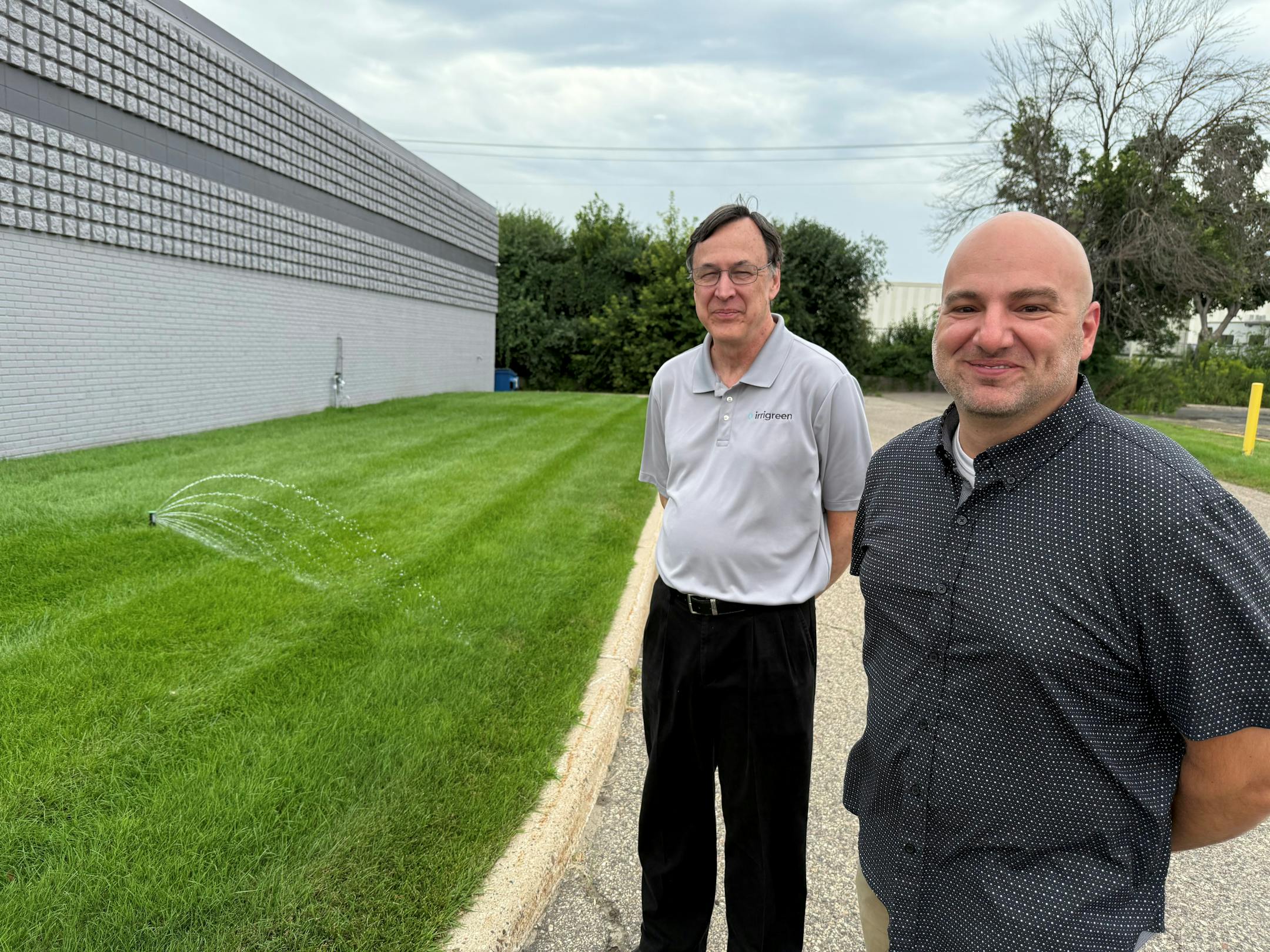
Gary Klinefelter, left, founder and chief technology officer of Irrigreen, and John Brine, head of customer experience and operations, at the company's headquarters in Edina. (Evan Ramstad/The Minnesota Star Tribune)

Entrepreneurs and inventors learn quickly that just solving a problem or making a better product isn’t enough to build a successful business. It has to get past the gatekeepers in a market, too.

Fourteen years ago, Gary Klinefelter incorporated Irrigreen in Edina to build smarter, less-wasteful lawn sprinkler systems based on his innovative nozzle that increased or reduced flow as it turned.

It was an innovation that appeared to meet the 2010s perfectly. Climate change had created a greater sense of environmentalism. And wireless technology and the “internet of things” had allowed companies like Irrigreen to constantly improve their products with software updates.

And yet the company has locked down only a small share of the home irrigation market, which is dominated by systems that spray indiscriminately and can’t efficiently direct water only where it’s needed.

Price isn’t the problem. Although the company’s sprinklers are more sophisticated than ordinary ones, fewer are needed in a yard. That saves not just on the sprinkler heads, but on the pipes that need to be run underground.

And for consumers more focused on saving a dollar than the environment, the company says there’s a relatively fast return on investment via savings in water usage. Irrigreen’s nozzles target a yard precisely, eliminating overlap that’s common with regular systems. Some customers find they use only half as much water to achieve soil-moisture goals.

“We love making accidental environmentalists,” said John Brine, Irrigreen’s head of customer experience and operations.

The major obstacle has been that Irrigreen’s distribution system relies on homebuilders and landscaping contractors whose installation routines are efficient and hard to change. Traditional watering systems are relatively simple: just create a perimeter around a yard and install a sprinkler head every few feet or so.

“I hate using the term, but our product is a paradigm shift from the way they’re doing business today,” Klinefelter said. “They are used to selling labor. They’re not used to selling technology.”

The company also had to overcome a practical problem. Irrigreen’s early sprinkler heads were about 8 inches long, twice the size of ordinary sprinkler nozzles. That forced contractors to dig deeper than usual to install water lines.

Last week, Irrigreen released its third-generation system, including a 5-inch sprinkler head that needs much less digging to install. The company also made installation easier by changing the base of the sprinkler so that a pipe goes in horizontally instead of coming up from the bottom.

“It’s much easier to get it oriented in the ground,” Klinefelter said.

Last year, Irrigreen set up its first distribution program with landscapers and irrigation installers, with four tiers of price, service and marketing benefits. When those firms purchase more from Irrigreen, they gain more pricing power to share with contractors.

“Some of the contractors are sharing that with their customers to be more price competitive. Some are taking that as [profit] margin,” Brine said. “There is intentionally a margin for their business on the product as well as their labor and installation.”

The new system also marks another milestone for Irrigreen, as it’s the first to be manufactured in the U.S. rather than overseas. Irrigreen tapped a precision molding company in Wisconsin, not because they were thinking about tariffs but because it was faster and cheaper to make changes to the product.

“We sent them a 3D-printed full spec version of our sprinkler,” Brine said. “Every part of it was printed based on what our engineers had designed. And they said, ‘This is the first time we’ve ever had somebody do this.’ ... It’s not looking at files in software. They had something they could take apart, and they could understand the complexity.”

Eight years ago, now-retired Minnesota Star Tribune columnist Neal St. Anthony visited Irrigreen at a time when Klinefelter was looking for a strategic partner to take the business to a new level. That article, Klinefelter told me, led to introductions that ultimately brought Shane Dyer, a Silicon Valley veteran, in as chief executive.

Klinefelter spent a decade in the digital printing business and applied the mathematical principles of ink jets in his design for the Irrigreen sprinkler. Dyer sold more investors on Klinefelter’s ideas. This spring, Irrigreen announced a $19 million Series A financing round involving a half-dozen venture capital firms.

In a patch of grass outside the company’s office last week, Brine turned on a sprinkler from his smartphone and demonstrated how it adjusts to an irregularly shaped lawn. He noticed that some ornamental grass in a rock bed near the building also needed water and incorporated it into the map. The sprinkler adjusted without spraying the wall.

The third-generation sprinkler has other innovations. Each sprinkler can clean itself from the dirt, sand and other debris that can get caught when it descends back into the ground. And each has a pressure sensor to detect changes in flow and try to maintain consistency.

The company hosted about 60 contractors from around the country on a videoconference a day after the “Sprinkler 3″ announcement. “You don’t know how many holes I have to dig each year,” one of the contractors said, with an expletive thrown in, Brine told me.

He said the contractor added, “If each one of those is 6 inches less, that alone is a game changer.”

about the writer

about the writer

Evan Ramstad

Columnist

Evan Ramstad is a Star Tribune business columnist.

See Moreicon

More from Business

See More
card image
Alex Kormann/The Minnesota Star Tribune

Fear on Twin Cities campuses has grown following recent detentions, leaving students to reconsider their daily activities

card image
Ai Holiday gift Illustration