

Ramstad: Businesses fear fewer will stop in Minnesota towns after highway bottleneck fixed

MnDOT’s solution for slowdowns at highways 371 and 210 in Baxter is buttonhook ramps and roundabouts.

Columnist Icon
The Minnesota Star Tribune
September 22, 2025 at 7:37PM
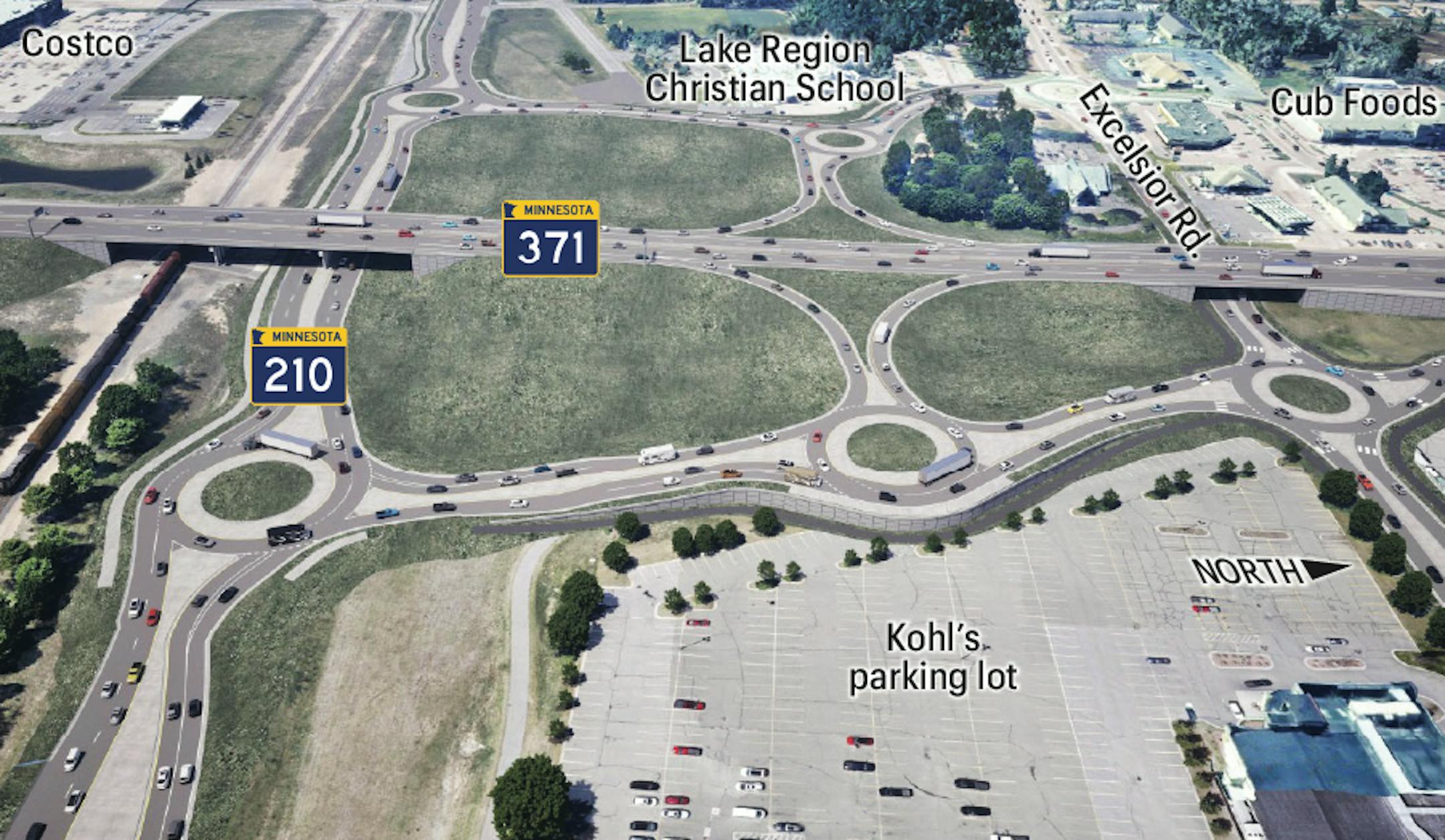
A MnDOT image of one of the proposals for a new interchange at Hwy. 371 and Hwy. 210 in Baxter, Minn.
MnDOT's recommended solution to relieve congestion at Hwy. 371 and Hwy. 210 in Baxter, Minn., involves new bridges and buttonhook ramps that connect to roundabouts. The Baxter City Council must decide whether to accept the design. (Mark Boswell/The Minnesota Star Tribune)

Twenty-five years ago, the state built a bypass for Hwy. 371 to skirt Brainerd and go through next-door Baxter, providing northbound Twin Cities residents with quicker access to lakes country.

Over time, big-box retailers and motels moved onto 371 in Baxter, economic activity in the communities shifted, and the bypass became a bottleneck at Hwy. 210, which runs east-west.

This summer, a plan to update the intersection with an eye-popping set of ramps and roundabouts opened a discussion on what a small town should look like these days — and whether a bit of congestion is actually a good thing.

“We’re looking at the models 20 years down the road and seeing ‘Oh, this is not likely to get better,’ ” said Eric Schiller, a Baxter-based project manager for the Minnesota Department of Transportation who is leading the planning process.

The Brainerd Lakes Chamber of Commerce said last month its survey of Baxter business owners found 60% rated the plan as “poor” or “very poor,” and 51% wanted something entirely different.

Businesses worry tourists will find the new interchange so confusing that they won’t bother to stop, the chamber’s leader told the Baxter City Council.

With its corridor of national chains, fast-food restaurants and motels, Baxter, population 9,200, already more closely looks like a Twin Cities suburb than it does Brainerd, population 14,500.

“Both 210 and 371 have really high volumes,” Schiller said, noting that on summer weekends the traffic volume rises 47% at the intersection due mainly to Twin Cities residents commuting to and from lake cabins.

MnDOT recently proposed separating the two highways, with 371 passing over 210 on a bridge, which sounds simple enough.

But with both a railroad and another four-way intersection very close to where 371 and 210 meet, MnDOT found that many of the ordinary solutions wouldn’t work.

After looking at dozens of ideas — and doing in-depth studies on about 20 of them — the agency settled on a system of “buttonhook” ramps between 371 and 210.

Such ramps are not novel in Minnesota. They can be found in Edina, Richfield and other parts of the Twin Cities metro area.

What’s different in the Baxter proposal is that the ramps flow without signals in and out of roundabouts.

Six large roundabouts, to be exact. Five of them are brand new.

Total cost to build: $58 million.

The design in many ways is ingenious, particularly given the constraints at the intersection: Besides the rail line, there are businesses all around it, and the water table is high because of the nearby Mississippi River.

MnDOT created a short video depicting the uninterrupted flow of traffic.

The proposal is now before the Baxter City Council, which is expected to decide by the end of the year whether to proceed. If it approves, construction bids would go out in late 2027.

The council plans a public hearing in November and last week decided that the meeting should happen in Baxter’s middle school because the city hall isn’t large enough for the expected crowd.

“I hear kind of an old line of thought that’s still around, maybe you’ve heard it before too, that traffic signals and congestion equal visibility,” said Schiller, who lives in Brainerd and hears from people about the 371/210 intersection almost wherever he goes.

“We tried to illustrate things to calm those fears of something different and change, but I don’t know we’re there yet,” he said.

The problem is Hwy. 371 through Baxter is both a high-speed road and a low-speed street. That’s a combination now known in urban design circles as a “stroad,” a word invented by a Brainerd resident who is a national figure in the field, Charles Marohn.

Stroads are notorious features of most American suburbs, destroying walkability and charm, and often so compromised in design they deliver neither the efficiency of a road nor the access of a street.

In a series of essays on the website of the nonprofit organization he leads, Strong Towns, Marohn criticized MnDOT’s solution for the 371/210 interchange as too costly and too complicated. He said it prioritizes people driving through Baxter rather than living in it.

He views the proposal as emblematic of a broader problem that communities, particularly suburbs, face across the country. There’s too much unproductive infrastructure being built — and requiring long-term maintenance — in the hopes that new growth will pay for it.

Marohn favors a simpler design that was on MnDOT’s list of finalists: a single-point interchange on 371 atop a bridge over 210 and the railroad.

He also says access to 371 should be cut off between 210 and another signaled intersection at Woida Road about 1½ miles to the north.

That would eliminate some left-turn crossovers in a stretch of the highway where cars reach fairly high speeds. It would also space out the full intersections far enough for traffic to stabilize, Marohn writes.

However, businesses along that 1½-mile stretch would no doubt be upset at the distance drivers would need to get onto frontage roads and reach them.

Last week, the Baxter City Council voted its approval for another national restaurant chain to take a spot in that stretch of 371 north of 210 — one with a track record of creating traffic jams.

Chick-fil-A.

about the writer

about the writer

Evan Ramstad

Columnist

Evan Ramstad is a Star Tribune business columnist.

See Moreicon

More from Business

See More
card image
Provided by AGNT Media

A former Cold War-era missile launch site is among three Minnesota listings with their own “safe rooms.”

card image