Opinion editor’s note: Strib Voices publishes a mix of material from 8 contributing columnists, along with other commentary online and in print each day. To contribute, click here.
•••
When President Donald Trump stepped into his second term in office last January, one of his first actions was an executive order terminating any federal program that could be connected to the concepts of diversity, equity and inclusion. Among the lost research and data was work on environmental justice. This is the understanding that climate change and other kinds of pollution affect different communities in different ways — and some Americans are left holding the short end of the stick.
It shouldn’t be a difficult concept to understand. You can look around Minneapolis with your own two eyeballs and notice that nobody is building industrial sites near Linden Hills. Other parts of the city have had factories plopped down in the middle of them, though. And it’s not too much of a stretch to suspect that might lead to different environmental outcomes.
The president can erase funding for environmental justice, but he can’t erase the reality of the problem or the need for solutions. That’s why research like the kind being done by the Mapping Prejudice project at the University of Minnesota is so important. Its work shows how a history of racism in Minneapolis led to a city where some neighborhoods are hotter and less prepared for climate change than others.
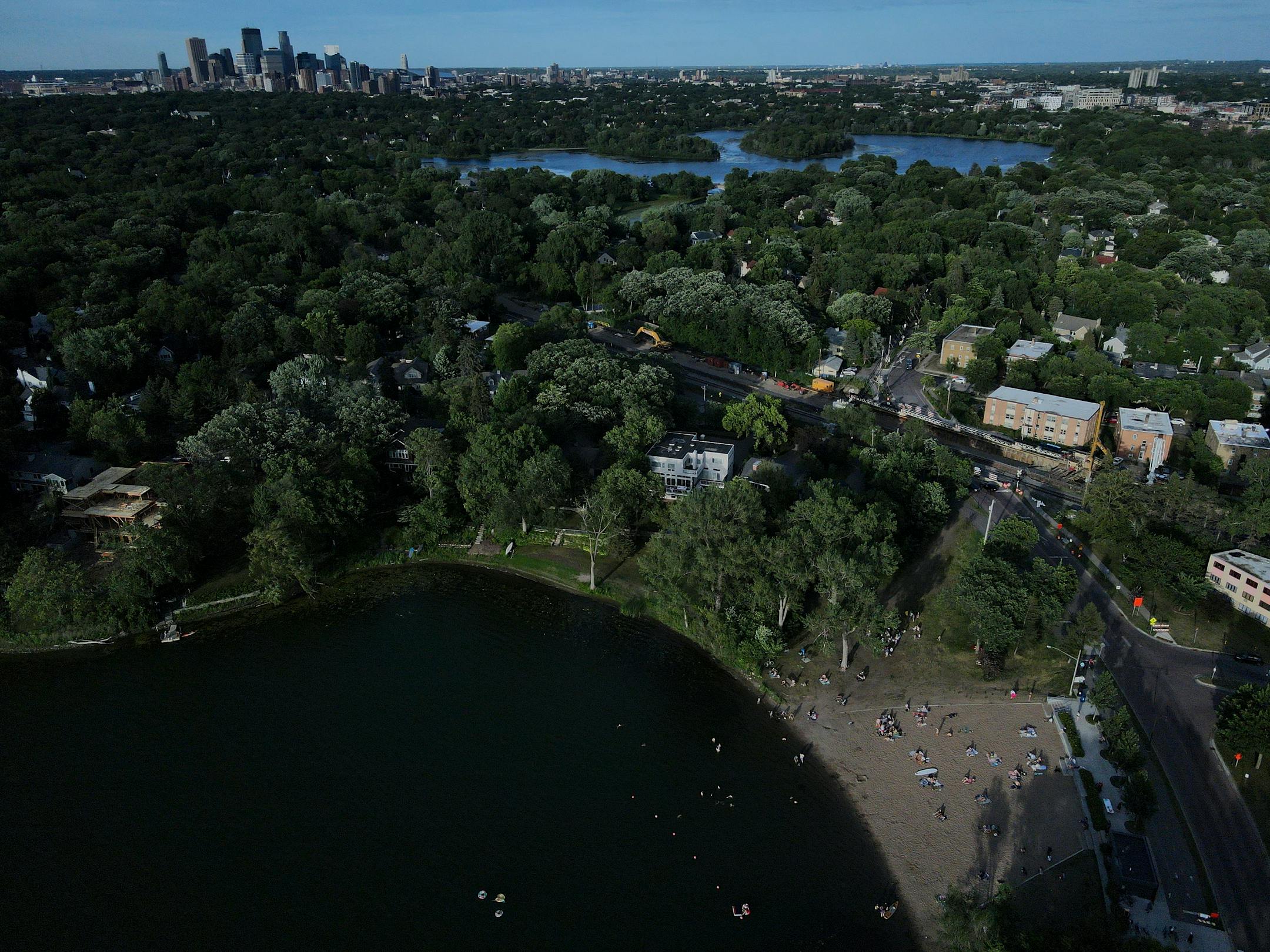
Today, neighborhoods along Minnehaha Creek and the Chain of Lakes have some of the highest rates of tree cover in the city. That feature is both aesthetically pleasing and environmentally protective. Temperatures in these parts of town can be as much as three degrees cooler on average than the overall city.
That seemingly small difference matters on hot summer days. It shrinks electric bills, makes the outdoors more livable, and improves the health of the elderly and medically vulnerable. And it all started with agreements between land developers and the Minneapolis Park Board that created a network of exclusive whites-only neighborhoods with ample public parkland.
Racial covenants — legal contracts preventing homeowners from selling or renting to anyone “of Chinese, Japanese, Moorish, Turkish, Negro, Mongolian, Semetic or African blood or descent,” as one ad from 1919 noted — were pretty common in Minneapolis and surrounding suburbs between 1910 and 1955. They were, obviously, racist and wrong. But city planners of the time saw them as a progressive tool to build a harmonious city, said Rebecca Walker, a postdoctoral research fellow at the University of Minnesota who co-authored a paper on connections between racism and parks in Minneapolis.