
Rash: U.S. strikes on Venezuelan boats demand Hegseth’s congressional testimony

Congress is a co-equal branch of government and must provide oversight on the use of the U.S. military ― and the possibility of war.

Columnist Icon
The Minnesota Star Tribune
December 8, 2025 at 10:59AM
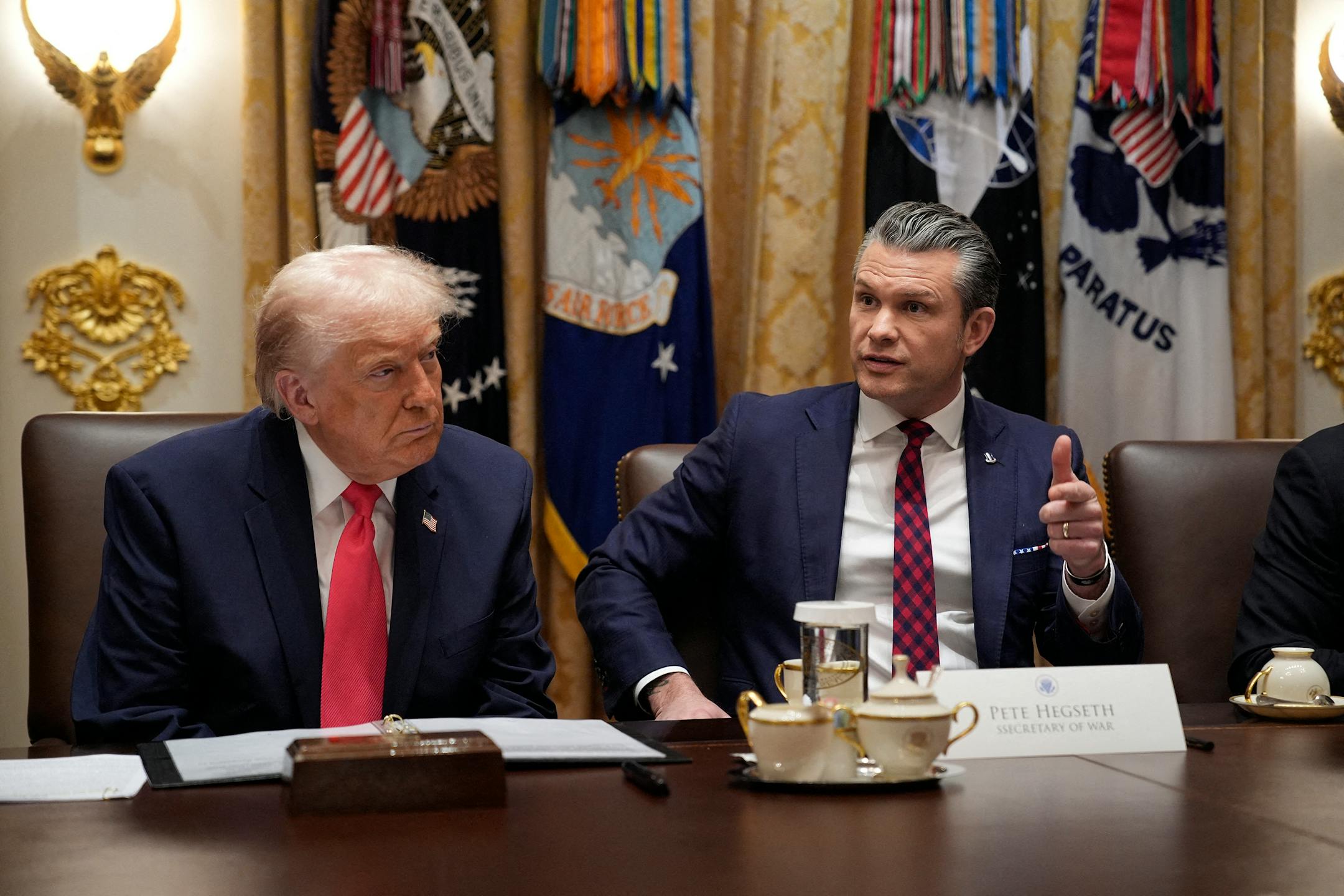
Defense Secretary Pete Hegseth, right, makes remarks as President Donald Trump listens during a meeting with his Cabinet in the White House on Dec. 2. (Yuri Gripas /Tribune News Service)

Opinion editor’s note: Strib Voices publishes a mix of commentary online and in print each day. To contribute, click here.

•••

Responding to reporters’ questions about a second strike on an alleged Venezuelan drug boat that killed two survivors, Secretary of Defense (and Forest Lake native) Pete Hegseth said: “I did not personally see survivors. The thing was on fire. It exploded, there’s fire, there’s smoke.

“This is called the fog of war.”

Congress can and must clear the fog. The fog about the second strike, which many military experts and lawmakers say may be a war crime; about the unprecedented campaign to strike such vessels in the first place instead of the longstanding protocol of having the U.S. Coast Guard intercept them to determine whether the craft have contraband; and most profoundly about the deployment of assets that suggests possible military action against Venezuela.

A bipartisan, bicameral hearing held on Capitol Hill on Thursday was behind closed doors. But lawmakers provided a window into what they saw, creating the latest example of Washington’s “Rashomon” effect (from the seminal 1950 film by Akira Kurosawa) of different interpretations of the same event.

Sen. Tom Cotton, R-Ark., said he saw the survivors “trying to flip a boat loaded with drugs bound for the United States back over so they could stay in the fight.” The strike, he added, was “righteous.”

Conversely, Connecticut Rep. Jim Himes, a Democrat, said that “what I saw in that room was one of the most troubling things I’ve ever seen in my time of public service. You have two individuals in clear distress, without any means of locomotion, with a destroyed vessel who were killed by the United States.”

Such disparate descriptions bolster the call for public release of the footage — and for Hegseth to testify instead of just Adm. Frank M. Bradley, who’s commanding the campaign on alleged drug boats, including yet another the same day of the hearing. Indeed, the entire endeavor deserves more scrutiny for this country as well as for America’s role in the world.

“These are really, really important issues for the U.S. military, since we are the ones that set the standard globally for how we think militaries should carry out operations under civilian political control,” said Jon Olson, a retired commander who spent 21 years in U.S. naval intelligence and now teaches national security courses at Carleton College and the University of Minnesota’s Humphrey School.

Olson said that Bradley, who was a year behind him at the Naval Academy, took the same courses that covered “morality and ethics in military operations, especially in combat operations, and the importance of ensuring that the orders you are giving or receiving are absolutely clear so that you can avoid the kind of things that happened at My Lai” (referring to the infamous massacre by U.S. troops in Vietnam).

The second strike “is just an absolute violation of everything the U.S. is supposed to stand for,” Olson said. “That’s not how the United States is supposed to do business.”

Olson said he hopes the truth emerges from the hearings, which is “why we have oversight of the U.S. military by Congress, to make sure the things we do abroad, the operations we carry out in the name of the American people, are done lawfully and within the bounds of moral and ethical behavior.”

Congress does have the right and in fact the responsibility for oversight, said Kathyrn Pearson, a University of Minnesota political science professor who’s an expert on Congress. In an email interview, she said that “Senate and House Armed Services and Intelligence Committees should conduct extensive oversight, including committee hearings open to the public. President Trump sent notices to congressional committees that the United States is engaged in a formal armed conflict with drug cartels, and if it continues beyond the time limits of the War Powers Resolution, Congress should also debate whether to authorize military action.”

That debate shouldn’t be ducked as in so many other recent conflicts. Especially since Trump, who in campaign rallies endlessly railed against endless wars, looks poised to enter one, partly on the pretext of trying to stop drug smuggling — all while recently freeing former Honduran President Juan Orlando Hernandez, who last year was sentenced to 45 years in prison for facilitating the trafficking of up to 400 tons of cocaine to this country.

The glaring hypocrisy of striking alleged drug boats without any interdiction or investigation while freeing a court-convicted drug smuggler isn’t lost on the world and shouldn’t be on Washington. Encouragingly, while not totally void of the partisanship paralyzing the country, there has been some semblance of bipartisan concern.

“In recent decades, partisan divisions have affected congressional oversight and policymaking on matters of war (in addition to domestic policymaking),” said Pearson. “When Congress is controlled by the president’s party, committee chairs and party leaders typically support the executive in matters of war and foreign policy. (By contrast, when Congress is controlled by the out party, committee chairs and party leaders are likely to challenge the president and increase oversight). That makes it notable that Republican committee chairs are joining Democratic committee leaders pressing for answers from the administration. That said, Democrats have been more critical of the Trump administration than Republicans, but it is significant that we are seeing Republican committee chairs and members ask tough questions on this issue in a Congress that has exercised very little oversight of the Trump Administration, and I expect continued congressional oversight led by Republican committee chairs on this issue.”

The oversight should extend to Hegseth himself, on both his boat-strike bellicosity and his handling of the Pentagon inspector general’s report on the unauthorized, nonsecure use of a Signal group chat to discuss upcoming strikes on Yemen. Hegseth declined to be interviewed, and instead the report had to rely in part on reporting from the Atlantic magazine, whose editor-in-chief was inadvertently included in the conversation.

Congress is a co-equal branch of government and must not dodge its oversight role, especially on the most profound presidential power: the use of the U.S. military. Indeed, on this issue of warfare, there is no fog.

about the writer

about the writer

John Rash

Editorial Columnist

John Rash is an editorial writer and columnist. His Rash Report column analyzes media and politics, and his focus on foreign policy has taken him on international reporting trips to China, Japan, Rwanda, Kazakhstan, Turkey, Lithuania, Kuwait and Canada.

See Moreicon

More from Columnists

See More
card image
Yuri Gripas /Tribune News Service

Congress is a co-equal branch of government and must provide oversight on the use of the U.S. military ― and the possibility of war.