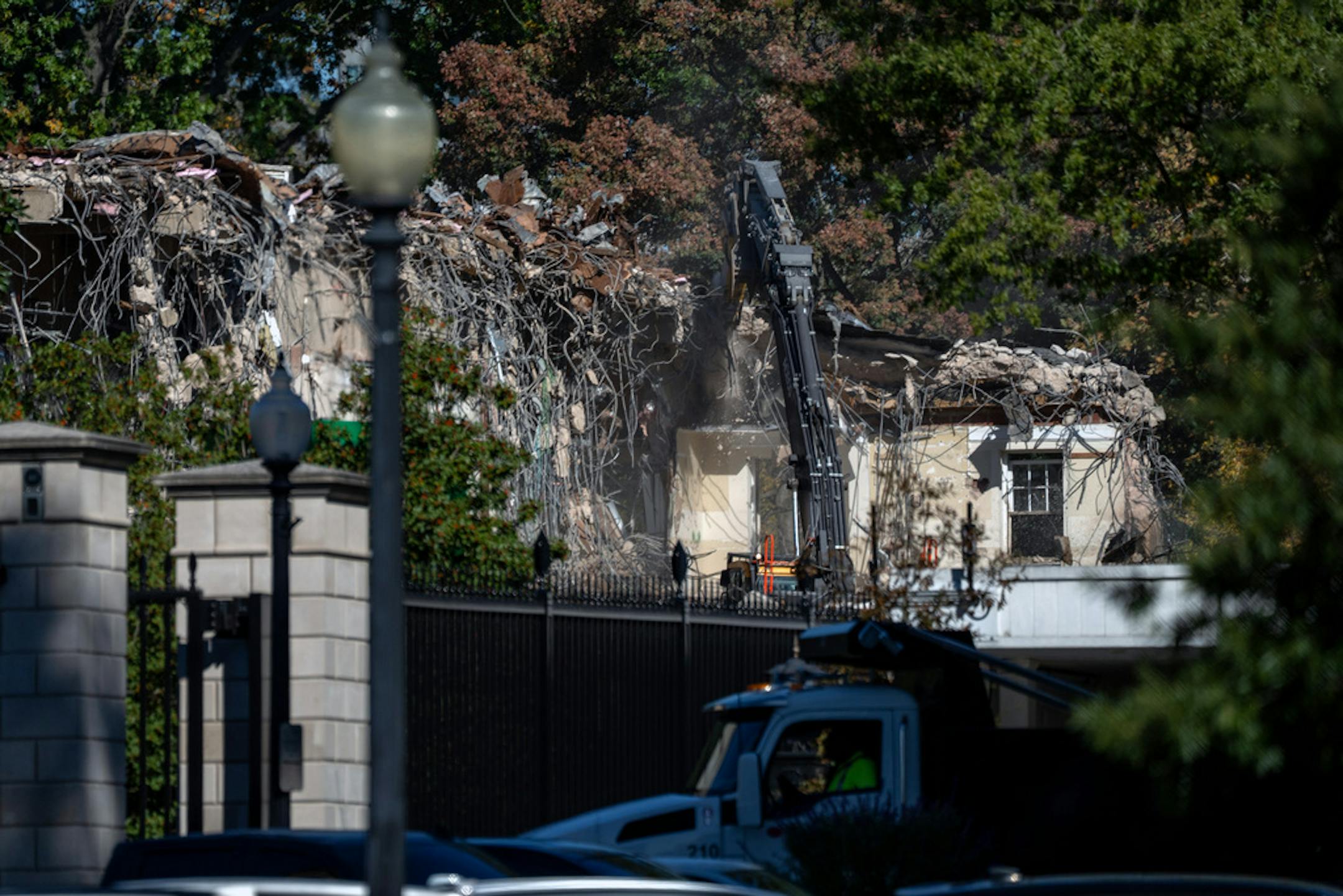
Can anyone stop Trump’s tear-down of the East Wing?

Many preservationists fear the answer is no. A pro-Trump review board is expected to approve the president’s planned 90,000-square-foot ballroom, too.

The Washington Post
October 23, 2025 at 1:54PM
Demolition crews continue dismantling parts of the East Wing of the White House on Wednesday, Oct. 22, 2025 in Washington, D.C. The work is part of preparations for the construction of a new ballroom, ordered by President Donald Trump. (Peter W. Stevenson/The Washington Post)

President Donald Trump’s plan to build a White House ballroom has underscored an oft-overlooked aspect of presidential power: No one could stop the president from tearing down much of the East Wing this week.

The next stage of the project is also likely to proceed withfew restraints: The key panel slated to review the president’s construction plans is now stocked with Trump allies ready to approve them.

Photos of construction teams knocking down portions of the East Wing, first revealed by The Washington Post on Monday, have rattled city residents, historians and politicians, many of whom contended that Trump was wrongly tearing apart “The People’s House” to build his long-desired ballroom.

“It’s not his house. It’s your house. And he’s destroying it,” Hillary Clinton, who battled Trump for the presidency in 2016, wrote on social media.

Others contend that Trump’s shifting projections and promises — such as pledging in July that the ballroom wouldn’t “interfere” with the White House, and increasing his estimate of cost and how many people will fit in the building — illustrate the need for more transparency. Conservative commentator Byron York said Trump “needs to tell the public now what he is doing with the East Wing of the White House. And then tell the public why he didn’t tell them before he started doing it.”

Rebecca Miller, executive director of the D.C. Preservation League, a nonprofit that advocates for protecting historic sites in Washington, said dozens of concerned citizens from the city and around the country have called and emailed her to express outrage.

Miller said she has had to explain that the White House, because of the National Historic Preservation Act of 1966, is exempt from the required reviews that other federal agencies must undergo when seeking to alter government property.

“Our hands are tied,” Miller said, adding that normally government officials discuss major projects with preservationists — but not this time. “It’s very frustrating that there’s nothing that the organization can do from a legal or advocacy perspective.”


The National Trust for Historic Preservation, a nonprofit created by Congress to help preserve historic buildings, urged the administration “to pause demolition until plans for the proposed ballroom go through the legally required public review processes,” including a pair of commissions that have reviewed past White House construction.

Polls have shown many Americans are concerned. YouGov polling conducted Tuesday found that 53 percent opposed demolishing part of the East Wing, 23 percent supported it and the remainder were unsure. YouGov also found that 23 percent believed the ballroom will have a positive effect on the White House, 35 percent believed it will have a negative effect, and the remainder were neutral or unsure.

But the project is moving forward. White House officials said Tuesday to expect a full-scale teardown of the East Wing, defending it as a “modernization” of the building. They also touted past renovations, circulating a fact sheet that argued Trump was continuing a “proud presidential legacy” of changing the White House grounds — although the swimming pool, tennis pavilion and other past projects they highlighted pale next to the president’s planned 90,000-square-foot ballroom, which would be nearly twice the footprint of the 55,000-square-foot main section of the White House next door. Trump said this week that the ballroom will seat nearly 1,000 people, up from an earlier estimate of about 650.

He also said Wednesday that the project will cost $300 million, up from his initial claim of $200 million, and defended the decision to tear down the East Wing.

“In order to do it properly, we had to take down the existing structure,” Trump told reporters.

The White House said it would soon send ballroom plans to the National Capital Planning Commission, which is required to review any external construction project at the White House and will decide whether to approve the new building. But the 12-member board is now led by a majority of Trump allies, including its chairman, Trump staff secretary Will Scharf.

Officials have said that the NCPC has no role in stopping demolition on federal property. “What we deal with is essentially construction — vertical build,” Scharf said at the commission’s Sept. 4 meeting.

Past members of the NCPC previously told the Post that distinguishing between preparation work and literal construction is not how the commission has worked in the past. Instead, the agencies have held off on all work, including demolition, until final commission approval, said former chairman L. Preston Bryant Jr.

Large projects in the past have endured a rigorous, four-step review ending with a presentation at a public meeting, Bryant said. At each stage, commissioners and staff give feedback on details including aesthetics and environmental impacts. All construction or renovation of federal buildings in the D.C. region goes through some sort of review.

“Whether you’re expanding a sidewalk, putting up a mobile cell tower or putting a new wing on the Pentagon, you’ve got to come to us. It’s big stuff and little stuff,” Bryant said in August. He noted that two White House projects from the past decade — replacement of a perimeter fence and construction of a tennis pavilion — took more than a year to move through the commission. Neither involved changing the White House itself.

The National Trust for Historic Preservation and other groups have separately appealed to the Commission of Fine Arts, a seven-member panel that helps guide design projects related to the nation’s capital and is currently stocked with appointees named by President Joe Biden, saying that the ballroom project requires the CFA’s approval.

But the White House may sidestep the CFA’s review, citing historical precedent, architectural experts said. During a 1947 battle with President Harry S. Truman, who sought to add a balcony to the White House, CFA’s then-chairman said the panel could serve only in an “advisory” role to the president. Truman ultimately proceeded with his plans, setting an example that Trump appears poised to follow.

The CFA also is dealing with a leadership vacuum: Architect Billie Tsien, who had chaired the commission since 2021, recently resigned from the panel. Tsien, who is helping construct the Obama Presidential Center in Chicago, told the Post in August that she was removing herself from the CFA because her term had expired and she assumed that Trump would not reappoint her.

The White House declined to comment on whether it believed CFA approval was necessary for the ballroom project to move forward. An official who spoke on the condition of anonymity to discuss ongoing construction said that “all necessary agencies and entities who need to review the project” were in the process of being consulted.

Some experts argued that there is still a chance to slow Trump’s project. Sara Bronin, who last year stepped down as chair of the Advisory Council on Historic Preservation, an agency that reviews federal construction projects, said that while the White House is exempt from the National Historic Preservation Act, the National Park Service — which is involved with the ballroom project — is not.

As a result, Bronin believes that outside groups could file suit to potentially halt the project if the administration cannot prove it has undertaken required reviews.

“This is the kind of shortsighted government action that inspired Congress to pass the National Historic Preservation Act six decades ago,” said Bronin, a George Washington University law professor, citing the law’s Section 106 provisions that mandate reviews. “It’s for federal agencies to stop, look and listen before they proceed with action that could harm historic properties.”

The administration has taken steps to keep details of the construction from the public. After images spread Monday, employees of the Treasury Department were told not to share photographs of the adjacent demolition site.

The White House has released few details on the project’s funding — and has not sought permission from Congress, which is empowered with authorizing all federal spending. Trump officials have touted that the planned ballroom will be paid for by private donations, including from wealthy individuals and large companies that have contracts with the federal government, including Amazon, Lockheed Martin and Palantir Technologies. (Amazon founder Jeff Bezos owns the Post.) The donations are being managed by the Trust for the National Mall, a nonprofit that helped manage the restoration of the Washington Monument after it was damaged in a 2011 earthquake and other federal projects.

Many local residents this week have questioned the project. Gloria Black, a resident of Alexandria, Virginia, said she was particularly concerned after seeing images of the torn-down East Wing, which she and other area residents discussed at a community meeting Monday night.

Black told the Post that she wanted more transparency about the companies and donors involved in the project and whether they stood to gain from their participation. She also questioned why Trump had made the ballroom a personal priority.

“How much of his time is his involvement likely to be taking away from other very serious national and international matters?” Black said.

Others say they support Trump’s effort. Patrick Mara, chair of D.C.’s Republican Party, said he agrees with Trump’s vision that the White House needs more space to accommodate guests.

“Sounds a little absurd, but there really isn’t a lot of space for events,” Mara said.

Pegge Caccavari, a Trump supporter who lives in McLean, Virginia, said the plans would have become mired in red tape if Trump had submitted them before starting demolition.

“How many years would it have taken for an approval to transpire?” said the retired mortgage broker. “They’re not doing anything outrageous. More people than ever are going to want to see the beauty of the White House.”

Trump has maintained that a ballroom is a long-needed addition to the campus — and a personal priority. David Axelrod, an Obama adviser, has said that Trump pitched him in 2010 on the project.

Trump told the Post in 2016 that, if elected, he did not plan to make changes to the White House. “I’d leave it the way it is,” he said at the time.

But in his second term, the increasingly emboldened president has moved to remake the White House grounds, changing them to increasingly resemble the luxury properties he has built and lived in for decades.

The renovated Rose Garden is pictured at the White House, Aug. 22, 2025, in Washington. (Jacquelyn Martin/The Associated Press)

The president paved over the 112-year-old Rose Garden, saying that guests’ shoes too often sunk into the ground. The overhauled site — which Trump has dubbed the “Rose Garden Club,” evoking his Mar-a-Lago resort in Florida — hosted two events Tuesday.

Trump also has cited the ballroom he built at his property in Turnberry, Scotland, as a model. The White House has said the ballroom project, which is being overseen by McCrery Architects, will be built in a classical style that is integrated with the surrounding buildings.

Architects have offered mixed reviews of the ballroom, with some decrying its likely size and others saying they wished to see more details before weighing in. The American Institute of Architects in August called for a “rigorous” review before construction.

“It is a very challenging project, to build a large ballroom next to the president’s house,” said Duncan Stroik, an architecture professor at the University of Notre Dame, adding that he was curious if the new ballroom would reference the history of the United States through symbols, ornament and art.

Stroik, who was appointed by Trump in 2019 to the Commission of Fine Arts for a four-year term that ended in 2023, also praised lead architect James McCrery II, a past colleague, as an “excellent” choice to construct the ballroom.

Preservationists have mostly panned the project. Shelly Repp, chair of the Committee of 100 on the Federal City, a century-old nonprofit “dedicated to safeguarding and advancing Washington’s historic distinction,” said he was “shocked” when he learned of the plan, “and I’m still shocked now that they’re knocking down the East Wing.”

“There’s nothing wrong with a president doing stuff,” Repp said. “The question is, what is he doing? In this case, he’s doing something that doesn’t fit within the character of the White House.”

Repp said he did not object to what Trump did to the Rose Garden because “I assume it’s reversible.” Demolishing the East Wing, he said, “is not reversible.”

Trump has a history of rankling preservationists that dates back to his years as a New York developer. In the early 1980s, after razing the Bonwit Teller department store on Fifth Avenue to make way for Trump Tower, he promised to donate to the Metropolitan Museum of Art several art deco treasures from the building’s edifice, including a pair of 15-foot-tall reliefs depicting nude women and an ornate grill from the entrance. Instead, Trump’s workmen jackhammered the reliefs, and the grill vanished.

Cat Zakrzewski and Steve Hendrix contributed to this report.

about the writer

about the writer

Dan Diamond, Paul Schwartzman, Jonathan Edwards

The Washington Post

More from Politics

See More
card image
Renée Jones Schneider/The Minnesota Star Tribune

Attorney General Keith Ellison and Twin Cities mayors called for an end to the increased federal presence that has left one woman dead and sparked mass protests.

card image
card image