
White House expands East Wing demolition as critics decry Trump overreach

More of the structure was torn down Tuesday to make way for President Donald Trump’s planned ballroom, despite complaints about the project’s lack of transparency.

The Washington Post
October 22, 2025 at 8:32PM
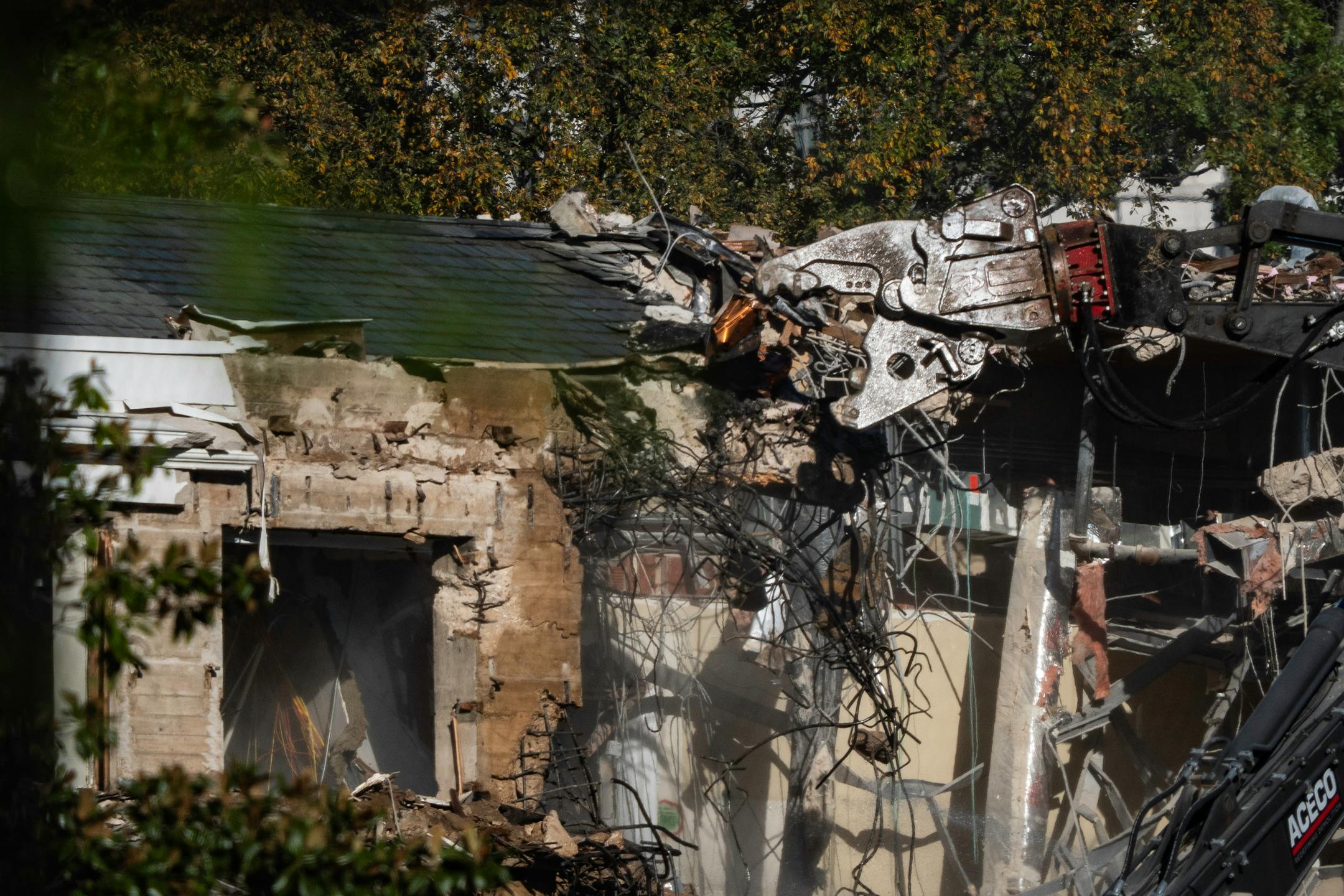
Part of the East Wing of the White House is demolished by work crews during construction to build a new ballroom in Washington, D.C., on Oct. 21, 2025. (Salwan Georges/The Washington Post)

A demolition job that began Monday with the disappearance of the White House’s eastern entrance advanced Tuesday with the destruction of much of the East Wing, according to a photograph obtained by the Washington Post and two people who spoke on the condition of anonymity to describe the scene.

Photos of construction teams knocking down parts of the East Wing, first revealed by the Washington Post on Monday, shocked preservationists, raised questions about White House overreach and lack of transparency, and sparked complaints from Democrats that President Donald Trump was damaging “the People’s House” to pursue a personal priority.

“They’re wrecking it,” said Martha Joynt Kumar, a political scientist and professor emeritus at Towson University in Maryland. “And these are changes that can’t be undone. They’re destroying that history forever.”

A White House spokesman said that the “entirety” of the East Wing would eventually be “modernized and rebuilt.”

The National Trust for Historic Preservation, a nonprofit created by Congress to help preserve historic buildings, sent a letter Tuesday to administration officials, warning that the planned 90,000-square-foot ballroom “will overwhelm the White House itself,” which is about 55,000 square feet.

“We respectfully urge the Administration and the National Park Service to pause demolition until plans for the proposed ballroom go through the legally required public review processes,” Carol Quillen, National Trust’s CEO, said in a statement, citing two federal commissions that have traditionally reviewed White House additions.

White House officials dismissed the criticism as “manufactured outrage,” arguing that past presidents had pursued their own changes to the executive campus as necessary. They said that the privately funded ballroom will be a “bold, necessary addition” to the presidential grounds.

“For more than a century, U.S. Presidents have been renovating, expanding, and modernizing the White House to meet the needs of the present day,” the White House’s rapid-response team posted on social media, listing examples of prior campus construction.

Trump has long touted his plans for an expansive ballroom, insisting that presidents needed the space to host large events. He also said in July that the construction of the planned addition would not affect the existing White House.

“It won’t interfere with the current building. It won’t be. It’ll be near it but not touching it — and pays total respect to the existing building, which I’m the biggest fan of,” Trump said during an executive order signing in July. “It’s my favorite. It’s my favorite place. I love it.”

Other White House officials have said that constructing the planned ballroom would inevitably require changes to the East Wing.

A White House official, speaking on the condition of anonymity to discuss ongoing construction, said Tuesday that historic artifacts of the East Wing had been “preserved and stored” under the supervision of the White House Executive Residence and the National Park Service with support from the White House Historical Association, a nonprofit organization. The official cited items from Rosalynn Carter’s Office of the first lady, and said that there were plans to use them. The person did not say whether any of the building itself would also be saved.

The Treasury Department on Monday evening instructed employees not to take or share photos of the construction project without permission, according to a person who spoke on the condition of anonymity to detail an internal email. The Treasury headquarters is next to the White House, with some of its offices providing a close view of the East Wing. But areas where the demolition is viewable are closed to the public, fueling criticism about the Trump administration’s lack of transparency.

One of the people who witnessed the demolition Tuesday said that views of the site from Treasury headquarters amplify the demolition, but a large part of the structure remained by late afternoon. However, it appeared that what remained was also headed for demolition, with no evidence that the structure was being protected and only jagged damage visible in the exposed building.

ACECO, a company that bills itself as “the premier demolition contractor in the D.C. area,” has been responsible for the demolition work, according to photographs released this week. ACECO did not respond to questions about its involvement in the ballroom project. The company’s website was largely taken down Tuesday and replaced with a new message: “This site is under construction.”

The modern East Wing emerged in 1942 when a renovation added a second story to the annex, which houses office space for the first lady, her staff, the White House Military Office and the social secretary. The East Wing is one of the most well-known parts of the White House, having also been used for decades as the entrance for almost all visitors touring the White House, a fact the administration underscored last month by indefinitely canceling all public tours of the White House because of the ballroom construction.

For years, millions of visitors submitted to U.S. Secret Service security checks at an outbuilding before making their way toward the East Wing. The stroll allowed them to shake off the experience of a security checkpoint and start to feel the aura of the White House, said James McDaniel, who was the National Park Service White House liaison from 1984 to 2002. Upon entering, they could walk through a sun-soaked colonnade, enjoying the Jacqueline Kennedy Garden on the left and photos of significant historical moments on the right.

“It represented the nonpolitical side, the softer side of White House operations,” McDaniel said.

about the writer

about the writer

Dan Diamond, Jonathan Edwards, Maureen Linke, Tim Meko

The Washington Post

More from Politics

See More
card image
Renée Jones Schneider/The Minnesota Star Tribune

“His immigration policy was cruel in his first administration, and now it’s just outright dangerous,” she says.

card image