

Minneapolis nonprofit’s discovery may allow for more bone marrow donations

Pairing donors and recipients with mismatched blood types could hasten more life-saving stem cell transplants for patients with leukemia and other blood disorders.

The Minnesota Star Tribune
November 3, 2025 at 2:00PM
The cell research and donation group NMDP is reporting results in using mismatched donors to provide stem cell transplants to people with leukemia and other disorders. The positive results could hasten transplants for people with rare blood types who struggle to find perfect matches. (Jeremy Olson/The Minnesota Star Tribune)

Life-saving stem cell transplants have been limited by the need to perfectly match the blood types of donors and recipients, but a discovery by the Minneapolis agency that orchestrates these procedures nationwide could eliminate that barrier.

A study group of transplant recipients showed encouraging survival rates from leukemia and other disorders, even though they only matched their donors on five or six of eight key blood markers, the cell therapy agency NMDP reported Monday.

Doctors had long sought perfect eight-of-eight matches to reduce the potentially fatal risk of transplant rejection. Perfect matches meant that patients and donors had common proteins on their cells, making them recognizable to the immune system rather than something foreign like a virus that the body would attack.

But that high safety threshold left patients with rare blood types waiting for years or dying before matches were found. Proving the safety of so-called mismatched transplants especially opens up options for ethnic and racial minorities who struggled to find matches.

“We now have a donor for all,” if matches of six or less lead to successful transplants, said Dr. Steven Devine, chief medical officer of NMDP. The nonprofit maintains a registry of more than nine million Americans who have volunteered to donate bone marrow or blood for stem cell transplants.

The discovery could result each year in thousands more transplants, which infuse regenerative stem cells and healthy blood cells in patients after chemotherapy and other treatments have wiped out their diseased cells.

Challenges remain. The rate of new volunteers is declining, along with the rate of existing volunteers who go through with donations when matched to patients in need. But Devine said the use of mismatched donors has more potential to increase transplants than more volunteers.

Even when tapping into a global database of 42 million potential donors, NMDP struggles to find perfect matches for patients with rare blood types, especially for racial and ethnic minorities. African Americans needing transplants have a 29% chance of finding a perfect match, but the odds increase to 84% for a seven-of-eight match and almost 100% beyond that.

“The disparity in access to a life-saving transplant based on race or ethnicity is no longer an issue” if mismatched donations can be widely used, Devine said.

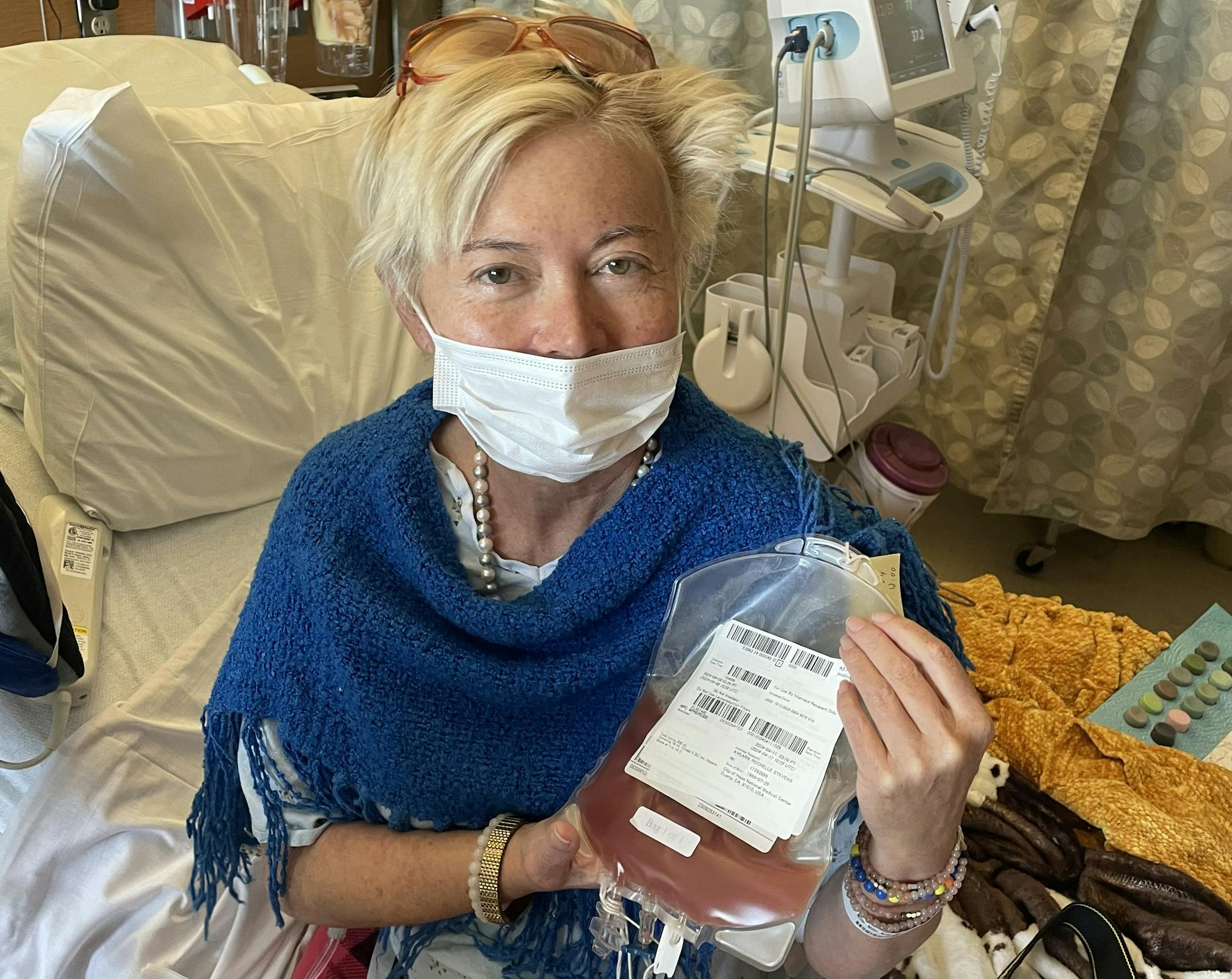
Rochelle A’Hearn, 59, of San Diego poses with the stem cells obtained from an unrelated donor in Spain before her transplant as part of her treatment in 2024 for leukemia.

Filipino-born Rochelle A’Hearn waited more than a year for a match after a recurrence of her leukemia, a cancer that disrupts bone marrow and its ability to produce healthy blood cells. More than half of these transplants use stem cells taken earlier from the patients themselves, or from their genetically similar relatives, but neither was an option for the 59-year-old San Diego attorney.

When a six-of-eight match was found in a woman who lived in Spain, there wasn’t much debate among her doctors at the City of Hope cancer center in Los Angeles.

“My particular leukemia moves very rapidly,” she said. “So there was no real messing around. We had to move fast.”

A’Hearn agreed to the mismatched transplant as part of a clinical trial, similar to the one NMDP reported this week, that compared outcomes with perfect matches. Her alternative was long-term chemotherapy medication to prevent another recurrence of cancer, which presented its own health risks.

Researchers had already established equivalent transplant results when comparing perfect matches with donors and recipients who only matched on seven of eight blood markers. That discovery helped NMDP achieve a record last year when it facilitated 8,879 stem cell transplants or cell therapies.

The agency had even changed its name in 2024 from Be The Match, which some confused as a dating agency but also carried the implication that a perfect match was necessary. (NMDP previously was known as the National Marrow Donor Program, but now uses the acronym only.)

The next step was to prove that even bigger mismatches could work safely. Monday’s findings highlighted at the American Society of Hematology’s annual conference were based on a comparative clinical trial of 268 adult transplant recipients.

The researchers actually showed a higher one-year survival rate of 86% among recipients with five- or six-of-eight matches with donors compared with the 79% survival rate among recipients with seven-of-eight matches.

Those outcomes were considered statistically identical. However, Devine said it’s easier in mismatched cases to pair recipients with younger donors who have more robust stem cells than older donors, which may improve survival odds.

Success with mismatched transplants is largely due to the use of cyclophosphamide, a chemotherapy agent used for decades in the treatment of breast and other cancers. When given after transplants, the drug reduces the risk of graft-versus-host disease, which occurs when transplanted immune cells perceive the new tissue as foreign and attack it.

Increasing usage resulted in a doubling of transplants since 2019 involving stem cells from unrelated, mismatched donors.

The discovery means many more people on NMDP’s registry could be called on to donate in mismatched cases, which raises another challenge. Only 45% of people on the U.S. registry confirmed their willingness to donate last year when they were matched to patients and doctors contacted them to double-check their blood types. That was a decrease from 52% in 2019.

The declining interest appears rooted in some of the same health care skepticism that has resulted in fewer blood donations and fewer people getting recommended vaccinations, said Amy Ronneberg, NMDP’s chief executive.

The agency has switched its recruiting practices to gain more upfront commitments at the time people register. As a result, the number of new registrants has declined from about 419,000 five years ago to about 232,000 this year. However, NMDP has confidence in the people who are signing up, Ronneberg said.

Many people declined to register or donate in the past when transplants required bone marrow, which surgeons obtained from patients by placing them under anesthesia. The majority of transplants now involve stem cells derived from simple blood draws.

“You can sit in a chair and watch TV or play video games” during donations, Ronneberg said.

Rochelle A’Hearn, 59, of San Diego gained so much energy and strength following the stem cell transplant in 2024 to prevent a recurrence of leukemia that she was able to return to rock climbing.

A’Hearn, her husband and her two daughters wrote a long letter of thanks to the anonymous donor in Spain. There were some scares after her stem cell transplant, including an infection when her body was somewhat defenseless and regrowing a new immune system.

More than a year later, she said she is healthy and energized. She gave up law practice to avoid the stress that could have complicated her health during treatment, but is doing charitable work. Her “playland” years ago was scaling rock faces in Joshua Tree National Park.

“I started climbing again,” she said. “It’s pretty remarkable.”

about the writer

about the writer

Jeremy Olson

Reporter

Jeremy Olson is a Pulitzer Prize-winning reporter covering health care for the Star Tribune. Trained in investigative and computer-assisted reporting, Olson has covered politics, social services, and family issues.

See Moreicon

More from Business

See More
card image
Elizabeth Flores/The Minnesota Star Tribune

Though the U regents said the doctors acted ‘unlawfully’ in striking the deal, the interim chief of the doctors’ group says it’s no different from past deals.

card image
card image