
New deal between Minneapolis teachers and school district raises pay, lowers class sizes

The two sides reached a late-night agreement just three days before a planned strike on Tuesday.

The Minnesota Star Tribune
November 10, 2025 at 6:37PM
Lizz Done, left, the lead negotiator with the Minneapolis Federation of Educators, and Alicia Miller, a senior HR officer with the school district, signed a ceremonial tentative agreement Monday between the two sides. The teachers union and district were in negotiations since April. (Richard Tsong-Taatarii/The Minnesota Star Tribune)

After seven months of tense negotiations between Minneapolis teachers and the school district, the two sides came together Monday to celebrate reaching a late-night agreement Saturday, just three days before a potential strike.

Leaders of the state’s third-largest district announced Monday that the new deal will shrink class sizes, create manageable special education caseloads and raise pay, including giving a 2% increase to teachers this year.

The deal averted what could have been the second Minneapolis teachers strike in just three years. In 2022, the teachers picketed for nearly three weeks.

The two-year package is expected to cost the district a total of about $35 million during the 2025-26 and 2026-27 school years, which falls within the budget parameters set by the school board, district spokeswoman Donnie Belcher said Monday.

Minneapolis faced a $75 million shortfall this school year — the first year under the new agreement — and is eyeing a deficit of at least $20.5 million in 2026-27.

Now, the teachers and support staff in the Minneapolis Federation of Educators (MFE) will vote whether to accept the tentative agreement on Thursday and Friday, and then it goes to the school board for approval.
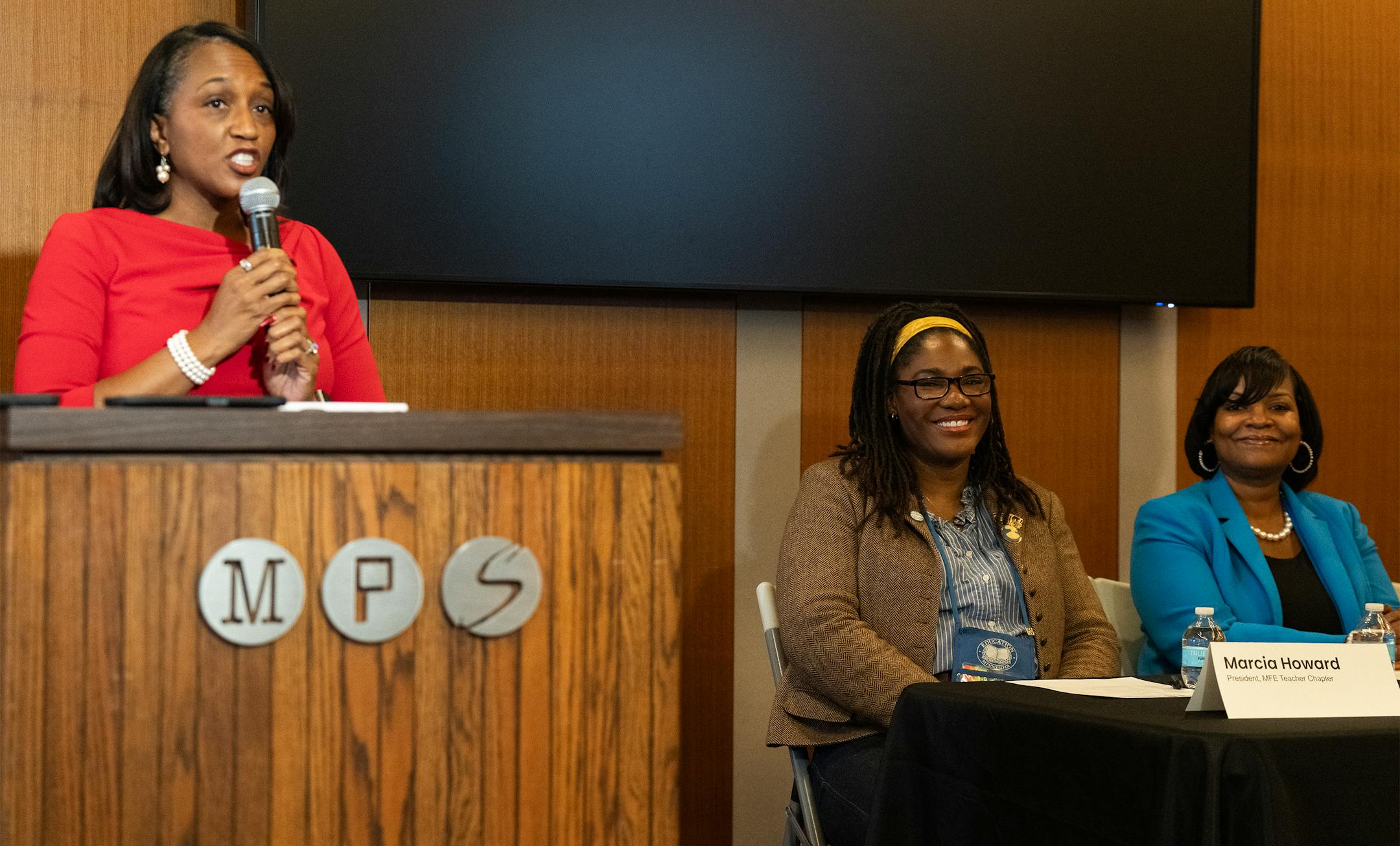
Minneapolis Public Schools Superintendent Lisa Sayles-Adams spoke Monday about a tentative deal with the teachers union as Marcia Howard, center, president of the teacher chapter of the Minneapolis Federation of Educators, and Catina Taylor, president of MFE's education support professionals chapter, looked on. (Richard Tsong-Taatarii/The Minnesota Star Tribune)

Negotiations began in April on three separate union contracts that expired June 30 and cover more than 4,300 employees. But after the union voted last month to authorize a strike, the pace began to quicken last Wednesday, with the union issuing daily updates, reporting that progress was being made. Still, teachers and supporters continued to mobilize and on Thursday, they marched with picket signs at sites across the district.

A new parents group — Minneapolis Families for Public Schools (MFPS) — also bolstered the union’s efforts, filling district headquarters with hundreds of people on Friday to urge that the district to do all it could to meet the federation’s demands.

Last week’s bargaining came without the input of an outside mediator — just negotiators for the two sides, plus school district staff. Catina Taylor, president of MFE’s education support professionals, said Monday that a new collegial spirit took over to help seal a deal.

Now, she added, “we will start breaking the past practices of being adversarial toward one another and building better relationships so that we could get these contracts done for our students and staff a little bit more faster, easier and smoother.”

School Board Chairman Collin Beachy said: “Our educators deserve respect, our students deserve stability and our community deserves confidence that we are responsible stewards of the public trust. This agreement delivers on all three.”

The tentative agreement includes:

  • Pay raises: Teachers will receive a 2% pay raise this year followed by a 2% raise in the 2026-27 school year. Pay steps are also being condensed to allow teachers to reach the top of their salary schedule faster. Education support professionals (ESPs) will receive a lump sum of $750 to $1,750 based on their years of experience as well as a 3% raise in the next school year and receive 14 days of full pay for days when school isn’t in session during school year breaks; they’ll also get 15 minutes a day for lesson planning. Adult education teachers will receive the same salary as teachers, giving some a pay raise of more than 30%.
    • Smaller class sizes, with lower caps at schools with 70% or more students qualifying for food assistance. No middle or high schools will have more than 38 students in a classroom.
      • Smaller special education caseloads to give students more staffing.

        The district and union had been at odds for months over the issues, with the district saying it couldn’t afford the union’s proposals — while adding that space in some schools was too tight to make the union’s class-size proposal work. (Minneapolis and St. Paul are the only school districts in the state with negotiated class-size caps in union contracts.)

        On Monday, the district reported facing a projected shortfall of at least $20.5 million in 2026-27 — this after balancing its $75 million shortfall this year through a combination of cuts plus the use of about $15 million in rainy-day funds. The union had suggested that the district dip into reserves again to settle the contract.

        Marcia Howard, president of MFE’s teachers’ chapter, said the two sides began talking earlier than usual with hopes of finalizing an agreement “before the snow flies.” At the same time, she said, they were hearing from outside voices who opined about the “travails” of the school district.

        “That noise has sort of deafened us to what was great about Minneapolis Public Schools, about our educators, about our families, about all the people who choose to move to this city,” Howard said. “And we had to sit across from each other at a table and remember who we are. And that took a little more time than we thought it would.”

        Superintendent Lisa Sayles-Adams looked out at a roomful of district and union leaders on Monday, and added: “This was an all-hands-on-deck and I’m very, very proud of you all, and I’m excited to see where we’re going to go together and how all of our children will prosper.”

        about the writer

        about the writer

        Anthony Lonetree

        Reporter

        Anthony Lonetree has been covering St. Paul Public Schools and general K-12 issues for the Star Tribune since 2012-13. He began work in the paper's St. Paul bureau in 1987 and was the City Hall reporter for five years before moving to various education, public safety and suburban beats.

        See Moreicon

        More from Minneapolis

        See More
        card image
        Shari L. Gross/The Minnesota Star Tribune

        The nonprofit grocery store opened in 2017 to serve a neighborhood deemed a food desert.

        card image
        card image