As strike threat looms, Minneapolis teachers union leans on new parents group to back its demands

Some parents question why teachers and district are at odds so soon after a 2022 strike.

The Minnesota Star Tribune
November 8, 2025 at 11:00AM
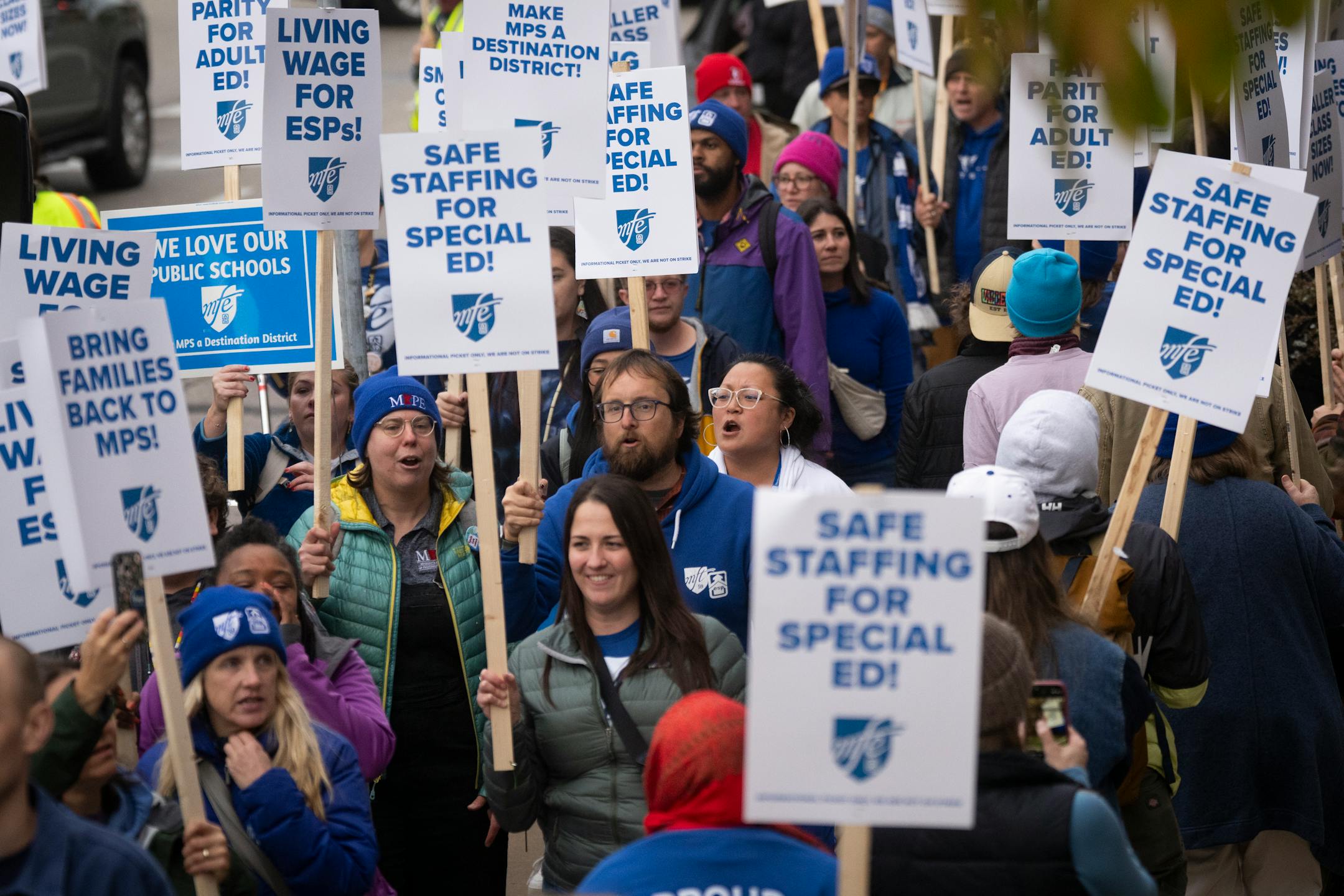
Hundreds of people marched after rank-and-file members of the Minneapolis Federation of Educators voted to authorize a strike last month. (Renée Jones Schneider/The Minnesota Star Tribune)

Minneapolis has the threat of a teachers strike looming for the second time in three years, and some parents — still with hard feelings about the last walkout — could see their lives disrupted anew.

But this year, teachers also are leaning on a new organized group of parents and other family members — Minneapolis Families for Public Schools (MFPS) — that has insisted the district meet the union’s demands.

As the district and union negotiators continued talks Friday aimed at averting a Tuesday strike, both sides said they’re committed to doing all they can within reason to shrink class sizes, strengthen special education staffing and pay competitive salaries.

The new parents group bolstering the union’s efforts said it’s in it for the long haul, and it includes more than 450 people with teams at 22 schools. The group rallied at school district headquarters Friday afternoon.

But parents elsewhere question why the teachers and district are at odds so soon after a 2022 strike that lasted for nearly three weeks.

Negotiations began in April on three separate Minneapolis Federation of Educators contracts, which expired June 30 and cover more than 4,300 employees.

The district faces a projected shortfall of at least $25 million in 2026-27, according to a school board presentation in June.

The two sides were about $20 million apart on their respective class-size proposals, according to the district, which added it would have to make significant staff cuts and scale back or eliminate programs and services if it accepted the union’s offers.

The federation has countered that the district should tap its budget reserves and funds earmarked for outside contracts.

‘Why are we here again?’

The strike threat issued last week has unnerved some parents who had kids in school when teachers picketed for nearly three weeks in 2022, the second strike in the district’s history.

In 2024, the two sides reached an agreement just before a strike authorization vote was slated, giving teachers their highest pay increase in 25 years.

Now, in southwest Minneapolis, parents not affiliated with MFPS who have seen families leave the district for private schools and neighboring school systems say they’ve heard others ask: “Why are we here again? Why are teachers demanding money when it just isn’t there?”

Carly Beetsch, a parent with two children at Burroughs Elementary, counters: “It seems to me there has to be a better solution than unequivocally saying there are no dollars,” she said this week.

The 2022 strike came on the heels of distance learning during the COVID-19 pandemic and a deeply unpopular district redesign, leaving some families with “the feeling that nothing was going right for their children,” said Annie Meister, a former district teacher who volunteers at Kenwood Elementary and has two children at the school.

She backs the union’s contract requests and says students need the consistency and the enrichment opportunities that are part of each school day.

“A strike can cause more inequity for those who need to go to school,” Meister said. “It can exacerbate the inequities of children from low-income homes.”

Lara Bergman, a Montessori educator who ran unsuccessfully last year for the school board seat representing southwest Minneapolis, recalled speaking with a Linden Hills resident who had pulled her kids to go to Edina schools during the 2022 strike.

“She told me, ‘It’s not much better (academically and programmatically), but at least I know the teachers won’t go on strike,’” Bergman wrote in a text message.

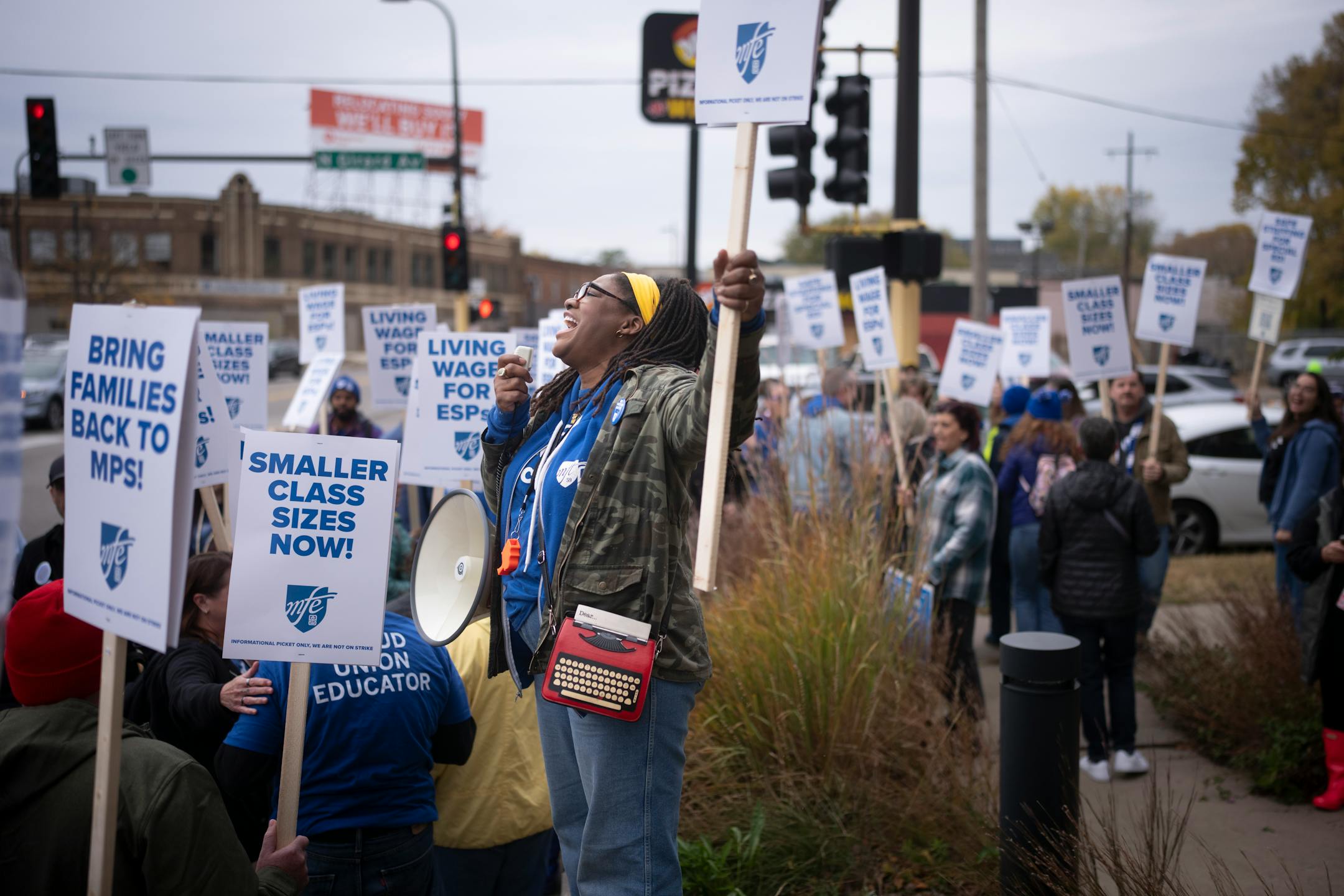
Marcia Howard, president of Minneapolis Federation of Educators, leads a chant during a Minneapolis Federation of Educators rally Oct. 28. (Renée Jones Schneider/The Minnesota Star Tribune)

Tapping parents for support

MFPS members sat in on public bargaining sessions in the spring, and in the past three weeks members of the group contacted district leaders by the hundreds to implore them to accept proposals they believe “offer a vision for stabilizing our district and a clear road map to make public schools” the best choice for parents, said Laura Proescholdt, communications director for TakeAction Minnesota, a progressive political advocacy nonprofit that has teamed with MFPS.

The group said four Minneapolis school board members — Abdul Abdi, Greta Callahan, Adriana Cerrillo and Joyner Emerick — signed its commitment to support demands for smaller class sizes and smaller special education and English language learner caseloads.

MFPS’s involvement comes after parents also were more involved in teacher contract negotiations in St. Paul. That district’s teachers union expanded its negotiation strategy more than a decade ago to add class-size limits in contracts and other measures, and the union relied upon parents to support its strategy. Other unions elsewhere also have enlisted families at the start of bargaining cycles to help craft contract requests and then turn out later for rallies and other work actions.

St. Paul teachers went on a pandemic-shortened strike in 2020 and settled a new contract this summer.

In Minneapolis, Rob Aspholm, a parent leader with MFPS, said this week that the group’s origins can be traced to the 2022 teachers strike. Parents and caregivers who supported the contract proposals then realized “we didn’t really have a vehicle for expressing that support,” he said.

Now, Aspholm and others cite specific examples of overcrowding in their children’s classrooms and what they describe as the district’s “whack-a-mole strategy” of easing pressures in schools where well-connected parents organize and speak out the loudest — while those who lack influence are left to “languish.”

MFPS backs a union proposal to create a committee at every school to resolve class-size cap violations, ensuring uniformity districtwide, Aspholm said.

And parents, in the process, would have a seat at the table, supporters say.

“Educators don’t want to go on strike and families don’t want the schools to be closed,” Aspholm said. “But these are the things we need to see in our schools, and we’re fully committed to those things, even if it comes to a labor stoppage.”

about the writer

about the writer

Anthony Lonetree

Reporter

Anthony Lonetree has been covering St. Paul Public Schools and general K-12 issues for the Star Tribune since 2012-13. He began work in the paper's St. Paul bureau in 1987 and was the City Hall reporter for five years before moving to various education, public safety and suburban beats.

See Moreicon

More from Minneapolis

See More
Archbishop Bernard Hebda blessed those gathered as he prepared to enter the cathedral.
Glen Stubbe/The Minnesota Star Tribune

Archbishop Bernard Hebda’s statement comes after Gov. Tim Walz warned of a possible surge of ICE agents in Minnesota in the next two weeks.

card image
card image