The greatest challenge the Lakers faced in Minnesota was that they never really had a permanent home. NBA games were played in the St. Paul Auditorium, the Minneapolis Auditorium and the Minneapolis Armory — and the team often played in more than one facility during the same season. Practices were held in college gyms and, from time to time, in the gym of what was then the Minneapolis Catholic Boys Home.
But things were evolving around the nation, and those developments affected our local scene. In 1960, the ownership group of the Lakers, led by Bob Short and his lawyer Frank Ryan, acquired most of the shares of the Minneapolis Basketball Corporation from the minority shareholders (for about $50,000) and moved the team to Los Angeles. I recall the vitriol that followed. My mother received a phone call from someone who identified himself as a Minneapolis Police officer, informing her that her husband, Bob Short, had been in a plane crash, with the loss of all lives. Even back then fans saw sports franchises as community assets, not businesses.
Then in 1961 Calvin Griffith and his family, the majority owners of the historic Washington Senators baseball franchise, moved west. The Senators were interested in Minnesota because of the existence of the Metropolitan Stadium, built in 1955 to attract a major league baseball team. The original focus had been on the New York Giants, but the Twin Cities lost that franchise to San Francisco. So as fate would have it, Calvin Griffith took the plunge and moved his team to Minnesota as the Twins.
In the early years, the Twins struggled, primarily with the weather. Some may remember the first homestand at Met Stadium, where helicopters were employed to dry out the field, recently covered with heavy rain and snow.
The Twins soon enjoyed success, winning the American League Pennant and getting to the World Series in 1965, only to lose to Sandy Koufax and the Los Angeles Dodgers in seven games. They also hosted the All-Star Game that year. But by the 1970s, Met Stadium was considered “outdated.” The results on the field were lackluster and there was talk about the franchise moving. In response, a group of civic boosters from the business community succeeded in getting the Hubert H. Humphrey Metrodome built for $55 million. It opened in 1982 without any air conditioning as the home of the Minnesota Twins, the Minnesota Vikings and the University of Minnesota Golden Gophers football team.
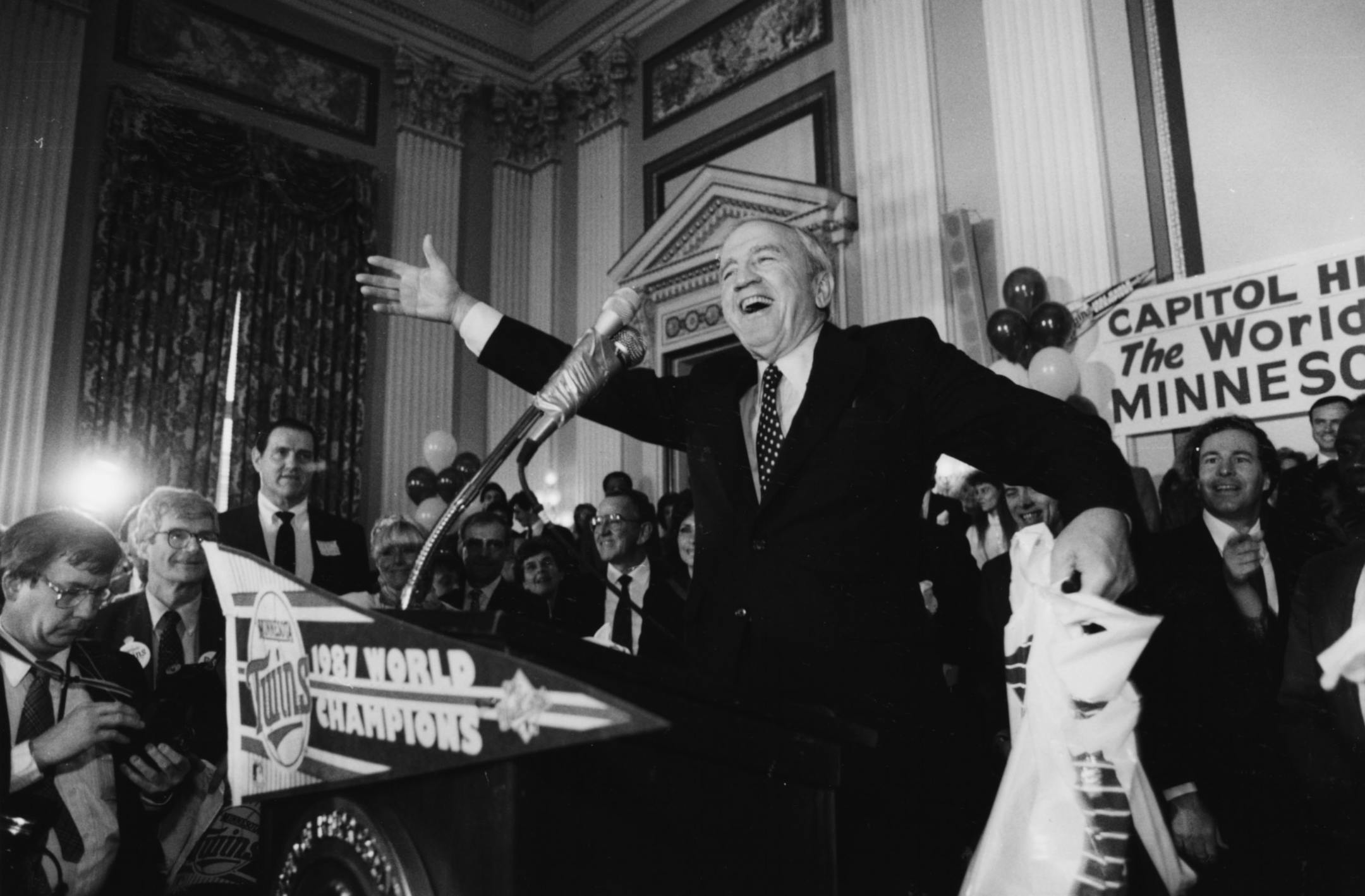
In the early years at the Metrodome, the Griffith organization struggled as it relied on income from the Twins to support the business. In 1984, largely to prevent loss of another sports franchise, Carl Pohlad bought the team from the Griffiths for approximately $40 million. The first few years under Pohlad were also a struggle. In 1985, the Twins won 77 games and lost 85. In 1986 the results were even worse — the Twins’ record was 71-91, and over those two seasons the Twins had four managers.