
Olson: Security at the Minnesota Capitol: Lock doors, ban guns and check bags

A violent summer shows an overdue need for tighter statehouse controls at the doors and a higher level of safety.

Columnist Icon
The Minnesota Star Tribune
August 3, 2025 at 1:00PM
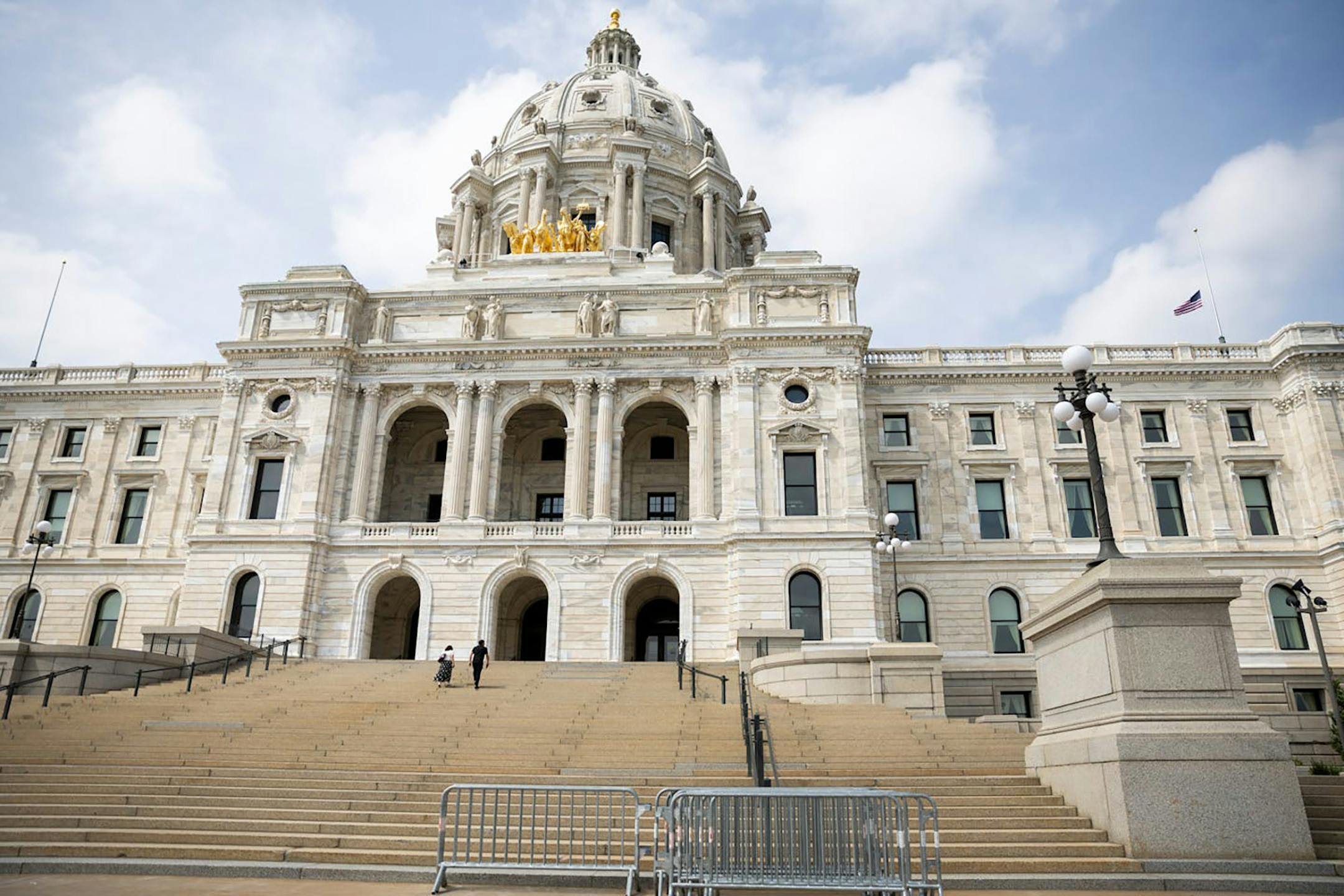
The Minnesota State Capitol in St. Paul on June 15. (Rebecca Villagracia/The Minnesota Star Tribune)

Opinion editor’s note: Strib Voices publishes a mix of commentary online and in print each day. To contribute, click here.

•••

The break-in at the Minnesota State Capitol building last weekend is far from reassuring for many who remain unnerved by the fatal violence of June 14, when State Rep. Melissa Hortman and her husband Mark were slain in their home, allegedly by a politically motivated gunman.

We had been led to believe that security in and around the Capitol complex had tightened after the attack on the Hortmans and the nearly fatal shooting of Sen. John Hoffman, DFL-Champlin, and his wife, Yvette Hoffman, on the same day.

We’ve now learned those were false assurances. Frankly, that’s both frustrating and terrifying.

Most who routinely enter the Capitol believed until recently that the Minnesota statehouse was a relatively secure place, as public access is limited to a few entrances. Those of us who work there, including journalists, have ID badges, pass cards and keys to enter the buildings.

But the sense of security created by cards and keys is illusory. If I forget my access card, I know I have to walk around the grounds to find an open, unlocked public entrance, then implore a colleague to open a door to the locked press room.

Last weekend, a man believed to be mentally distressed was able to prop open a Capitol door with a simple wedge, which remained in place, undetected by security staff, for hours. Later the same man reportedly returned and entered not just the building, but the supposedly secured Senate chamber where he was found naked, seated on the president’s chair, claiming to be the governor. (He’s been charged with second-degree burglary, but to date no security staff has been disciplined or relieved of duty for their lack of oversight.)

That prompts the question: Why? A summer that has produced fatal political violence, and now the spectacle of a naked intruder in the Senate chambers, also reveals a vulnerable security apparatus lacking an urgent sense of accountability.

At a news conference last week, Capitol security officials declined to say how the man was able to get into the Senate chamber. What we did learn from Department of Public Safety Commissioner Bob Jacobson and the State Patrol, which oversees Capitol security, is that the state has entered a contract for an independent, third-party review of the security breach.

Jacobson informed us that the review will not be “about pointing fingers” but obtaining an “outside perspective. Someone who will ask the hard questions and help us see what we might not be seeing internally.”

As someone who routinely works at the place, I offer my independent review. Why don’t we start by limiting public entrances, screening for weapons and banning guns?

If the Hortman assassinations and the break-in don’t jolt us from our smug stasis about security, what will it take?

The first question a reporter asked Jacobson at the news conference focused on possible new restrictions. It was a simple question: What was stopping him from immediately restricting public access to one entrance with a security checkpoint and a metal detector?

His response reflected no sense of urgency:

“Our preference is to work with the legislative partners. Our preference is to work with those that are utilizing the Capitol. Safety is, continues to be, our No. 1 priority,” he said.

Unfortunately, Minnesota is far from alone in recent attacks and threats against public officials. But Minnesota remains an outlier in terms of security. As of 2021 only 13 states, including Minnesota, didn’t have metal detectors at the Capitol doors, according to the Council of State Governments.

The Capitol is often called “the people’s house.” It’s open to everyone from lawmakers to children on school field trips. Finding the proper balance between openness and security is a challenge.

The past two months should have changed the security calibration at the Capitol. Our leaders must find the courage and fortitude to understand that public security is a core purpose.

Are metal detectors an annoyance? Sure. But have you been to the State Fair or U.S. Bank Stadium? You walk through a metal detector. You leave your guns at home because they’re banned in those busy, public spaces.

The same should be required of those who visit the Capitol.

Ramsey County Sheriff Bob Fletcher is the rare official who has been consistently candid about the security needs at the Capitol.

“As it is right now, a person could carry a couple automatic weapons with extra magazines in a bag into any entrance of the Capitol and walk to the gallery,” he said, referring to the public seating areas overlooking the House and Senate chambers. “That’s not a way to run government, where people have to be in fear of who’s bringing weapons in.”

But Jacobson, our public safety commissioner, wouldn’t take a position himself. Instead, he told us to save the date Aug. 20 for a meeting of the Advisory Committee on Capitol Security, the panel chaired by Lt. Gov. Peggy Flanagan.

Unfortunately, putting our faith in that committee’s influence might prove foolish. The 2025 Legislature agreed to spend just $2 million of the $40 million in security enhancements recommended by the committee years ago.

And yet somebody was clearly considering metal detectors when the state spent more than $300 million on renovations completed in 2017. The Capitol building’s walls were wired for metal detectors as part of that effort.

The wiring is there. Let’s accept the inconvenience of screenings and limited entrances. It beats the nightmare of the alternative.

about the writer

about the writer

Rochelle Olson

Editorial Columnist

Rochelle Olson is a columnist on the Minnesota Star Tribune Editorial Board focused on politics and governance.

See Moreicon

More from Columnists

See More
card image
Yuri Gripas /Tribune News Service

Congress is a co-equal branch of government and must provide oversight on the use of the U.S. military ― and the possibility of war.