The making of J.J. McCarthy and the big business behind becoming an NFL quarterback

September 7, 2025
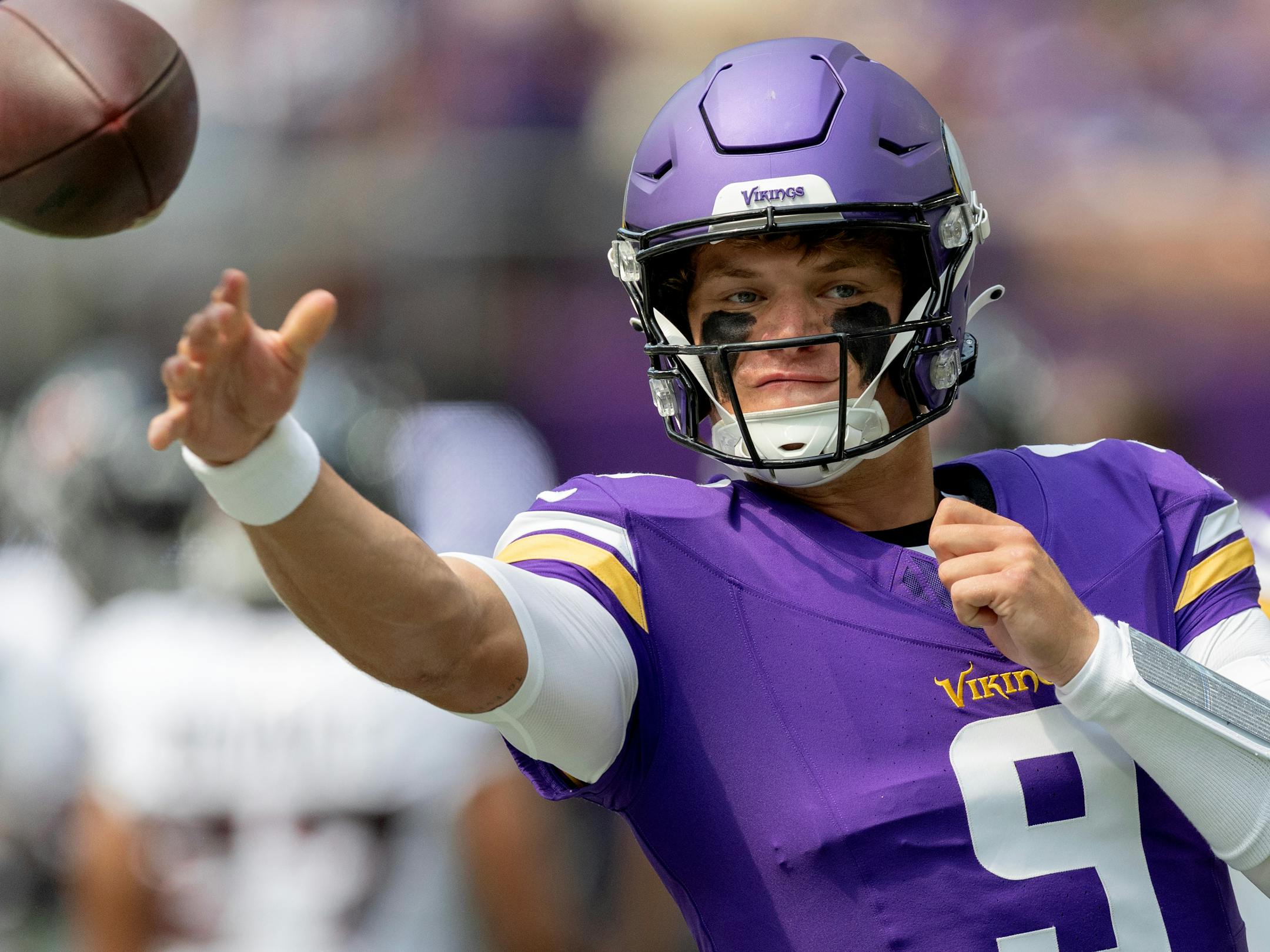
J.J. McCarthy's longtime personal coach says being a quarterback is "just part of his fabric." (Carlos Gonzalez/The Minnesota Star Tribune)

Is the Vikings’ new QB a product of a booming coaching industry, or was he destined to thrive in it? Either way, he’s a beacon for hopeful Vikings fans and an archetype for aspiring young players.

The Minnesota Star Tribune

They did it all: competitive dance and cheer tournaments for daughters Caitlin and Morgan, thrice-weekly private quarterback coaching sessions and elite 7-on-7 tournaments in the Sun Belt for son J.J. The 1,800-square foot ranch house with the one-car garage was good enough; paying for college might mean taking out loans. But Jim and Megan McCarthy, of La Grange Park, Ill., had decided long ago their kids’ passions would get their investment.

“And if Mom and Dad have to work until eternity,” Jim McCarthy said, “so be it.”

J.J. had it all: the rambunctiousness that made on-field chaos feel serene; the pristine mechanics that led his QB coach to ask what Faustian bargain his parents struck to get them; the drive that would not be sated by a mere all-metro selection. After his parents asked about his goals following his first youth football championship, fifth-grader Jonathan James McCarthy said he wanted to be one of the best quarterbacks in the country. When told how much toil that would require, he simply replied, “Let’s go.”

“There’s nothing you can’t do if you’re willing to work for it,” he said. “The best engine fuel for that is the joy you have every day doing it.”

Did the system — the network of private instructors, prestigious camps and elite programs that now produce so many of the nation’s quarterback prodigies — make J.J. McCarthy? Or was he wired, innately and uniquely, for the decade-plus journey from La Grange Park to a national championship at Michigan and then to the top 10 of the NFL draft?

Whatever the case, the Vikings quarterback will make his NFL debut Monday night at Chicago’s Soldier Field, where he saw his first game at age 4. He is set to live out the childhood fantasy of millions, after successfully traversing the road that seems to have become both more complex and more essential for kids who dream of being NFL quarterbacks.

The quarterback development industry has boomed, with families hiring private instructors for kids earlier than ever and high schoolers building offseason schedules on year-round training, regional and national camps and tournaments. Greg Holcomb, McCarthy’s QB coach at Next Level Athletix in the Chicago area, estimates he has about 75 clients; many ramp up in middle school, while some are as young as 6.

“Parents bring kids in earlier and earlier,” he said. “I used to turn them down, and then I’d watch my competition take them.”

ADVERTISEMENT

Former Augsburg quarterback Quinn Frisell founded 612 Quarterbacks in 2021 while he was student teaching at Southwest High School in Minneapolis and preparing to play in Europe. He began with three QBs in St. Cloud, Jordan and Prior Lake, charging $10 a session and losing money on gas. This summer, he worked with more than 150 kids, either through $125-an-hour private sessions or small-group sessions that run $50 per hour per quarterback. He has made it his full-time job, launching a second location in Arizona. This year, he worked with Hall of Fame quarterback Kurt Warner. Even Vikings coach Kevin O’Connell’s 10-year-son Kaden, who has started playing quarterback in flag football, has worked with Frisell several times.

“It’s trying to give quarterbacks an opportunity, outside of their short three-month [school] season,” Frisell said. “It’s not only QB recruiting in Minnesota — because we know it’s not a hotbed — but taking that JV quarterback to varsity. Little wins like that are huge."

Vikings coach Kevin O'Connell has had a hand in every phase of quarterback development, from his days as a New England Patriot, left, to his work as a passing game coordinator in Washington, right. (Michael Dwyer and Mark Zaleski/The Associated Press)

‘The space is flooded now’

There’s nothing new about gifted young QBs seeking extra training; O’Connell, now 40, remembered his father, Bill, driving him two hours from San Diego to Mission Viejo to work with Mark Sanchez and Jordan Palmer under coach Bob Johnson.

The Vikings coach has had a hand in every phase of quarterback development, from his days as a player to his work as a QB trainer and broadcaster before he started climbing the NFL coaching ranks. Asked where he’s seen it change, O’Connell pointed to social media, where quarterbacks post workout clips to attract college recruiters or line up name, image and likeness deals, and new coaches pop up all the time.

“Maybe it’s tied to the fact you can earn a real income now,” he said. “It’s not just about scholarships anymore, and that’s transferred even more into the private space. There’s more opportunity financially for the player, and naturally more opportunity for people to help the player improve.

“The space is flooded now. Coast to coast, north to south, state to state, you can find somebody that will work with quarterbacks.”

It complicates the path for families, with proven instructors showing up in the same Google search as hucksters charging hundreds for a large-group session. Vikings QB coach Josh McCown and NFL Network draft analyst Daniel Jeremiah slow-played extra training for their own sons, unsure of its long-term benefit, especially if it discouraged multisport participation.

“Is it really a net win? It’s hard to say,” McCown said. “It’s hard to discourage anybody wanting to get extra work. It’s just who’s teaching them is critical.”

But with middle schoolers landing major scholarship offers (as McCarthy did from Iowa State and Indiana and Holcomb’s son Sam did from Michigan and Purdue), the QB development industry likely isn’t slowing down.

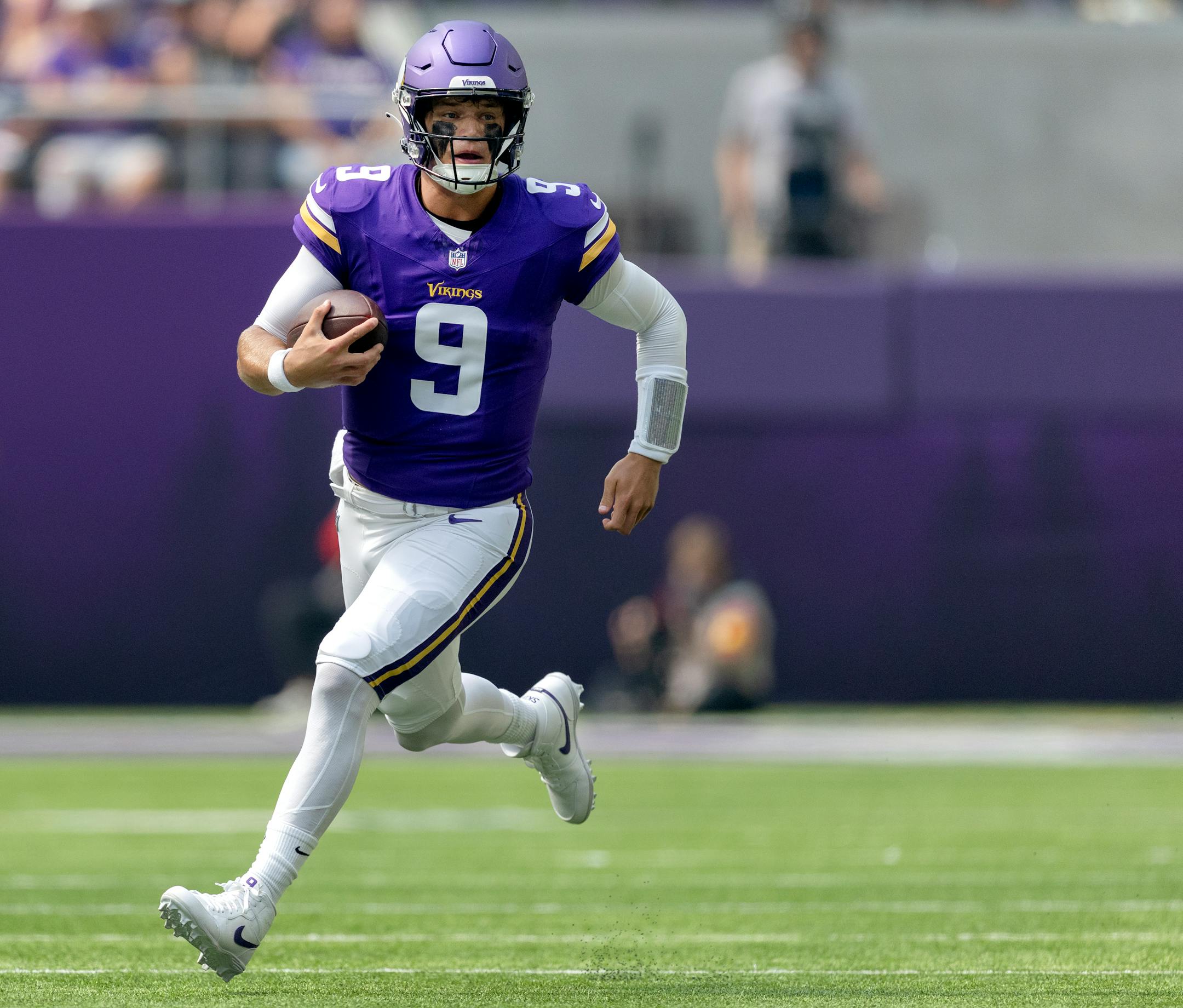
J.J. McCarthy (9) scrambles for a first down in the first quarter of a preseason game against the Houston Texans at U.S. Bank Stadium, Aug. 9, 2025. (Carlos Gonzalez/The Minnesota Star Tribune)

Its marks are all over McCarthy’s path to the Vikings.

He carried the ball lower after lessons with Mike Donato, the first coach the McCarthys hired when Jim realized he’d taught his fifth-grader as much as he could. The search for a coach in middle school taught McCarthy to trust his instinct about the fit with Holcomb, his private coach to this day. And his fall 2020 stint at IMG Academy in Bradenton, Fla., after Illinois’ pandemic-related postponement of the football season, meant he would leave home for the first time at 17 to play with teammates from around the country and cope with the depression that crept in through boarding school isolation.

He estimates that “75 percent” of his lessons at IMG were off the field.

“I learned a lot football wise, just because you’re doing it sunup to sundown,” he said. “But the dark place I was at, being able to dive into why I got there, and what I’m going to do to get out of it, that was the most profound lesson.”

Now McCarthy is a 22-year-old beyond his years: intellectually curious, emotionally intelligent, already comfortable living on his own and seemingly undeterred by the expectations that come with leading a team that went 14-3 last year or with becoming a father for the first time this month.

“It’s just part of his fabric: ‘I’m a quarterback in every single thing I do,’” Holcomb said. “There’s something different about his maturity level and preparation that matches his physical ability.”

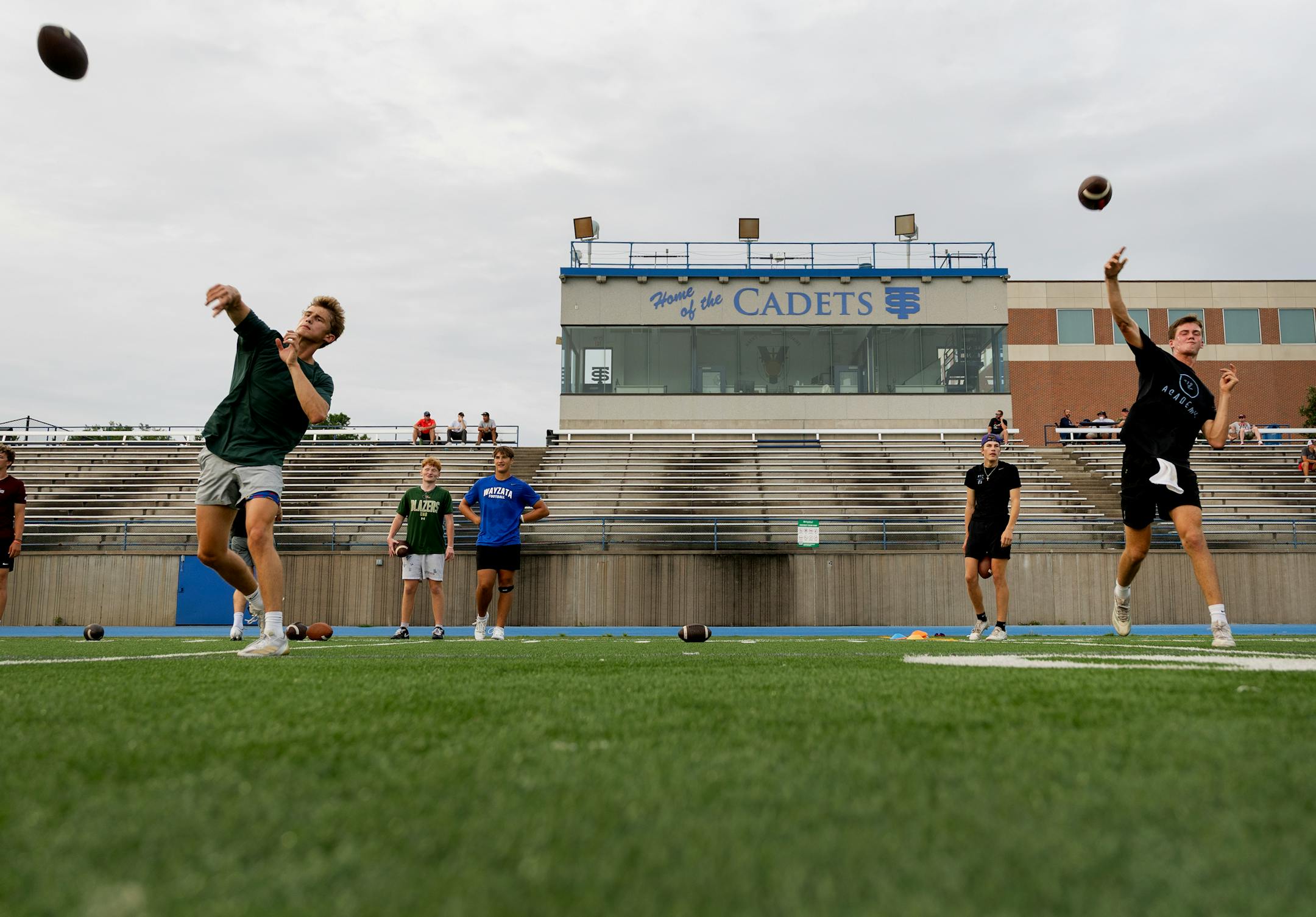
High school quarterbacks run through drills during a 612 Quarterbacks camp at St. Thomas Academy in Mendota Heights, Minn., on July 28, 2025. (Carlos Gonzalez/The Minnesota Star Tribune)

‘I want it done right’

Less than two miles from the Vikings practice facility, St. Thomas Academy’s stadium speakers throbbed with hip-hop beats on the final Monday evening in July, as four dozen quarterbacks took turns firing downfield shots to receivers streaking through hazy twilight.

This session is 612’s last large QB event of the summer, where 50 high school quarterbacks and 70 receivers, wearing shirts from more than 15 schools and coming from as far as Duluth, Iowa and Wisconsin, work out at stations before gathering for the “hole shot” competition that closes every practice.

The large-group workouts are the most informal of the 750-plus sessions Frisell led this summer, and they’re priced as such: Athletes pay $10 each to work out with Frisell and three other coaches, including Concordia (St. Paul) quarterback Logan Butler. Frisell keeps his instruction bite-sized and fast-paced so athletes can get as many reps as possible, while two videographers capture clips that athletes can post on social media or their Hudl pages.

The most frequent 612 clients take individual or small-group classes. Each winter, some of Minnesota’s top quarterbacks apply for 16 spots in the company’s $2,800 passing academy, which incorporates strength training, film study and on-field work into three-hour classes each Sunday for 15 weeks.

Annandale QB Michael Kovall books multiple weekly individual sessions with Frisell during the summer, with weekly maintenance sessions scheduled around his three sports (football, basketball and track and field) during the school year.

Kovall’s father, Annandale defensive coordinator Mark Kovall, estimates he’s spent $5,000 on extra training for Michael through high school. Michael has worked with Frisell for a year, and if he’d found him sooner, Mark Kovall said, he’d have booked even more training.

“He doesn’t let you slide. If you’re doing it wrong, he’ll correct you, and I love that,” Mark Kovall said. “[Michael]’s had other coaches where, as long as the ball comes out, they’re OK with it. But I want it done right.”

Those endorsements are Frisell’s livelihood; he markets on social media, but much of his business comes through word of mouth, from other clients or coaches he’s met while working on his father Dave’s staff at Belle Plaine.

Holcomb, a former Wisconsin-Oshkosh quarterback who had started an advertising career in Chicago, was jogging around a turf field one Sunday in 2012 when he offered a few tips to a middle-school quarterback named Jordan Skach, who was playing pickup football with friends.

When Skach’s mother approached Holcomb, he feared she would come to confront him. Instead, she asked if he could return each Sunday to work with him. The sessions grew as Skach thrived that fall, and as Holcomb fielded interest from more families, he realized he could leave his corporate job and make a living training quarterbacks.

“It was a huge blessing in disguise,” Holcomb said. “And then, it wasn’t long after that J.J. walked in the door.”

Skach and McCarthy started working with Holcomb in middle school, which is when interest in private instruction seems to spike. Belle Plaine quarterback Reed Creighton started with Frisell before seventh grade, to get an edge on two other QBs he’d be competing with in high school. When Vikings QB Max Brosmer sought a coach in sixth grade, Atlanta-based coach Quincy Avery, a former Minneapolis Washburn quarterback, gave him a free trial. Brosmer’s family hired Avery shortly after, and the two still work together. Cam Ward, the No. 1 pick in the draft by the Titans, said he started with Houston-based coach Darrell Colbert Jr. after eighth grade.

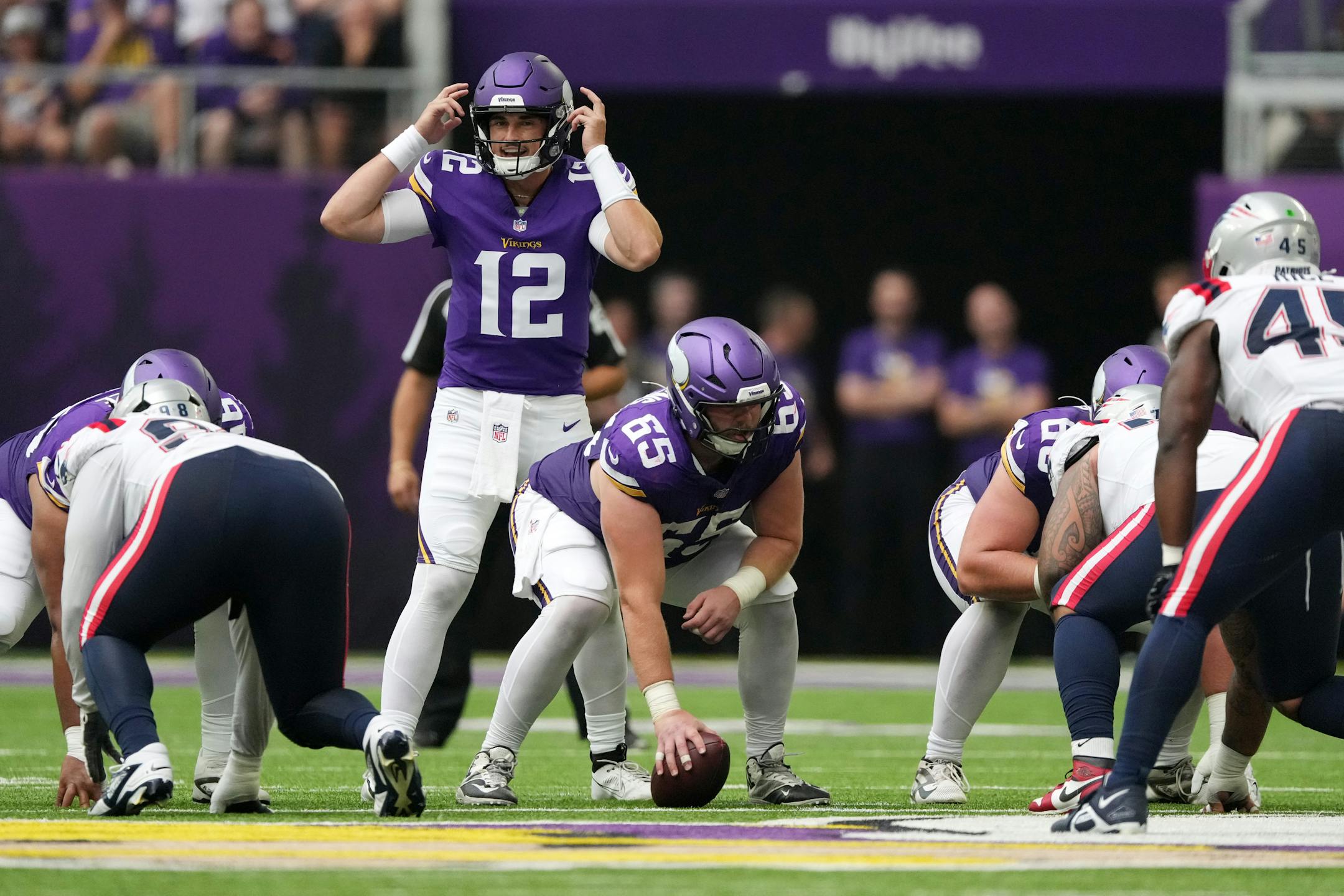
Vikings quarterback Max Brosmer (12) calls out from the line of scrimmage in the third quarter of a preseason game against the New England Patriots on Aug. 16, 2025. (Anthony Souffle/The Minnesota Star Tribune)

As more young athletes seek extra training, Brosmer worries about the ones who are left behind because of cost. He’s proud to work with Avery, he said, because he is willing to support kids who don’t have the means to pay for training.

“It’s so expensive nowadays,” Brosmer, 24, said. “There are third-graders having private coaches. I’m not sure how people do it, and it shows the business of football at such an early age. But that’s the world we live in. You’re getting income now as a high schooler, which is insane.”

Indeed, the potential for a payoff is hard to ignore: Of the six first-round QBs in McCarthy’s 2024 class, five were picked in high school for the Elite 11 camp, which selects the country’s best prospects from a series of regional tournaments. People told Holcomb he should start pursuing NIL deals for his 14-year-old son after he received scholarship offers.

“I’m like, ‘I don’t want my son dealing with that right now,’” he said. “Go ride your bike and hang out with your friends; don’t worry about getting paid from a trading card deal.”

When McCarthy found out about Sam Holcomb’s Michigan offer, he texted, “Congratulations. I want you to understand this means nothing. You need to keep working your butt off. Just promise me you’ll never get complacent.”

‘Adapt and keep rolling’

The night his Nazareth Academy team was denied a second straight Illinois state championship by Mount Carmel in 2019, McCarthy returned home around 10 p.m. and told his parents he was going to bed. Jim McCarthy replied: “I got you, bud. Love you.”

The next morning, J.J. left for a run in the damp, chilly November weather to clear his head. His parents checked his bedroom to find the whiteboard on his wall, which had been filled with scouting reports on Mount Carmel before the game, was wiped clean.

J.J., then a junior, had stayed up all night, writing the 37-13 score in one corner and the word “OVERRATED” in all capital letters in another. He drew a NFL shield in the middle, with a note that this pursuit “is not going to come easy.”

He was back in the weight room with his teammates a week later, vowing they would win another state title as seniors.

Then the pandemic brought sports to a standstill.

In July 2020, Illinois became the third state to move football to the spring. McCarthy had already committed to Michigan, hoping to graduate high school early and start college in January. He couldn’t do that if he played Illinois’ spring season, which would have no state tournament, which meant no championship for McCarthy and Nazareth to chase.

“That was the most difficult part,” McCarthy said. “Because it’s like, ‘All right, this isn’t happening, whether you like it or not.’”

Shortly after, he received a call from IMG Academy. He was familiar with the school after a trip there to work with former coach Adam Behrends. He’d never left home for long, even for camps. But IMG offered elite coaching, a national schedule, a chance to play with teammates from across the country and a weekly routine built around football.

His parents supported it, and Holcomb endorsed it. They left the decision up to him; he made it with a pragmatism more common in corporate strategy meetings than a 17-year-old’s brain.

J.J. McCarthy, the NFL’s youngest starting quarterback, said his experiences coping with depression and anxiety have helped him grow up and find power in his practice. He returns to both his hometown and the national spotlight on Monday night. (Carlos Gonzalez and Jerry Holt/The Minnesota Star Tribune)

“How can you adapt and keep rolling? It was an easy decision for me,” McCarthy said. “I knew I was going to get the toughest competition every single day, the best coaching. It taught me a lot about life and myself, too.”

Breakfast was at 6:30 a.m., with weigh-ins at 7 and practice from 8 to 10. The rest of the morning was for lifting and speed training, or meetings with dietitians and mental performance staff.

School was from 12 to 5:30 p.m., with students 6 feet apart and in masks. Dinner was at 7 p.m., followed by what students called “yard time” outdoors. When darkness fell, the kid whose parents signed him up for football and hockey to keep him from wrecking the house was stuck in his dorm room alone.

“It was extremely isolating,” McCarthy said. “I want to be around people; I want to just be doing something.”

His parents called regularly, and at least one of them made it to each of his games. When school officials said they wouldn’t permit the McCarthys to take their son out for dinner, Jim replied, “You’re gonna have a big ol’ problem if you don’t.”

But the monotony and loneliness wore on McCarthy. He sought out a strength coach “and a couple different mentors” while researching ways to cope with depression and anxiety. “He found meditation,” Jim McCarthy said, “and thank God he did.”

The common pregame sight of McCarthy sitting at the base of the goalpost — with legs crossed, hands folded, eyes closed and headphones on — traces back to those lonely days in Bradenton. There he began the meditation practice he still performs each day. He leaned on it again last year, when his torn right meniscus cost him a season for the first time in his life.

The darkness, as he looks back, was part of his training.

“I grew up a lot. I treat that as a special experience,” McCarthy said. “If you dig yourself out of a rut, that power you have is something you carry every single day.”

‘Chasing the feeling’

In conversations with his own son, O’Connell keeps returning to the same principle: It’s not worth it if you don’t enjoy it.

“You’ve got to love chasing the feeling of the first time you throw without really thinking about it, and you put it right in a spot only you know you were aiming for,” he said. “It’s like, why do people hunt? Why do people fish? It’s got to be enjoyable from that standpoint.”

Independently, McCarthy offered a thesis that’s uncannily close to O’Connell’s.

“There’s got to be some purpose behind it, whether it’s football, painting, being a doctor,” he said. “If you love it, you’re going to be willing to sacrifice a lot for it.”

Perhaps that’s the secret for J.J. McCarthy, the NFL’s youngest starting quarterback, returning to both his hometown and the national spotlight on Monday night as the hope of a fanbase still looking for its successor to Fran Tarkenton.

Was he built into a quarterback? Maybe he was born to become one.

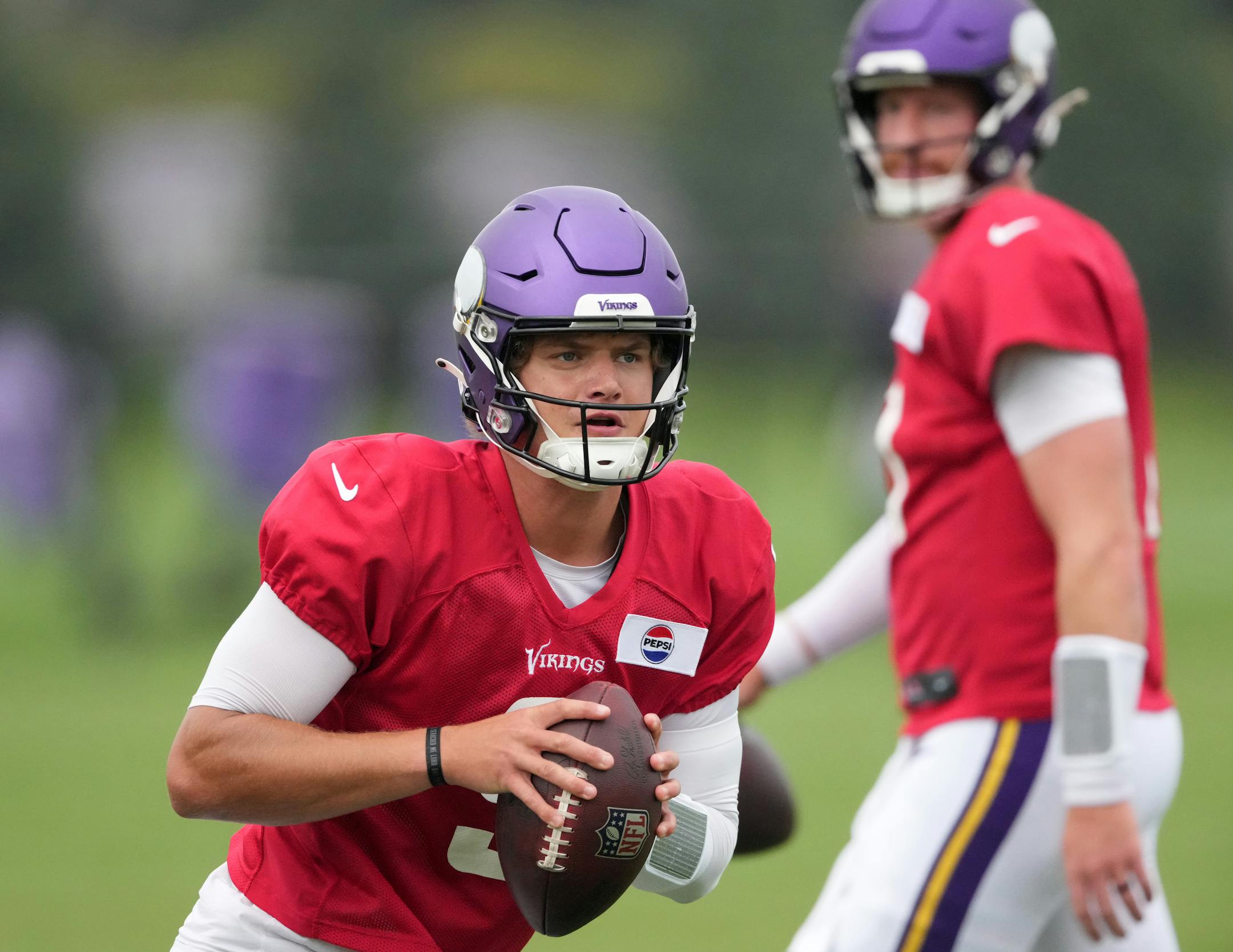
J.J. McCarthy (9) works out during practice Sept. 3, 2025, at the TCO Performance Center in Eagan. (Anthony Souffle/The Minnesota Star Tribune)

Sign up for the free Access Vikings newsletter to get exclusive analysis from Ben Goessling in your inbox every Friday. You can also subscribe to the “Access Vikings” podcast on Spotify, Apple Podcasts and YouTube.

about the writer

about the writer

Ben Goessling

Sports reporter

Ben Goessling has covered the Vikings since 2012, first at the Pioneer Press and ESPN before becoming the Minnesota Star Tribune's lead Vikings reporter in 2017. He was named one of the top NFL beat writers by the Pro Football Writers of America in 2024, after honors in the AP Sports Editors and National Headliner Awards contests in 2023.

See Moreicon

More from Vikings

See More
card image
Elizabeth Flores/The Minnesota Star Tribune

Vikings receiver Justin Jefferson said this season is among the most difficult of his career, but he wouldn’t call it a waste of one of his prime years.

card image
card image