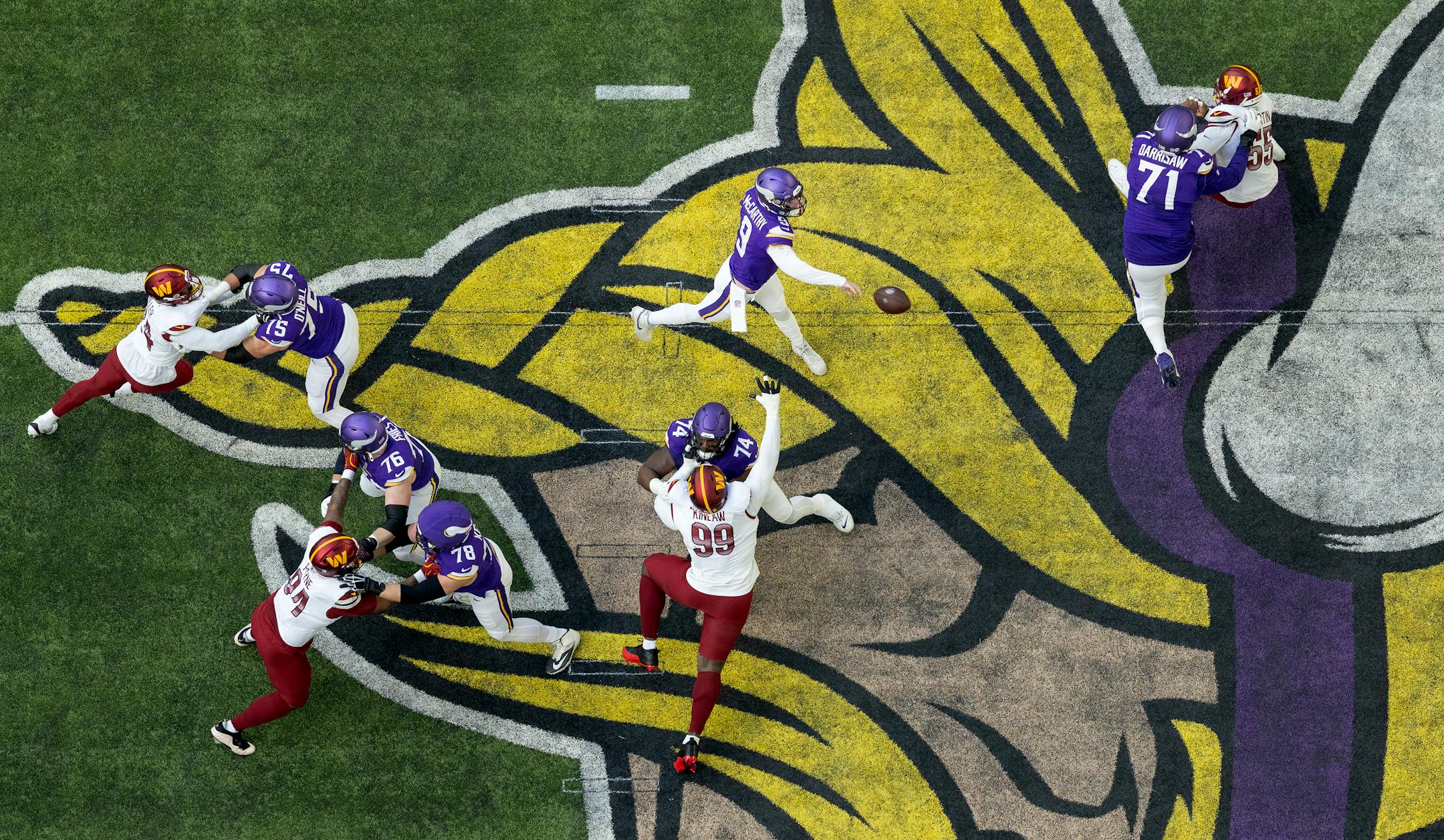
Can J.J. McCarthy make progress in the Vikings’ progression-based offense?

Tom Brady and Kurt Warner have criticized the pure progression scheme the Vikings and many other teams use for stunting young quarterbacks’ growth by not asking them to decipher coverages.

The Minnesota Star Tribune
December 13, 2025 at 1:00PM
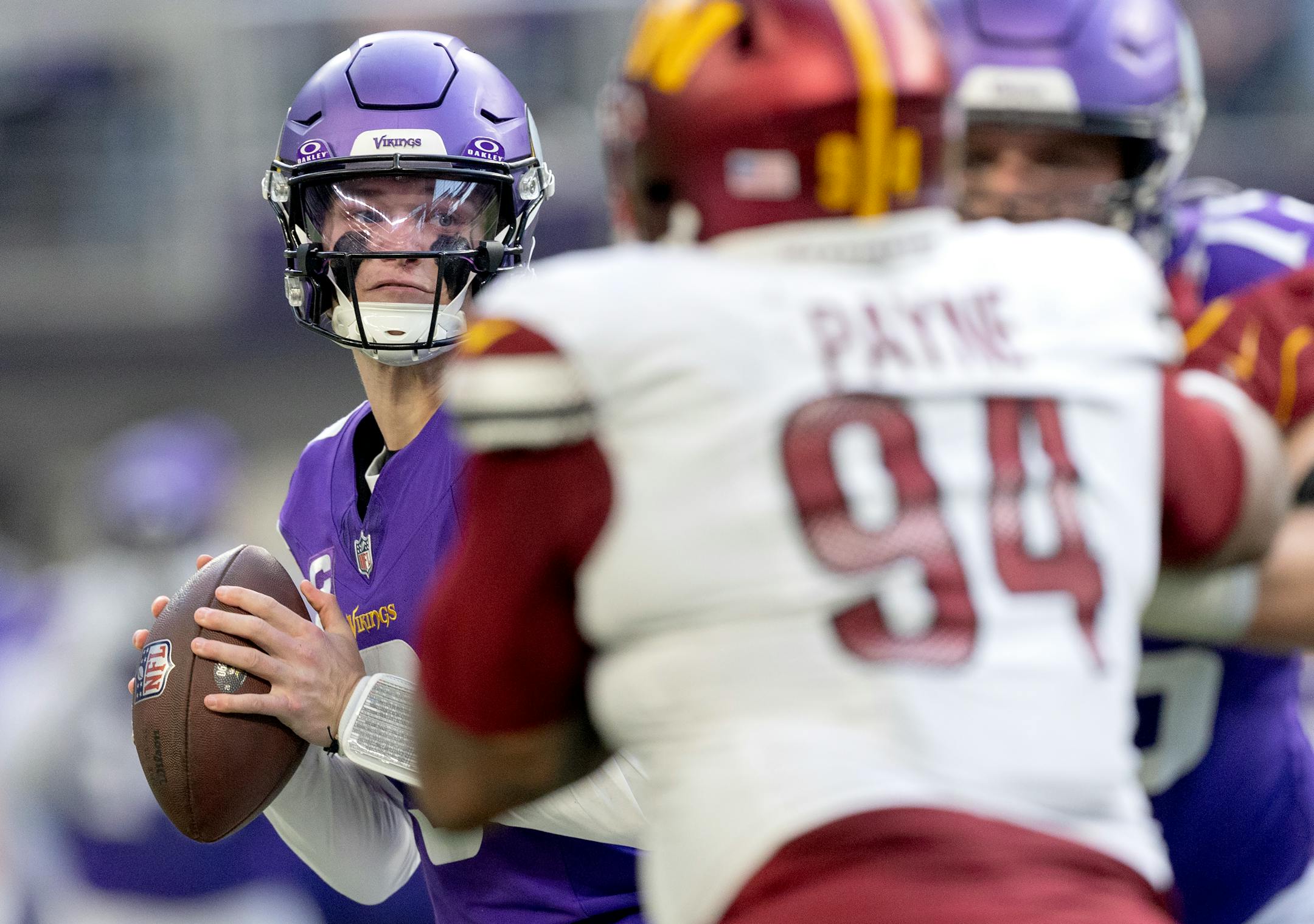
The Vikings' J.J. McCarthy is the NFL’s youngest starting quarterback, at 22, and facing defensive coverages that are more adaptive and intricate than ever. (Carlos Gonzalez/The Minnesota Star Tribune)

The Vikings faced a third-and-9 near midfield on the 10th play of their 98-yard drive against the Commanders last Sunday. They lined up with three receivers to quarterback J.J. McCarthy’s left, as Justin Jefferson ran a short motion from the slot toward left tackle Christian Darrisaw before breaking back out.

Jefferson was the first read on the play on an out-breaking route near the first-down marker, but cornerback Mike Sainristil took the route away. McCarthy saw Sainristil, his former teammate at Michigan, break on Jefferson and looked quickly to Jordan Addison on a corner route against safety Quan Martin. McCarthy got to the top of his drop and hitched once before firing a low 21-yard strike to Addison that Martin couldn’t reach. Immediately, Jefferson turned back toward McCarthy, pointed at the quarterback and clapped his hands.

“He ends up turning around and celebrating because he knows, ‘Hey, it was a loaded coverage look [toward] me, the cloud corner took me away, there’s a void behind me, J.J. threw it in rhythm and threw a great ball, and Jordan made the play,” coach Kevin O’Connell said Wednesday. “So the football intelligence is off the charts. We’ve seen every coverage known to man in that pure [progression] world. He plays football at a wildly elite level between the ears, and then his physical skill set, his impact on the organization, his impact on much more than just people in this building, is phenomenal.”

The coach’s multilayered answer, to a question about Jefferson’s leadership, touched on several pertinent themes about the Vikings offense in 2025. Jefferson’s celebration was actually the second play O’Connell brought up — after highlighting how Jefferson created space for T.J. Hockenson on a fourth-quarter touchdown by recognizing the Commanders’ coverage and widening his route — to praise how the receiver solves defenses to help his young QB and open space for others.

O’Connell’s mention of McCarthy focused on the quarterback’s ability to find space and throw on time (two keys of QB play in the Vikings offense) while delivering an accurate pass. And his mention of pure progression was a subtle glance at criticism that the system, which the Vikings and many other teams use, stunts quarterbacks by taking them through a fixed set of receiver reads rather than asking them to decipher coverages.

It’s all part of the gossamer world the Vikings inhabit in 2025, developing the NFL’s youngest starting quarterback against defensive coverages that are more adaptive and intricate than ever while cultivating support from veteran players like Jefferson and building a berm against unpleasant critique.
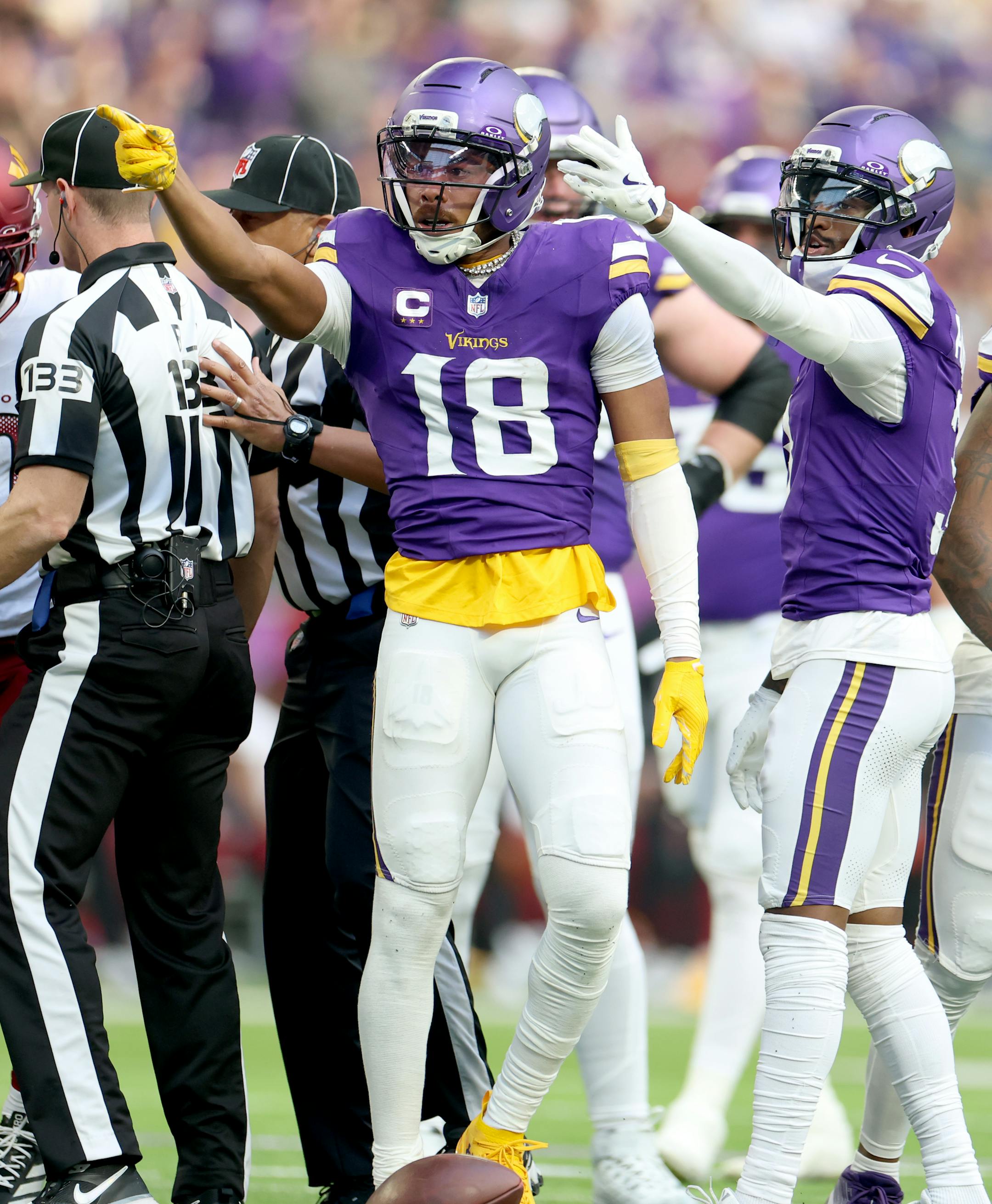
Vikings wide receivers Justin Jefferson (18) and Jordan Addison signal for a first down in the second quarter against the Washington Commanders at U.S. Bank Stadium on Dec. 7. (Elizabeth Flores/The Minnesota Star Tribune)

They beat the Commanders 31-0 to end a four-game losing streak as McCarthy had his most efficient game of the season, and will try to create some consistency in a high-profile finishing stretch, starting with a Sunday night game at Dallas.

McCarthy, who threw fewer passes in college than all but one QB in his 2024 draft class and missed his rookie year because of a torn right meniscus, is preparing for only his eighth start in a league that has traded violent collisions for duplicitous coverages as means of corralling passing games. At the same time, leaner, fast-twitch pass rushers explode off the ball, stealing precious tenths of seconds from young quarterbacks searching for coverage answers.

ADVERTISEMENT

“That rush gets to you quick. And they’re doing so many things on the back end that, you could figure out it’s Cover 2, but by the time you figure out it’s Cover 2, you’re on your back,” McCarthy said. “So it’s being able to process quickly post-snap and [confirm] the information that you gathered pre-snap.”

The NFL’s 2011 collective bargaining agreement shortened rookie contracts at the same time it truncated an offseason program that future Hall of Famers such as Tom Brady and Aaron Rodgers have praised as crucial to their development, condensing the amount of time teams have to prepare a quarterback before making a decision on his long-term future.

It leaves every team searching for solutions at a time when the college environment almost undercuts development. The Vikings hope their combination of talent around McCarthy, the scheme they are asking him to execute and the instruction they are giving him will help the 22-year-old resemble that solution toward the end of his first starting season.

“I feel like the emphasis for me, as I’m watching the tape and self-scout[ing] is, ‘How many times could I put it in play as quickly and efficiently as possible?’ ” McCarthy said.

What pure progression means

Of the 15 NFC champions since the start of the rookie wage scale, eight were teams whose highest-paid quarterback was on a rookie contract. The payoff for a team that can win with a young QB is obvious. If a team can pay $5 million or less for productive play at a position where the market rate is north of $40 million per season, that team can use the unclaimed salary cap space on veterans that help it become a quick contender. It’s one of the reasons why, after moving on from Kirk Cousins, the Vikings still went with McCarthy in 2025 despite the fact Sam Darnold won 14 games last year before becoming a free agent.

But starting a rookie QB means playing catch-up; McCarthy had some pure progression reads and similar route concepts at Michigan, but college quarterbacks simply aren’t asked to handle the offensive volume and defensive challenge they face in the NFL.

“It’s not only that,” said O’Connell, mentioning the NFL’s tighter hash marks. If you’re on the left hash in the NFL, there’s an extra 10 feet, 9 inches of space to the sideline.

“It’s harder to defend the middle of the field in college because there’s so much of it,” O’Connell added. And in the NFL, everything happens faster too."

Like many teams who hail from the family of offenses modernized by Kyle Shanahan and Sean McVay, the Vikings use pure progression reads to make the passing game more accessible. Rather than scanning defenses for weak spots in coverage while they drop back, QBs read receivers in a predetermined order, starting on one side of the field and working across to the other side. If the first receiver in the progression is open, the QB throws the ball; if he is covered, the QB moves on to the second receiver, and so on.

McCarthy and offensive coordinator Wes Phillips said the Vikings have some plays that require QBs to read coverage. But, Phillips added, “A lot of our dropback [passing game], I would categorize as a pure progression system.”

Vikings quarterback J.J. McCarthy said the team's progression-based system “is a great way to have an answer against every single coverage." (Carlos Gonzalez/The Minnesota Star Tribune)

There are alerts built in to certain plays, where QBs target a certain route based on a coverage look, and O’Connell said pure progression plays still require QBs to make coverage reads, eyeing individual players within coverages and attacking open space based on how the play is constructed.

“A lot of our concepts are simply: ‘Is he open? [If not], who took it away?’ ” Phillips said. “Who took it away will then put you to the next progression to the right place.”

For the Vikings’ young QBs, pure progression provides a starting point.

“It is a great way to have an answer against every single coverage, where you start and go 1-2-3-4,” McCarthy said. “With coverage-based reads, it’s kind of like, ‘OK, I got to make sure I diagnose and process this coverage in the right way, quick enough to be on time for that concept on that specific side.’ ”

Former quarterbacks like Brady and Hall of Famer Kurt Warner have criticized pure progression, with Brady saying on Fox this past week that it robs QBs of the autonomy they need to succeed in the NFL and Warner arguing it slows quarterbacks down, particularly if the timing of routes aren’t synced up with a passer’s reads.

But while the skill of reading coverages might not be fully developed in younger QBs, it’s also harder to master in an era where defenses thrive on deception, showing one coverage before the snap and morphing into another coverage as soon as the quarterback takes the ball.

O’Connell said he showed several clips of the Vikings defense in a team meeting this week where he only knew the coverage Brian Flores had called because he could see it on the defensive coordinator’s play card.

“If you paused it from the time the ball hits the quarterback’s hands to the top of his drop, you’d be hard-pressed to know what the coverage is,” O’Connell said. “I’m not going to say [that] didn’t exist back in the day. I don’t want to be that coach, either, because I have so much respect for people that have played this game.

“But you can throw the ball over the middle now. Back in the day when you had the Ronnie Lotts of the world, you didn’t throw the ball — no matter what coverage it was — if he was standing in the middle of the field."

As rule changes eliminated violent hits over the middle to protect players, defenses traded intimidation for disguise to constrain passing games over the middle. The risk now lies with the quarterback who throws an interception to a defender he didn’t expect, rather than a receiver leveled by a safety he didn’t see coming.

It’s why, even though quarterbacks aren’t reading coverages in a traditional sense, the secret sauce of pure progression is a QB who can use his eyes to manipulate defenders and survey coverages while throwing to a spot with anticipation. Matthew Stafford won a Super Bowl doing it with O’Connell as his offensive coordinator for the Los Angeles Rams; Jordan Love is having his best season doing it for a third year as Matt LaFleur’s starter with Green Bay.

As one NFL coach who has worked in pure progression schemes put it, the key question isn’t whether the receiver is open now. It’s whether he’s going to be open a split-second from now.

Getting that question wrong can lead to big mistakes. Getting it right can create the big plays the Vikings have thrived on in their best years under O’Connell.

“The first thing you always learn is a pure progression read,” backup quarterback Max Brosmer said. “Plays that are run in the NFL, you’re also running in sixth grade, where it’s an out [route] and crossers coming back to it. Where the quarterback takes it to the next level is where you can apply coverage principles. What is being stressed [in Minnesota], obviously, is making sure you can identify coverages and how you can manipulate defenders on the pre-progression.”

Practicing patience

Of the supports the Vikings have constructed for McCarthy, a reservoir of patience from a receiver of Jefferson’s caliber might be the most valuable.

Jefferson said he pointed at McCarthy and clapped after that third-and-9 play because “positive feedback is something that goes a very long way.”

This year with a new quarterback has taught Jefferson patience. He has never had fewer than 1,400 receiving yards in a season when he’s been healthy. Jefferson needs 190 in his final four games just to reach 1,000 for the year.

“It’s tough, because you want to win,” he said. “You want to be a big part of the offense, having all the yards and everything. But sometimes you’ve got to sacrifice that to be a leader.”

The hardest thing about it, Jefferson said, is “being a leader when things aren’t going well.” He has learned the space his routes can create for McCarthy, and the weight his words carry whether he’s using them to praise or criticize.

“Of course, there’s a lot to still learn, a lot to fix and clean up,” Jefferson said. “But when you see the confidence, the poise, the focus he carries himself with, he has the potential to be way bigger than he is.”

Sign up for the free Access Vikings newsletter to get exclusive analysis in your inbox every Friday and complete coverage of every game. Subscribe to the Access Vikings podcast on Spotify, Apple Podcasts and YouTube.

about the writer

about the writer

Ben Goessling

Sports reporter

Ben Goessling has covered the Vikings since 2012, first at the Pioneer Press and ESPN before becoming the Minnesota Star Tribune's lead Vikings reporter in 2017. He was named one of the top NFL beat writers by the Pro Football Writers of America in 2024, after honors in the AP Sports Editors and National Headliner Awards contests in 2023.

See Moreicon

More from Vikings

See More
card image
Carlos Gonzalez/The Minnesota Star Tribune

Tom Brady and Kurt Warner have criticized the pure progression scheme the Vikings and many other teams use for stunting young quarterbacks’ growth by not asking them to decipher coverages.

card image
card image