


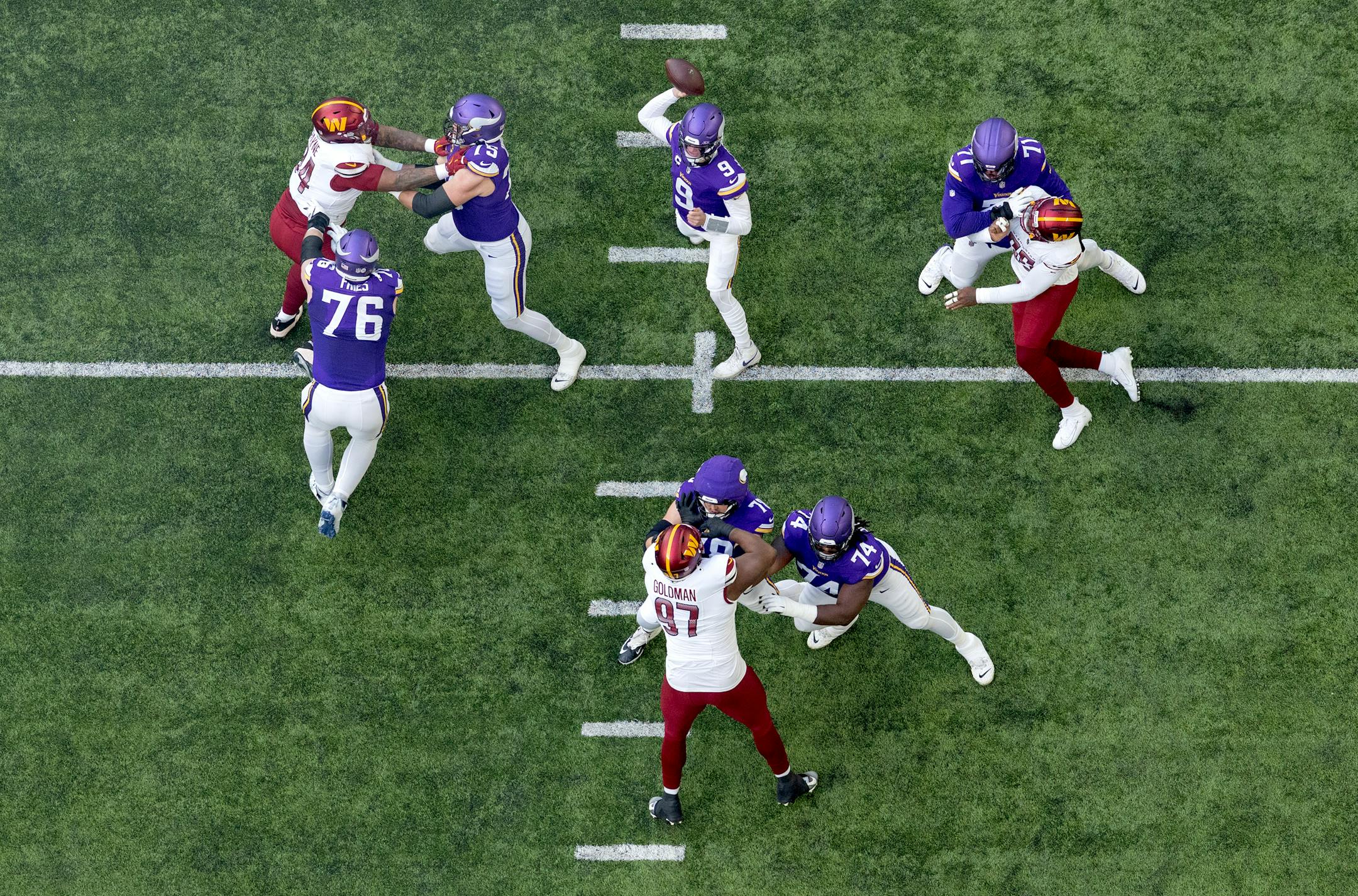
We should begin with the necessary caveats: The Vikings had all five of their preferred starting offensive linemen on the field for an entire game for the first time this season. They were playing at home. They had the lead for 56 minutes, 3 seconds after scoring a touchdown on the game’s opening drive. And they were playing a Washington Commanders team that had lost seven in a row, including back-to-back overtime games in different countries, and arrived at U.S. Bank Stadium with little to play for.
The conditions for the Vikings on Sunday were as pristine as they’ve been all season. General Manager Kwesi Adofo-Mensah talked before the season about building a team that could win “any type of fight”; the Vikings’ 31-0 win over the Commanders didn’t demand a great deal of resourcefulness.
But the Vikings, who had lost their last four games and scored six points in their last two before Sunday, weren’t in a position to quibble with how they secured this victory. And while a win over Washington might not earn them many style points, it came in a manner that has been rare for them under Kevin O’Connell but might actually work for them at this point in J.J. McCarthy’s tenure.
The Vikings ran the ball on 55.7% of their offensive plays, the highest single-game rate under O’Connell (according to NFL Next Gen Stats) and just the ninth time in the coach’s 64 regular-season games they have run more than 50% of the time. They made the runs count, gaining 162 yards on the ground and averaging 0.25 expected points per run, which was a higher rate than in any game under O’Connell other than their Week 7 loss to the Detroit Lions last year.
They built it out of heavy personnel groups, using tight ends T.J. Hockenson, Josh Oliver and Ben Sims for a combined 95 snaps while playing C.J. Ham for 26 of their 64 offensive snaps, using the fullback as a pass blocker or receiving option on 10 snaps while making him a run blocker on 16. The Vikings had multiple tight ends or running backs on the field for nine of McCarthy’s 23 pass attempts; McCarthy’s first completion, to Sims, and his first touchdown pass to Oliver, an 18-yarder, came out of three-tight end sets.
On both plays, the Commanders countered with base personnel; on the touchdown, the Vikings ran Oliver and Hockenson up the seams, putting deep safety Will Harris in conflict and allowing McCarthy to pick between throws to Oliver and Hockenson. He started to Oliver’s side, hitting the tight end for a score against cornerback Mike Sainristil’s zone coverage.
Those throws, paired with base concepts like Smash (the hitch route-corner route combination run by most teams in the NFL), allowed McCarthy to play decisively and work fast, letting the ball go in 2.56 seconds, his lowest figure of the season.
It made the Vikings more efficient through the air, too. According to NFL Next Gen Stats, the Vikings averaged 0.36 expected points per pass play Sunday, their highest figure of the season and their first with a positive EPA-per-play average with McCarthy as the starter.


