
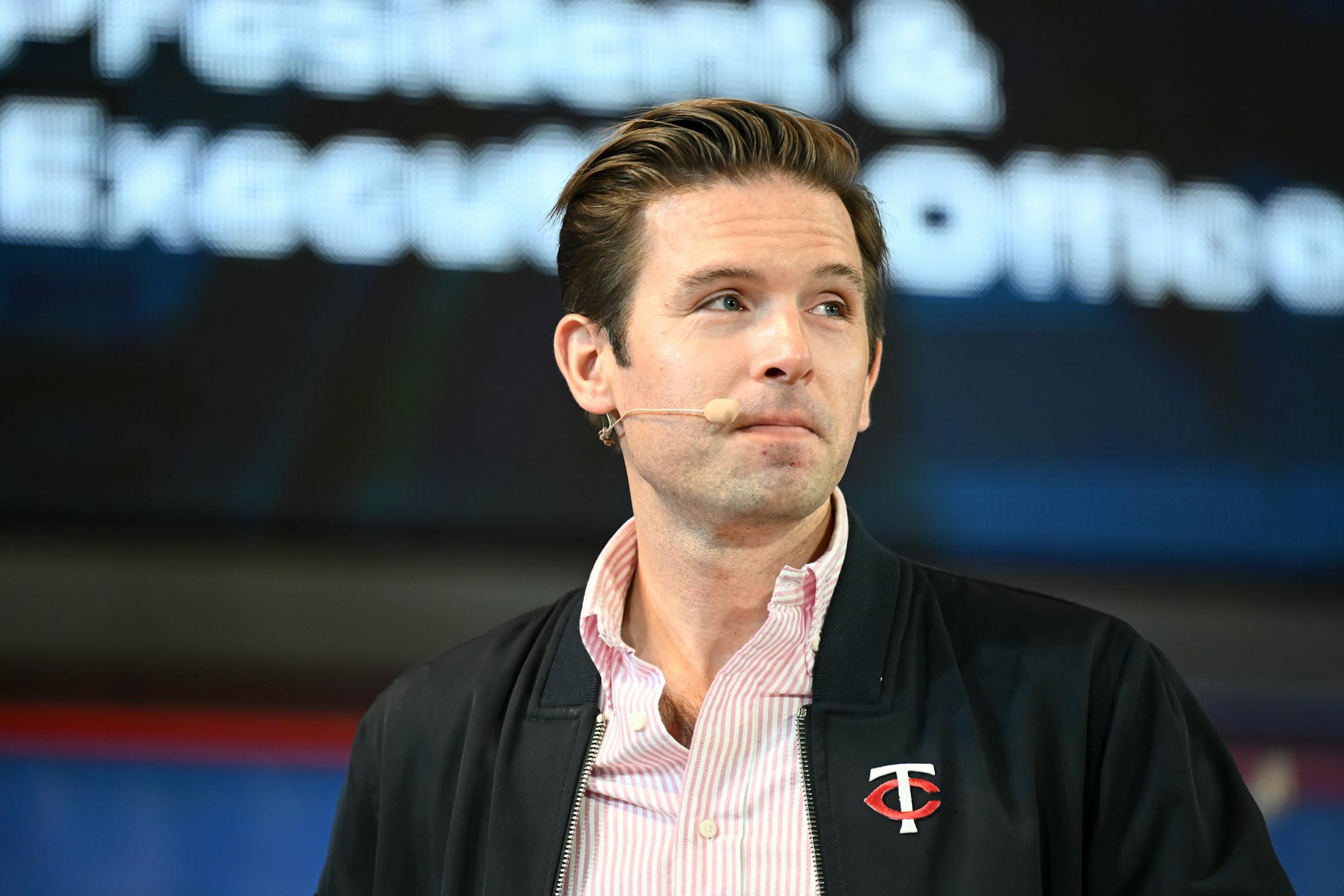
Twins chairman Joe Pohlad, as family changes mind on team sale: ‘We want to win, too’

Joe Pohlad, in an interview with the Minnesota Star Tribune, declined to reveal two groups of new minority partners. He said recent moves to trade a large group of players came on suddenly.

The Minnesota Star Tribune
August 13, 2025 at 7:53PM
Joe Pohlad, executive chair of the Twins, represents the Pohlad family, which has owned the team since 1984. (Aaron Lavinsky/The Minnesota Star Tribune)

After 10 months of searching for a suitable buyer for Minnesota’s MLB franchise, the Pohlad family has chosen who they want to own and operate the Twins for the foreseeable future.

Themselves.

“Our family will remain the principal owner of the Minnesota Twins,” chairman Joe Pohlad announced Wednesday in a statement issued by the team, officially ending what he called “a robust and detailed process.”

Rather than selling the team as a whole, Pohlad said his family will instead take on two new groups of partners but retain control of the baseball franchise that his grandfather, Carl Pohlad, bought in 1984.

The family’s decision to not sell comes after a rocky stretch for the team, and Joe Pohlad understands fans might be skeptical at the turn of events.

“And I would say to those fans: It’s my job and this new ownership group’s new job to do everything we can to set this organization up for success, hopefully in the short- and long-term both,” Pohlad said. “I look forward to it.”

Pohlad declined to reveal the identity of his new partners — in both cases, they are groups of investors, not a single buyer — beyond saying that one is made up of Minnesotans, the other a family based on the East Coast. He also did not disclose what percentage of the franchise those partnership groups will own, nor how much they paid for their shares of a team whose estimated worth has been valued at $1.7 billion or more.

“I don’t think we could have imagined a better outcome than where we landed,” said Pohlad, who shared the news with Twins employees at a Wednesday morning meeting at Target Field. “We found two great partners and have already developed some pretty solid relationships with them. There is alignment on how we see the Twins moving forward, and also in our belief in the future of baseball in Minnesota. So I feel happy that this [sale process] has come to an end, and thrilled with the partners we have brought on.”

ADVERTISEMENT

But the Pohlads — the three sons of Carl Pohlad, who inherited the team when he died in 2009, and their seven children — will retain a controlling interest in the team, he confirmed. The transaction does not include a path toward the new partners expanding their stakes or becoming the controlling owners.

Each partnership group will have a seat on the team’s board of directors, so their “input, fresh ideas and long-term vision” will be heard, Pohlad said.

Major League Baseball must approve the transaction and the new partners, a process that is already in the works, said Pohlad, who replaced his uncle, Jim Pohlad, as executive chair of the team in November 2022. The family’s new partners will be revealed within a few weeks as that process goes on, he added.

A recent decision

The surprising conclusion to the Pohlad family’s “exploration of a sale,” as Pohlad put it last October, came after Allen & Co., the private investment bank he hired to conduct the sale, identified, interviewed and investigated “several” potential buyers, he said. The Twins even conducted tours of Target Field for interested bidders.

“We explored a wide range of potential investment and ownership opportunities,” Pohlad’s statement read. “Our focus throughout has been on what’s best for the long-term future of the Twins. We have been fully open to all possibilities.”

Ultimately, though, “we chose this path instead,” Pohlad told the Star Tribune. The decision, he added, “came together pretty recently. Very recently.”

Pohlad would not comment on Justin Ishbia, the Chicago investment banker and co-owner of the NBA’s Phoenix Suns, who took steps toward buying the Twins — “the leader in the clubhouse,” as MLB Commissioner Rob Manfred described him last month — before suddenly backing away in February in order to buy a larger stake in the Chicago White Sox instead. Ishbia’s involvement, Manfred said, was the reason the Twins’ future took so long to settle upon.

Now, “I’m just really excited about this team and its future with this new ownership structure,” Pohlad said.

Fan unrest

He’s aware, however, that a significant portion of the team’s fanbase will not share that excitement, not with his family’s long history of spending less on players than most teams. The Twins began this season, for instance, with a payroll of around $128 million, more than only 10 of the other 29 MLB teams — and two weeks ago, the team executed trades that trimmed another $26 million from this year’s salaries.

His decision nearly two years ago to reduce the team’s payroll by $30 million, shortly after the Twins snapped a two-decades-long postseason losing streak, made Pohlad a frequent target of disgruntled fans on social media.

Add to that the 34 years and counting since the Twins last played in a World Series, and Pohlad understands his stated commitment to “building a winning team and culture for this region, one that Twins fans are proud to cheer for,” figures to be greeted with widespread skepticism, even derision, in today’s fractious media climate.

Being criticized, even booed, “is just part of the role, part of owning the team,” Pohlad said. “Our fans are passionate. Our fans want to win. We have that in common — we want to win, too. I’d rather have passionate fans than fans who are disengaged."

What’s ahead?

So will the payroll rise next year? Those are discussions that will take place with Twins President Derek Falvey and General Manager Jeremy Zoll once the current season ends, as usual, Pohlad said. But “we’ll have a new process by then with our new limited partners involved,” he added.

Not to mention, a much smaller debt load.

Pohlad acknowledged the team has accumulated significant debt since the summer of 2020, when the COVID pandemic forced MLB to play with no fans in the ballparks. That red ink totals as much as $400 million, according to a report published by The Athletic, through baseball operations, the expiration of their $54 million-a-year TV deal with Diamond Sports Group and “investments in the fan experience” at Target Field, Pohlad said.

“As far as I’m aware, that debt was not a hindrance in this process,” Pohlad said. “But with this transaction, we’re going to be paying that debt down.”

A changing team

The decision by Falvey and Zoll to trade away 10 players at the July 31 deadline was a more extensive teardown than he originally expected, Pohlad said. “We didn’t know we were going to go in that direction until that week.”

He called each player to thank them for their contributions, making it “probably the hardest week in my career, outside of the announcement” the team was for sale, Pohlad said. “I can pretty confidently say the same for Derek.”

The trades had little to do with saving money, he said, and were not ordered by ownership.

“Those were truly primarily baseball decisions,” Pohlad said. “It certainly set us up for more [financial] flexibility, but they were primarily baseball decisions.”

And the aftermath, he believes, has turned out to be energizing, not discouraging, as the Twins have won four of their past seven games with a dozen new players.

“We’re really happy with how the team is playing right now,” Pohlad said. “There’s a lot to be excited about around here.”

about the writer

about the writer

Phil Miller

Reporter

Phil Miller has covered the Twins for the Minnesota Star Tribune since 2013. Previously, he covered the University of Minnesota football team, and from 2007-09, he covered the Twins for the Pioneer Press.

See Moreicon

More from Twins

See More
card image
Mike Janes

Winokur, a 6-foot-6 shortstop and center fielder, hit .226 with 17 homers, 68 RBI and 26 stolen bases in high Class A this year.

card image
card image