Minnesota schools reporting sharp increase in number of guns confiscated from students

October 21, 2025
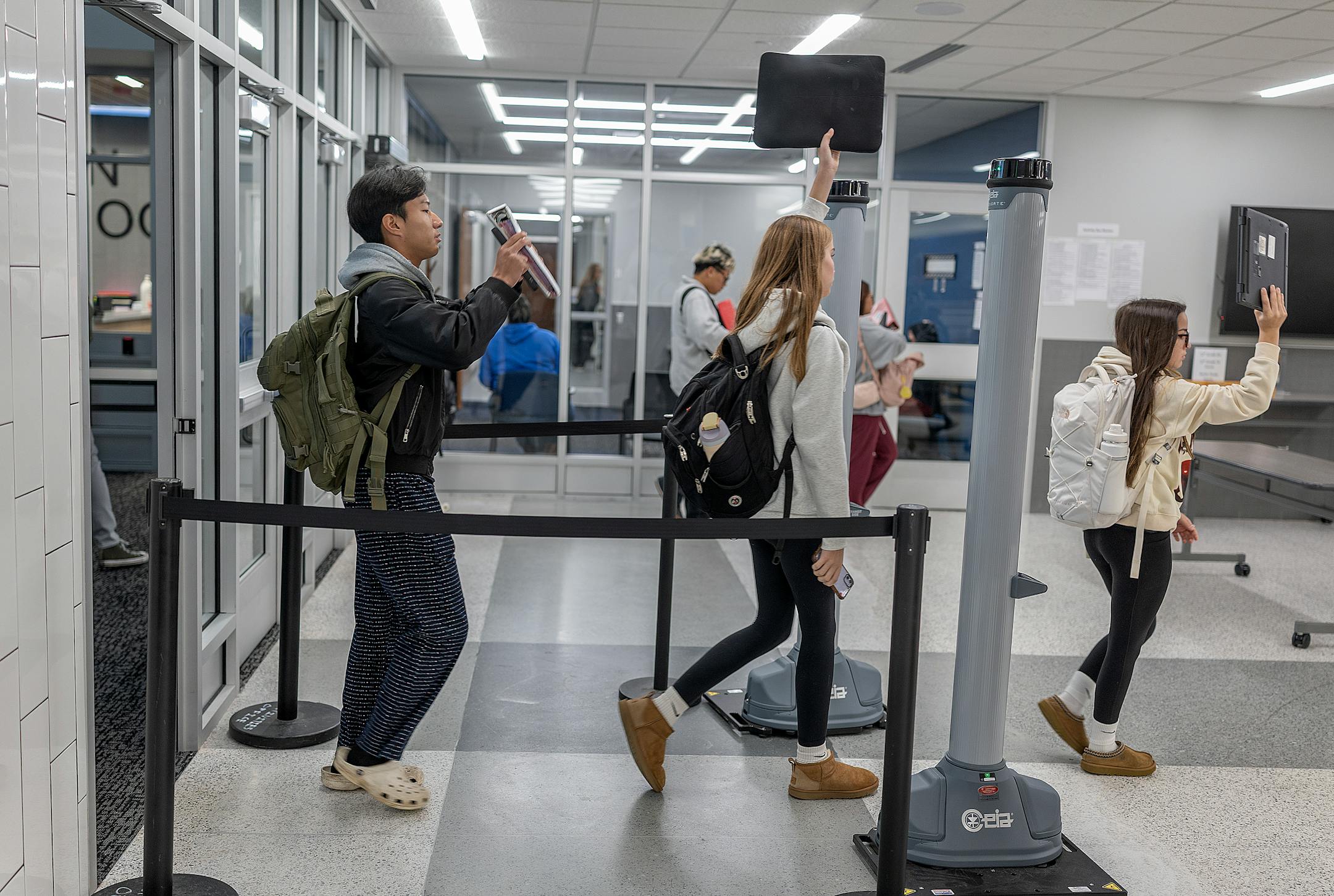
Tartan High School students make their way through the new weapons detection system as they arrive to school on Oct. 6. The system will also be used for football games, basketball games and homecoming dances, and was already used at the high school's graduation at Aldrich Arena. (Elizabeth Flores/The Minnesota Star Tribune)

Recent data shows a large increase in handguns in schools since 2021. Schools are turning to new technology and prevention strategies.

The Minnesota Star Tribune

Teenagers entering Tartan High School in Oakdale have a new routine this year: Hold their laptop above their heads and walk through a weapons detection system.

After tweaks to avoid flagging harmless items like eyelash curlers, the device works smoothly, revealing hidden pocket knives and serving as a deterrent to bringing in weapons, school leaders say.

The necessity for new school safety solutions like the detection system is supported by an alarming trend: The number of guns found on school grounds in Minnesota has skyrocketed since the beginning of the pandemic.

Nearly 200 firearms — including about 150 handguns — have been found in Minnesota schools since the 2021-2022 academic year.

That’s almost three times the number found in the school years spanning 2017-2020 and 30% of the nearly 700 firearms associated with student disciplinary incidents going back a quarter-century, according to a Minnesota Star Tribune analysis of disciplinary reports filed with the state Department of Education.

Data show overall enrollment in Minnesota declined by about 4,000 students during this time period, from 2021 to the 2023 school year.

Schools across Minnesota have long worked to balance “hard” safety measures — metal detectors, reinforced doors, bullet-resistant windows — with “soft” approaches that emphasize communication, relationships and student mental health support. That vigilance took on fresh urgency after shootings like the one at Annunciation Catholic Church and School in Minneapolis in August, which left two students dead and 30 others injured.

For the next few weeks, Minnesota schools and churches saw a spike in threats of violence, including a teen who threatened to shoot up a school in northern Minnesota and a St. Paul student who brought a loaded gun to school.

In the state data, handguns, rifles and shotguns were far less common than knives, while rates of airguns and fake guns also have jumped significantly since the pandemic.

About 2% of student disciplinary incidents in Minnesota schools since 2000 involved weapons. Numbers for the 2024-2025 school year were not immediately available.

Schools prepare for safety threats

School leaders and violence prevention researchers say rising weapons cases reflect broader spikes in youth crime and mental health struggles worsened by the pandemic. They add that improved detection and threat assessment may also account for the increase.

“Part of this is hypervigilance, but part of this is a real increase” in students carrying weapons, said Jillian Peterson, executive director of the Violence Prevention Project Research Center at Hamline University.

In a multiyear partnership with St. Paul Public Schools, staff with the Violence Prevention Project also saw a spike in weapons incidents once students came back to school after pandemic-era distance learning. Nationally, gun violence and gun sales also rose sharply in the first year of the pandemic.

In 2023, a 15-year-old St. Paul student died in a stabbing by a fellow high schooler after a hallway fight. And two St. Paul students brought guns, including one that was loaded, to school in the first weeks of classes this year.

In talking to students, Peterson said her group’s researchers found that many of the teens felt unsafe traveling to and from school.

Social media use — which boomed during the early pandemic years, too — can escalate that fear, Peterson added. A post from a peer brandishing a handgun can feel like a threat and add to the perception that other teens are carrying.

“I don’t think there is going to be one solution,” Peterson said, adding that schools can get criticized no matter how it reacts to potential threats. “Instead, I like to think about multiple layers of imperfect solutions.”

New safety efforts

Minnesota schools are required to have a crisis management policy, including emergency drills. What’s included in the plan or the specifics of its protocols, however, are not regulated by the state, said Megan Olstad, one of eight people who make up the Minnesota School Safety Center team under the state’s Department of Public Safety.

In addition to providing training for school resource officers, the team reviews school safety manuals and gives advice on best practices.

“School safety has multiple buckets,” Olstad said. “Sometimes people get narrowed into thinking about the specific technologies” like metal detectors, Olstad said. But, she added, it’s also about policies, training, communication and partnerships within the school, local law enforcement and the community.

North St. Paul–Maplewood–Oakdale school leaders take an approach to safety that combines prevention, strong relationships and technology. Since the pandemic, the district has emphasized rebuilding routines and social skills and ensuring every student feels connected through clubs, sports or other activities.

The district has also upgraded its buildings with secure entrances, lockdown systems, reinforced windows and security cameras, and implemented an app for crisis communication. Staff and students can use an anonymous tip line to report concerns.

The new weapons detection system at Tartan High School started as a pilot program but will likely stay. Another system will soon be added to North Senior High.

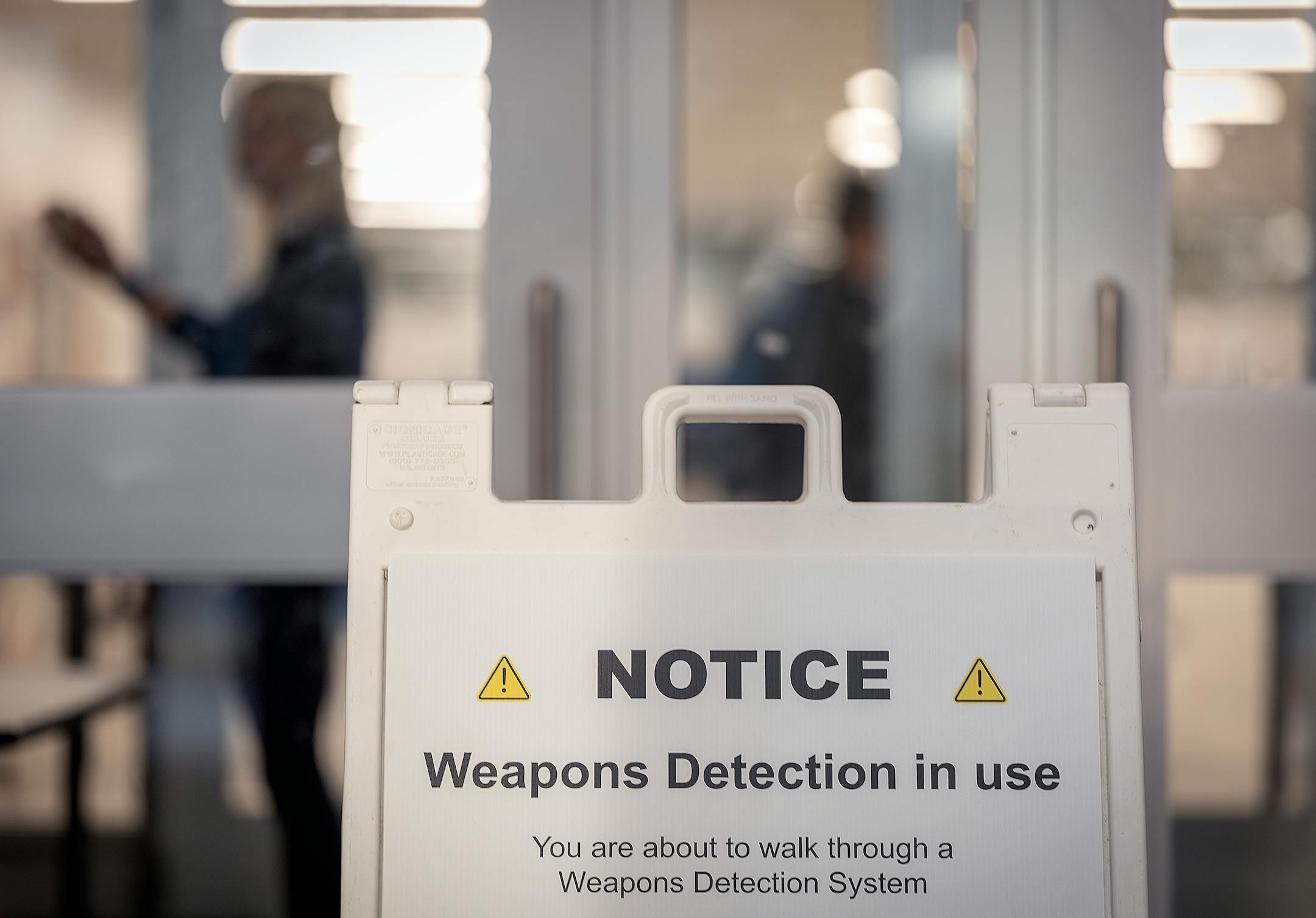
A sign indicates the use of the new weapons detection system on Tartan High School. (Elizabeth Flores/The Minnesota Star Tribune)

The technology “bells and whistles” add a layer of protection and psychological safety, said North St. Paul-Maplewood-Oakdale Superintendent Christine Tucci Osorio.

The bulk of the work in the district’s schools, however, is focused on identifying struggling students before they turn to violence. Helping students feel connected to school became a priority after the pandemic, when many returned to class dysregulated and on edge. School staff now try to get every student into a club, sport or activity.

“For all the mental health supports we do invest in in our district,” Tucci Osorio said, “that can never take the place of possible friendships.”

The North St. Paul school district also has a partnership with local law enforcement that alerts schools when police respond to calls involving students, allowing staff to offer extra support without knowing personal details.

Safety education now also extends beyond school walls. That’s led several districts, including North St. Paul-Maplewood-Oakdale, to consider how to promote safe gun storage to families.

“Schools have always been just a hub for everything good and bad,” said Andy Beaton, the assistant superintendent of secondary programs for the North St. Paul district. “Whether it’s about mental health or violence in the community ... the default is to go to the schools and we have to figure out solutions.”

‘A heightened state’

In St. Paul Public Schools, a 46-member department works to coordinate safety plans and resources. That includes three dozen internally trained school support liaisons (SSLs) who focus on both safety and student behavior.

Those positions replaced school resource officers, known as SROs, in 2020. The district also runs its own emergency communication center. Still, every report of a possible firearm— whether through an anonymous tip, social media or 911 — triggers a detailed internal and police response.

“It doesn’t matter if that tip is at 2 a.m., we immediately start the process,” said Laurie Olson, St. Paul Public Schools’ director of security and emergency management.

The team starts with sharing information about what they know about the student, their home life and the credibility of the threat.

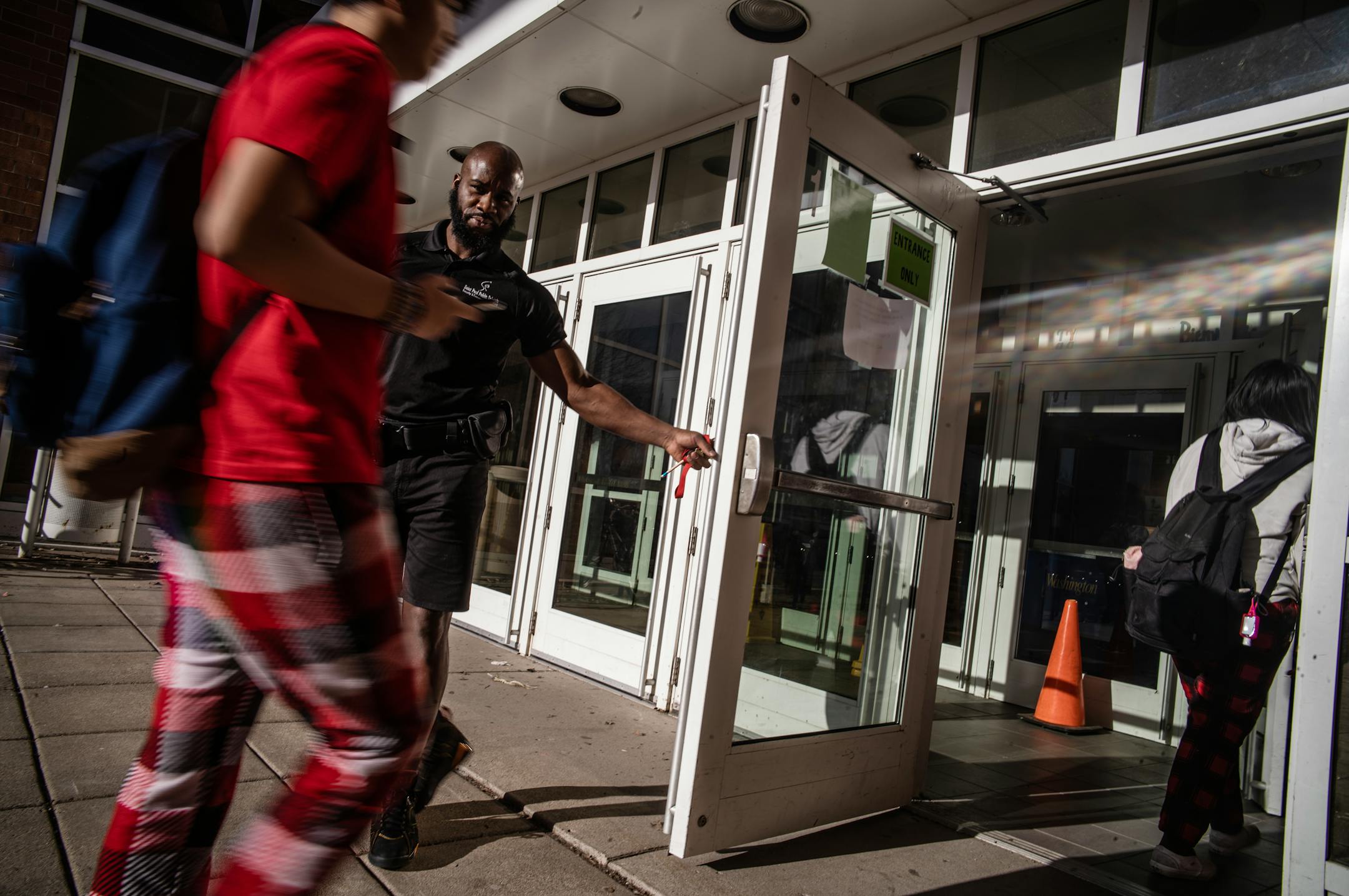
School security liaison Kehinde Olafeso welcomes students arriving at Washington Tech Magnet School in St. Paul on April 12, 2023. (Richard Tsong-Taatarii/The Minnesota Star Tribune)

“If we have a verified firearm, there’s a very strong protocol that is put in place,” Olson said. “I don’t want to say it is like a fine-tuned machine, but we are very, very complete in how we handle that and are able to take action to secure a space while we wait for law enforcement.”

Having set protocols and multiple layers of response is critical, Olson said. That’s easier with a district-wide team. But that can be tough to budget for, especially in smaller districts. Even St. Paul’s team has grown leaner from the last two budget cycles, Olson said.

Ultimately, the work of prevention and detection takes collaboration from everyone with “the ability to have touch points with kids each day,” Olson said.

“I know we’re in a heightened state on the heels of tragedy in Minneapolis,” Olson said, adding that after a school shooting, there are always questions about what schools are doing differently to ensure safety. “I just go back to the fact that we have to be good every day, no matter what. This is about consistency.”

about the writers

about the writers

Mara Klecker

Reporter

Mara Klecker covers suburban K-12 education for the Star Tribune.

See Moreicon

Jeff Hargarten

Data Journalist

Jeff Hargarten is a Minnesota Star Tribune journalist at the intersection of data analysis, reporting, coding and design.

See Moreicon

More from Twin Cities Suburbs

See More
card image