
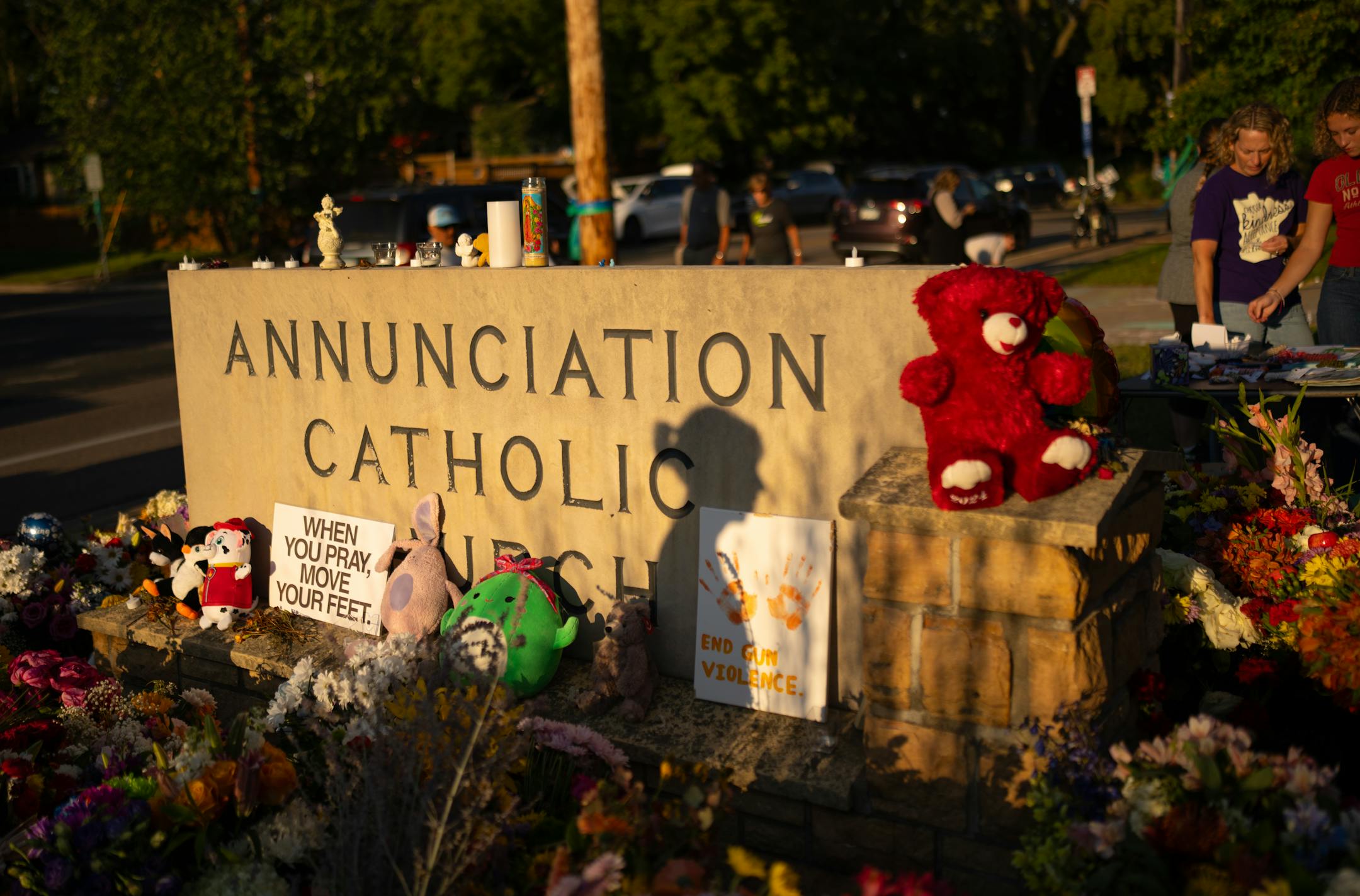
Annunciation shooting followed by other school threats, worries about ‘copycat’ incidents

The mass shooting at Annunciation Catholic Church has been followed by a surge in threats against Minnesota schools and churches.

The Minnesota Star Tribune
September 16, 2025 at 10:00AM
The memorial to the victims of the attack at Annunciation Church Saturday evening. The first mass since the shooting at Annunciation School earlier this week was held Saturday, August 30, 2025 in the auditorium of the school in Minneapolis. JEFF WHEELER • Jeff.Wheeler@startribune.com (Jeff Wheeler/The Minnesota Star Tribune)

A teenage boy accused of threatening to shoot up a northern Minnesota school. Another teenager charged with bringing a gun to a St. Paul high school. A Duluth man arrested for threatening to shoot out the windows of an elementary school.

In the three weeks since the shooting at Annunciation Catholic Church in Minneapolis, several other churches and schools across Minnesota have reported threats of violence.

Such threats are far from new, but professors who study gun violence say the evidence is clear that mass shootings often lead to a “copycat” effect, where those considering an act of violence or making threats are more motivated to do so.

“It’s very, very common nearly after all of these events that we see this type of increase,” said James Densley, a professor of criminology and criminal justice at Metropolitan State University.

Densley said several factors are at play. That includes the heightened community awareness around threats following a mass shooting, mass shootings’ potential to motivate others desiring similar notoriety, and hoaxers who want to cause chaos.

Last week, prosecutors charged a 72-year-old man with threatening to murder a federal judge after authorities were flagged to his manifesto, which they allege contained troubling ramblings, photos of guns and messages about killing children and targeting a specific church for violence.

Officers learned an Episcopal church in Minnetonka also had reported the suspect Aug. 28 for “abnormal behavior” toward its members. The church became concerned after discovering the man’s conviction in 2019 for threatening to kill a judge, the federal complaint said.

In northern Minnesota’s Hubbard County, a 14-year-old boy was arrested after authorities learned on Sept. 11 that he threatened to “shoot up” his school, according to the Hubbard County Sheriff’s Office. Deputies met with administrators at the Nevis school, which serves students from preschool to 12th grade. The boy reportedly told other students that he was going to “shoot up the school, shoot a particular student and then shoot himself.”

On the same day, police in Duluth arrested a man for allegedly threatening to shoot out the windows of Laura MacArthur Elementary School. Officers who searched his home found a shotgun, an assault-style rifle with an attached bayonet and ammunition at his house, police said.

And in St. Paul, a 16-year-old student was charged with a felony after he allegedly brought a loaded gun to his high school and fled while being patted down by a staffer. Police captured him in a resident’s yard about a mile away.

Meanwhile, dozens of college campuses across the country have been deluged in recent weeks with hoax calls about armed suspects and other violence, laying bare the challenges of detecting fake threats quickly to prevent mass panic.

The copycat factor

The reasons behind potential copycat incidents can be complicated. It can be difficult to determine whether potential perpetrators are motivated to carry out a similar horrific crime or simply want to cause panic.

The Annunciation shooter cited numerous high-profile killings, particularly involving schools, in a manifesto posted online. The writings showed fascination and reverence for school shooters.

Patricia Jewett, an assistant professor at the University of Minnesota School of Public Health, said one issue is that news stories and social media posts give attention to bad actors, which can inspire others to act out.

“They’re really seeking the infamy; they’re seeking the fame from these awful actions,” Jewett said. “I think that also explains why you would have — immediately after such a shooting — some people who also want to seek some attention and they would come out with these threats."

Jewett added that media outlets can unknowingly play a role in encouraging copycat incidents because a suspect reads a story and wants the same treatment for themselves.

The Minnesota Star Tribune reports the names of mass shooters when they are identified, but it tries to avoid repeated use of their names in ensuing coverage.

“I think mentioning names of shooters should just be a taboo,” Jewett said. “If you’re never mentioned by name, then you’re not famous, period.”

Academic studies in the past decade have examined how news stories can have a harmful impact by circulating the name of a particular mass shooter. The studies emphasize how news outlets put a disproportionate amount of focus on mass-homicide incidents instead of more common gun violence such as domestic incidents.

Densley, co-founder of the Violence Prevention Project Research Center at Hamline University, said he is similarly in favor of not giving notoriety to mass shooters. Instead, he suggested the focus be placed on solutions to mass-casualty incidents and the stories of survivors and first responders.

“Once the genie is out the bottle, there’s not a lot of putting it back in again,” Densley said of the social media world, where shooters’ names are often reported instantly. “So it’s really just a case of striking that right balance of: ‘If you’re going to use the name, use it in a context which then provides greater analysis and solutions-focused journalism.’”

In the years since the Columbine High School shooting in 1999, the popularization of the internet and social media has also contributed to the increasing amount of school threats and shootings, Densley said. He urged anyone who sees signs of interest in school shootings or other troubling behavior to report it.

“People are getting radicalized on the internet, falling into this kind of meme social media culture around these shootings,” he said. “That is a big red flag if you’ve got an unhealthy obsession and fascination with past shooters and then you’re studying them on the darkest corners of the internet. If you’re concerned about somebody doing that, you’ve really got to feel empowered to speak out.“

about the writers

about the writers

Louis Krauss

Reporter

Louis Krauss is a general assignment reporter for the Star Tribune.

See Moreicon

Paul Walsh

Reporter

Paul Walsh is a general assignment reporter at the Minnesota Star Tribune. He wants your news tips, especially in and near Minnesota.

See Moreicon