Editor's Pick

Editor's Pick

This Minnesota county is on the verge of losing its only child care center

Officials in the town of Slayton worry about a lack of day care affecting the local workforce and economy. It’s a stark example of a crisis playing out across rural Minnesota.

The Minnesota Star Tribune
October 12, 2025 at 11:00AM
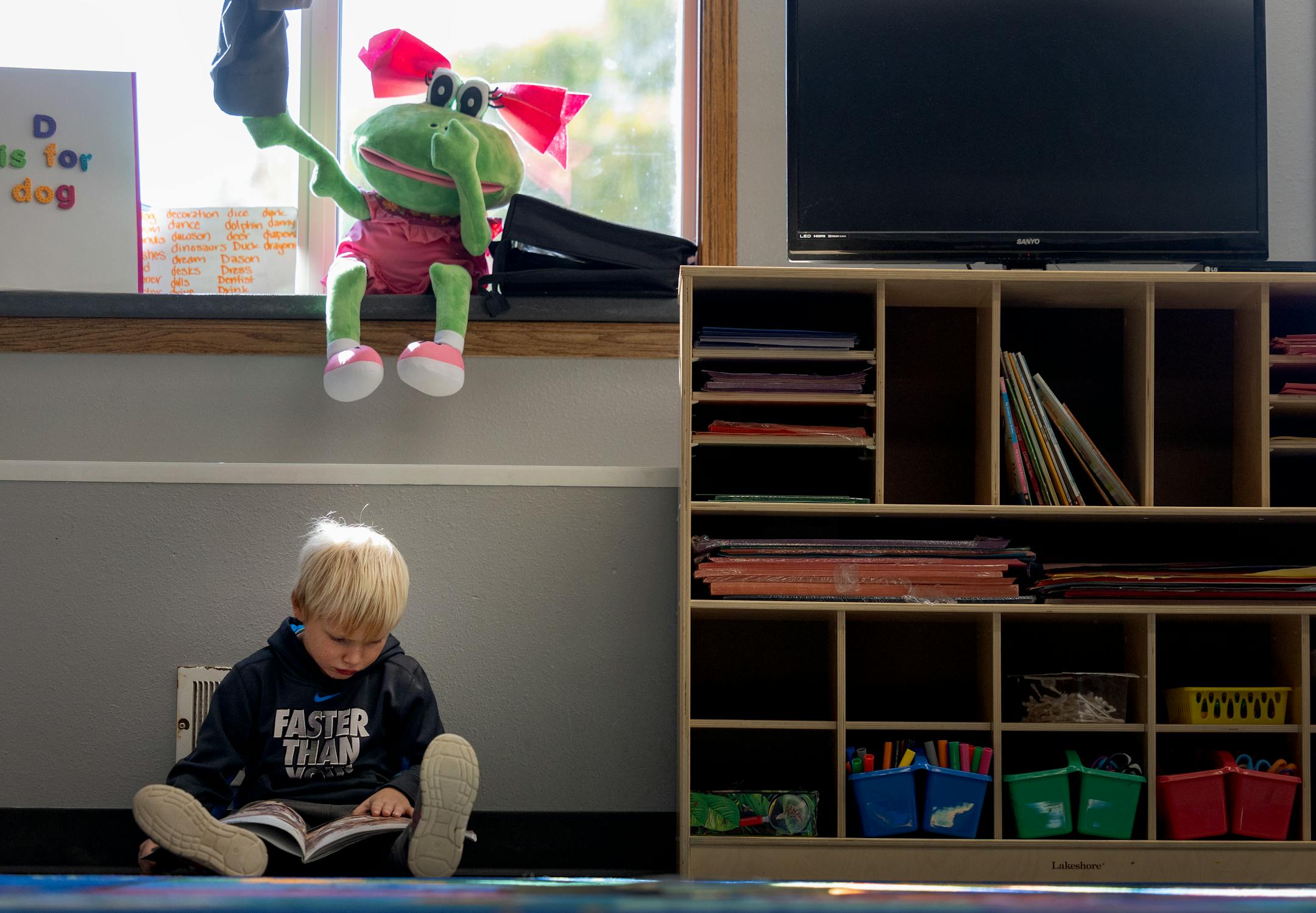
Colten Sandhurst, 4, sits down with a book at Wonder World preschool in Slayton, Minn., on Thursday. (Carlos Gonzalez/The Minnesota Star Tribune)

SLAYTON, MINN. – When Courtney Rossow moved back home to rural Minnesota, the question foremost on her mind was whether she would find child care for her newborn infant.

If Rossow hadn’t gotten a space for her now-toddler at Wonder World Preschool — the only licensed child care center in Murray County — she said her life over the past year and a half might have been very different.

“I probably would have had to stay home, not have a job,” said the 29-year-old paraprofessional, the only income earner in her household. “I probably wouldn’t have been able to provide for my family.”

But time may be running out for Wonder World. A surprise eviction notice from its landlord, the local Catholic church, followed by a bewildering funding reversal from county officials, has left supporters of the child care center in this southwestern Minnesota town scrambling to stave off closure. It has also ignited debate about whether public money should be used to support private child care facilities.

A lack of child care is the single biggest economic factor holding back rural Minnesota, according to reports from the Center for Rural Policy and Development. Greater Minnesota has half the child care capacity it had in 2000, a 2022 report from the center shows.

Rural child care centers often struggle to find staff and funding, leading to long waiting lists and families driving long distances to drop off their young ones. Low wages and rising costs have led to child care centers shuttering in recent years in both rural and urban areas, including in Duluth and Rochester.

The child care shortage is a continuing source of angst for rural employers, who already struggle to attract and retain workers. Losing child care options makes that even harder, said Scott Marquardt, president of the Southwest Initiative Foundation, an economic development organization.

“Parents cannot be fully engaged members of the workforce without child care,” Marquardt said, adding that losing the Slayton center would be “catastrophic” for the region.

Wonder World, a local institution for 50 years, needs to raise a $1 million in the next few months toward building a new facility for the approximately 50 preschoolers it serves.

(Sign up for the Minnesota Star Tribune’s Prairie Local newsletter covering Mankato and the southwest corner of the state.)

In Slayton, a city of about 2,000, the nearest licensed center is nearly 25 miles away in Tracy, and the number of nearby in-home day care providers is dwindling as they retire.

Gabrielle Thovsen watches Carson Nepp, 4, and Whitley DeLong, 4, as they wait for the bus at Wonder World. (Carlos Gonzalez/The Minnesota Star Tribune)

‘A total shock’

On a recent afternoon, Kristin Petros, director of Wonder World, put a bib on an infant as toddlers trundled through the hallway on their way to lunch. Petros grew up in Slayton, and her sons were among the generations of children raised at the center.

Without $2.1 million total needed by April to build a new site, Petros said, Wonder World will have to close.

Staff at the center, which rents space from St. Ann’s Catholic Church, learned last year that the church would not be renewing its lease. Board members and staff at Wonder World said the announcement blindsided them at a meeting in June 2024 with the Rev. Peter Schuster, who cited a need for more space as nearby parishes consolidated.

“It was a total shock,” said Petros, director of the child care center since 2019. “It was a nice relationship, I thought. And then boom, the bomb was dropped on us.”

The last year and a half has been a roller coaster for supporters of the day care amid negotiations with the church. As a nonprofit, Wonder World had little in its capital fund to buy a new building, said Ashley Haken, president of Wonder World’s board. She said the church’s notice created an urgent timeline to request money and write grants.

“I talked to multiple other day cares that built new facilities,” Haken said. “Each one I talked to were saying they worked on it for four to five years. … Here we’re trying to do the work on a much shorter timeline.”

Schuster declined to respond to emailed questions.

The decision regarding Wonder World was “entirely a local decision,” said William Thompson, vicar general of the Diocese of Winona-Rochester, who declined to comment further.

Faced with a looming deadline, Wonder World sought money from state bonding, grants from the Minnesota Department of Employment and Economic Development and congressionally directed spending. Grants for child care centers are very competitive and finding funding often takes years of planning, Marquardt and others said.

The prospect of funding from the county raised and then deflated supporters’ hopes for a new day care center.

In October 2024, the county’s board of commissioners voted 3-2 to approve a $750,000 loan. But a few months later, citing a procedural error in the motion’s wording, the board rescinded the loan. When a motion was made moments later with corrected language provided by the county attorney, it failed in a surprising 3-2 vote, with the county commissioner for Slayton reversing her earlier position.

Jackie Meier, the county commissioner who changed her vote, declined to comment.

County Board Chair Dennis Welgraven said on Thursday that Wonder World had not sent them requested information, an allegation that the child care center’s supporters have disputed. Welgraven declined to answer other questions, citing advice from legal counsel.

The city of Slayton criticized the County Board’s funding reversal. A statement in January denounced “Murray County’s inexcusable decision to reverse its funding commitment to Wonder World” and expressed “profound disappointment” in the commissioners involved.

The whole situation has led to distrust and Facebook arguments, Slayton City Administrator Josh Malchow said. Slayton residents don’t usually argue about decisions by the County Board — “until this project,” Malchow said.

The city voted in January to provide more than $225,000 in land and tax increment financing to Wonder World.

Communities have to invest in child care as part of economic development the same way governments gave financial aid to promote rural electrical projects, said Marquardt, who describes himself as a free market champion.

“That’s not a statement against free market,” Marquardt said. “It’s a reality that the cost in Minnesota to do child care does not allow the free market to do it entirely. ... Public investment is necessary for the free market to work.”

Students head outside to play at Wonder World Preschool in Slayton. (Carlos Gonzalez/The Minnesota Star Tribune)

Rippling effects

The closure of a day care center in a rural town often forces parents to choose between their jobs and their children’s care, said Marnie Werner, vice president for research at the Center for Rural Policy and Development.

It’s often rural clinics and hospitals that are affected the most by the child care shortage, Werner said. Nurses are overwhelmingly women, and dwindling child care options often means more nurses staying home in areas already facing a shortage of health care workers.

“If you’re a couple, suddenly one of you has to stay home with the kids, and that means the employer has lost a worker,” Werner said. “To lose more workers is a huge problem because you’re already having a problem trying to attract people.”

When 10 in-home day cares in Luverne closed in 2021, business owners said their employees were scrambling to find child care, said Mayor Patrick Baustian. Parents were competing to get into regional child care centers with long waiting lists, with some going all the way to Sioux Falls to find a slot, Baustian said.

Those employees couldn’t get to work until their children were dropped off, had to leave early in the afternoon, and also had to stay home on every holiday that the child care center was closed. “It was affecting businesses for the volume of work they could get done,” Baustian said, adding that the crisis led to the city investing in the Kids Rock! child care center.

Farther north, in Danube, the closure of the Little Lambs Learning Center in August 2024 led to a lot of stress for parents, said Stefanie Ryan, communications and grants coordinator for Renville County. The shuttering of the licensed child care center, due to staffing issues, left the county with a shortage of almost 120 slots, Ryan said. Parents in Danube were driving 30 to 40 miles a day getting their children to and from the nearest licensed center, she said.

Renville County is now working on a $704,000 project that would renovate a vacant assisted-living facility and create spaces for four individually licensed family child care providers. The project in the city of Renville, set to open early next year, could raise the number of child care slots in the county by 48, Ryan said.

In Slayton, the fate of Wonder World now rests on its capital campaign. The goal is a new building licensed for 92 children, with 8,820 square feet of space.

The center’s board continues to apply for grants, petition local businesses and hold fundraisers such as a 5K run in October and a meat raffle in November. But with the April deadline looming, the pressure is immense.

“Time is not on our side,” Petros said.

Students eat lunch at Wonder World. (Carlos Gonzalez/The Minnesota Star Tribune)
about the writer

about the writer

Jp Lawrence

Reporter

Jp Lawrence is a reporter for the Star Tribune covering southwest Minnesota.

See Moreicon

More from Greater Minnesota

See More
card image
Jp Lawrence/The Minnesota Star Tribune

The Minnesota State Patrol said the driver and passenger in one vehicle weren’t wearing seatbelts.

card image