
Annunciation parent: Our children are spiritually adrift

Guns make headlines. Policy divides us. What we lack is honest talk about what it means to raise children who can be sure of what steadies them.

September 23, 2025 at 11:00AM
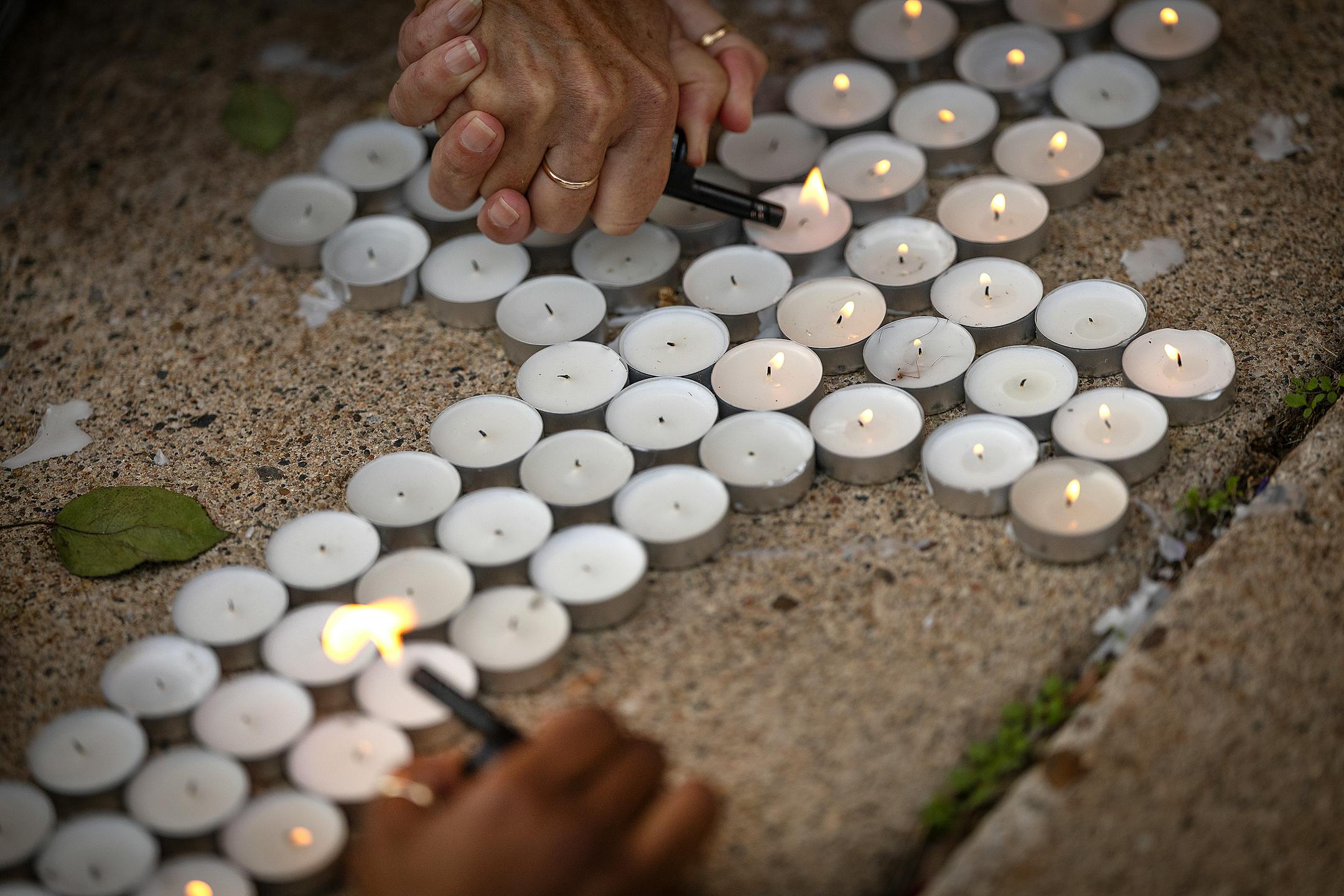
Mourners show their respects for the victims of the mass shooting at Annunciation Church in Minneapolis on Aug. 29. (Elizabeth Flores/The Minnesota Star Tribune)

Opinion editor’s note: Strib Voices publishes a mix of guest commentaries online and in print each day. To contribute, click here.

•••

Last week, my 4-year-old son had a “redo” on his first week of pre-K. He asked me, “Mommy, is a bad thing going to happen again?” I told him no, that it was all done now. But a more honest answer might’ve been, “I don’t know. I hope not. But things aren’t looking good.”

It’s been nearly a month since our community was thrust into every parent’s worst nightmare — the Annunciation school shooting. I thank God every day that my son was physically unharmed, that he is still young enough not to grasp the full weight of “the bad thing” that happened outside his classroom, while the older students were shot at, terrorized, injured, and lay dying in the sanctuary above.

I don’t pretend to carry the pain of those parents who lost children or are walking with them down a long road of recovery. I can only offer my deepest sympathy, prayers, and reassurance that God is with them. And yet, gratitude for my own son’s safety does not erase the question Annunciation leaves us with: Why did this tragedy occur, and why are these incidents multiplying?

I don’t have the perfect answer. Guns and mental illness matter, of course. But the deeper fuel is a cultural and spiritual unraveling, one that leaves people empty, cut off from truth and unable to find meaning. Guns may be the weapon, but despondency is what feeds destruction.

We are raising children in a culture that leaves them unmoored. Conditioned to look outward for every feeling — to peers for affirmation, screens for stimulation, and constantly shifting ideologies — they struggle to feel “real.” At the same time, they are given fewer chances to experience the grounding love that builds true confidence: not ego or bravado, but the quiet strength of knowing themselves, knowing God, and being at peace with that gift. Without it, they grow up untethered, unsure of who they are or what steadies them.

Even children from “good homes” are not immune. And I don’t know the life of the deeply troubled young person who opened fire on a church full of children. But I know evil is real. And what happened that day bore the marks of it in a way no policy or diagnosis can explain away.

Part of this cultural unraveling is the belief that discomfort itself is intolerable. Every frustration must be numbed or escaped — by scrolling, substances, distractions, or the endless reinvention of images and identities. Layer shame on top of that emptiness, and it becomes devastating. Shame whispers to a vulnerable young person, “You will never re-enter life with dignity.” When that message collides with a culture of escape, some turn inward to self-destruction. Others, tragically, turn outward in violence.

Being a dissenter in a moment of grief is not something I take lightly. After I initially wrote about the tragedy, several Annunciation community members reached out to me, saying they wished leaders would speak with more honesty and courage. Yet even in their agreement, some felt the need to hide their identities. When parents whose children lived through a school shooting feel they cannot speak honestly without fear of judgment or ostracism, it shows how deep our cultural erosion has become, and how urgently we need to recover truth as something we can stand on together.

This is the pattern we refuse to name. Guns make headlines. Policy divides us. But until we talk honestly about what it means to raise children who no longer feel real, who are taught to avoid discomfort, who don’t know truth, and who believe shame cannot be survived, we will keep rushing past grief into shallow debates that never heal us. What our children need most is not endless escape, but a shared reality strong enough to anchor them when their world feels unstable.

I recently heard a priest say that the church is not only a teacher but also a healer, and that when the healing is missing, things tend to go wrong. That struck me. Because it seems we have forgotten how to heal, especially after life-altering moments and tragedy. The work is hard. It is far easier to distract ourselves with something or someone to blame: the weapon, the policy, the parents, the problem of social media or isolation. But without healing — the work of tending to broken hearts and restoring dignity — we leave people alone and adrift.

Our hands are not tied. The victim paradigm tells us we are powerless, that life only happens to us, that we must wait for leaders or laws to fix what is broken. But that is a lie. We can change this trajectory by confronting our own spiritual deflation and choosing to embrace what is real.

Annunciation must be remembered as more than a tragic story of violence. It must call us to reckon with the soul of our city, with what we pass on to our children, and the existential unmooring already shaping their lives. Because if we cannot offer truth to steady them, dignity to return to when they stumble and a shared reality strong enough to hold them when life is painful, the next tragedy will not be a surprise. It will be the natural consequence of the ground we’ve given up.

Cally Proctor is a downtown Minneapolis resident and a parent of a child at Annunciation Catholic School.

about the writer

about the writer

Cally Proctor

More from Commentaries

See More
The family of Harper Moyski, far right, poses with their Christmas tree at the Annunciation tree lot in December 2024.
Provided by Jackie Flavin

She was one of two children killed in the Annunciation shooting in August. In the darkness of this winter, here’s what gives me hope.

card image
card image