
Annunciation parent: How will we choose to begin again after this tragedy?

Imagine what could happen if society valued children more than guns.

September 13, 2025 at 9:00PM
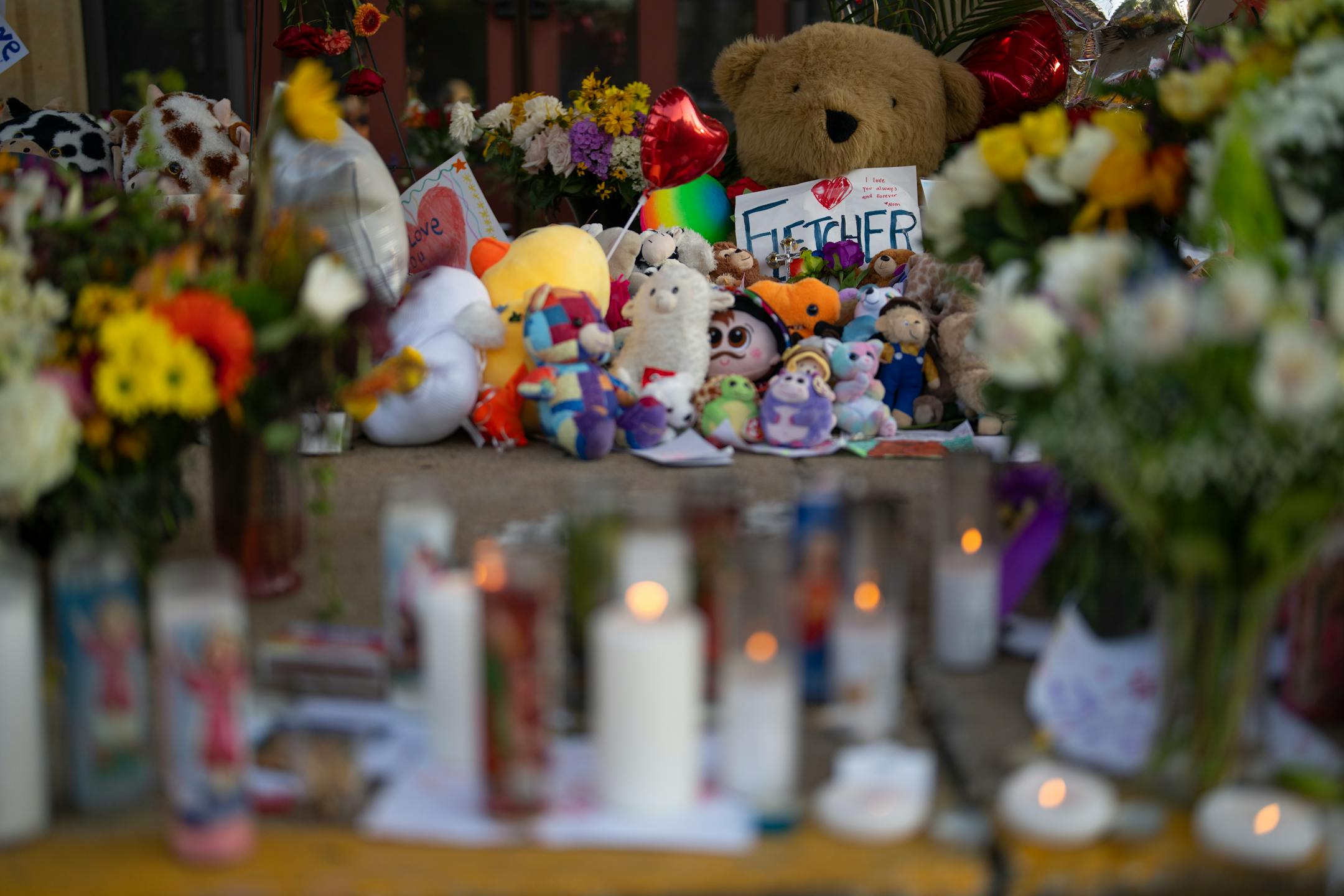
Items, including a giant teddy bear from one victim’s mother, left at the memorial to the victims of the attack at Annunciation Church. (Jeff Wheeler/The Minnesota Star Tribune)

Opinion editor’s note: Strib Voices publishes a mix of guest commentaries online and in print each day. To contribute, click here.

•••

My daughter is alive.

She escaped the more than 116 high-velocity bullets that shredded stained glass windows and tore through her back-to-school mass at Annunciation Church on Aug. 27. Two children — Harper Moyski and Fletcher Merkel — are dead, and many more of my daughter’s classmates were injured, including her seventh-grade mentee who is still fighting for her life, all because of myriad choices made by countless people over many centuries.

Our entire lives are but a series of choices strung end to end.

Our ancestors chose to make the dangerous trek to this country to escape from, and fight with vigor against, tyranny.

Those same ancestors who immigrated to these shores from other lands chose to craft one of the most revered and admired documents for self-government the world has ever seen — the U.S. Constitution. They also chose to adopt the Bill of Rights, which includes the Second Amendment, in 1791.

For many reasons, the language chosen for the Second Amendment is non-specific when it comes to defining what constitutes arms. But we know from historical accounts that what existed at the time were muskets, rifles and flintlock pistols. All of these weapons were single-shot, and slow to reload. That was the context in which that choice of language was made.

A hallmark of human ingenuity is our ability to turn ideas into action, products and more. So it was inevitable that ingenuity would eventually turn to the improvement of firearms. The choices made by numerous groups and individuals from the initial mass production of arms in 1777 to the present day have resulted in the current era of harshly divided opinions and incredibly lethal weaponry that outnumbers the population of the United States.

I have personally come face to face with guns. I was held up in 2021 at gunpoint, in front of my own house, by four youths who chose to demand my phone and wallet. Once they had them in their possession, they chose to make me kneel on the street, my family watching out the front window, and then chose to point the weapon at my head, before getting back in the car and speeding off. This may not have happened at all if guns had not been so easily available.

Which brings me to last month, when my family was once again face to face with guns — in the most horrific manner a parent can imagine — with hundreds of bullets heading toward our child. Again, this was a choice made by an individual who clearly needed help in many ways. However, imagine how the scene might have been different if the collective "we" of the United States, as in “We the People …” had made different, common-sense choices about our gun laws. What if the weapons that were chosen to commit this horror had been single-shot and slow to reload?

Hunting is one of the primary reasons for gun ownership in the U.S. Personal protection is the other. There are around 8 million hunters pursuing whitetail deer in a given year and around 2 million hunting wild turkeys. In my wildest imagination, I cannot begin to fathom why any portion of those 10 million individuals might need an assault rifle with the capacity to shoot over 30 rounds at a time to hunt a deer, or more incomprehensibly a turkey.

As for self-defense, I personally question the need vs. the want to have a weapon with the power to hurt someone beyond recognition. What does that say about us as human beings? That we don’t want just to kill, but to utterly obliterate another human being.

As the Stoic philosopher Epictetus said, every situation has two handles — one with which it can be carried and one with which it cannot. It is our choice which handle we grab in every situation, each day of our lives. To date, the choices our country, our leaders and our populace have made in regard to guns cannot carry the enormous weight of the situation. Instead of having the courage to choose the strong handle, they have grasped the weaker, servile handle that places objects above lives.

At this writing, over $4.6 million has been raised by GoFundMe pages related to the Annunciation tragedy. That is from just a few thousand people choosing to act! Imagine what could happen with a couple of hundred thousand voices, or a million. Americans’ overwhelming desire to help, a desire for change, a desire to keep schools and streets safe for children could become a choice for action instead of a choice for more thoughts and prayers.

As author Mark Manson has noted, we knowingly outsource our choices to others because we have given up and are not making any choices of our own. When others choose for you, you have little room to complain because you are effectively complicit — silence is complicity, as the saying goes. I have been silent for far too long myself, choosing the path of least resistance and ease. Is that brave? Is that wise? Is that just, to any of the thousands killed or wounded to date? Can I do better? Can we all? Unequivocally, yes!

What would this new era of neighborhoods, communities, towns, cities, and schools look like across the country if we chose to prioritize children over guns? Where would it begin?

It would begin now, in our collective darkness. We don’t seek out darkness. We are beings of the light. We seek brightness. We are a visual species; we like to see the world, first and foremost. This is much harder in the dark. Yet everything begins in darkness — you began in darkness, and any idea you’ve ever had did, too. You revitalize your body and mind each night while your body sleeps in darkness. Roots and seeds of every kind send out green shoots of life from underneath dark blankets of soil. This deep blackness that has washed over us in the aftermath of another horrible, seemingly inevitable, mass shooting holds the potential for something lovely to emerge, for light to eventually push through the dark.

Emergence comes from the Latin word emergere, which meansbring to light.” The idea of emergence is underlain with the notion of waking up, shaking off the stupor and rubbing sleep out of our eyes. Emergence is also embedded with the feeling of transformation, of moving through something on your way to the light. Just like in the children’s story, “We’re Going on a Bear Hunt,” which Annunciation’s Principal Matthew DeBoer read aloud recently. The characters in that story, when faced with an obstacle, “we can’t go over it, we can’t go under it, we’ve got to go through it.”

We know we must make the choice of action over inertia. We have to go through it. Emerging into the light is our collective choice for action. We could choose to stay in bed, where it’s warm and cozy and we can blot out the horrors of the world around us. But we are not made for that. We are made for action. We are made for love.

“Our very life here depends directly on continuous acts of beginning.” So says the Irish writer John O’Donohue. This truth has been a part of our species for eons. We begin again and again and again. The sun does it every morning. The trees do it every spring. A beginning is a choice to move toward something. A wedding, a birth, a new school year … .

As we choose to begin again after tragedy, let us model for our children — and watch them model for us — the virtues of wisdom, courage, justice, and self-control in our pursuit of change on their behalf.

May history one day show that this community chose hope and succeeded.

David Motzenbecker is an Annunciation parent, a landscape architect and the founder of Motz Studios Forest Bathing Experiences. He lives in Minneapolis.

about the writer

about the writer

David Motzenbecker

More from Commentaries

See More
card image
Leila Navidi/The Minnesota Star Tribune

In government leadership, young people need to be ready to accept the torch, but previous generations can’t slow down their leg, or delay the pass.

card image
card image