
Annunciation parent: This violence is not normal

And we need to stop pretending that it is.

September 2, 2025 at 8:30PM
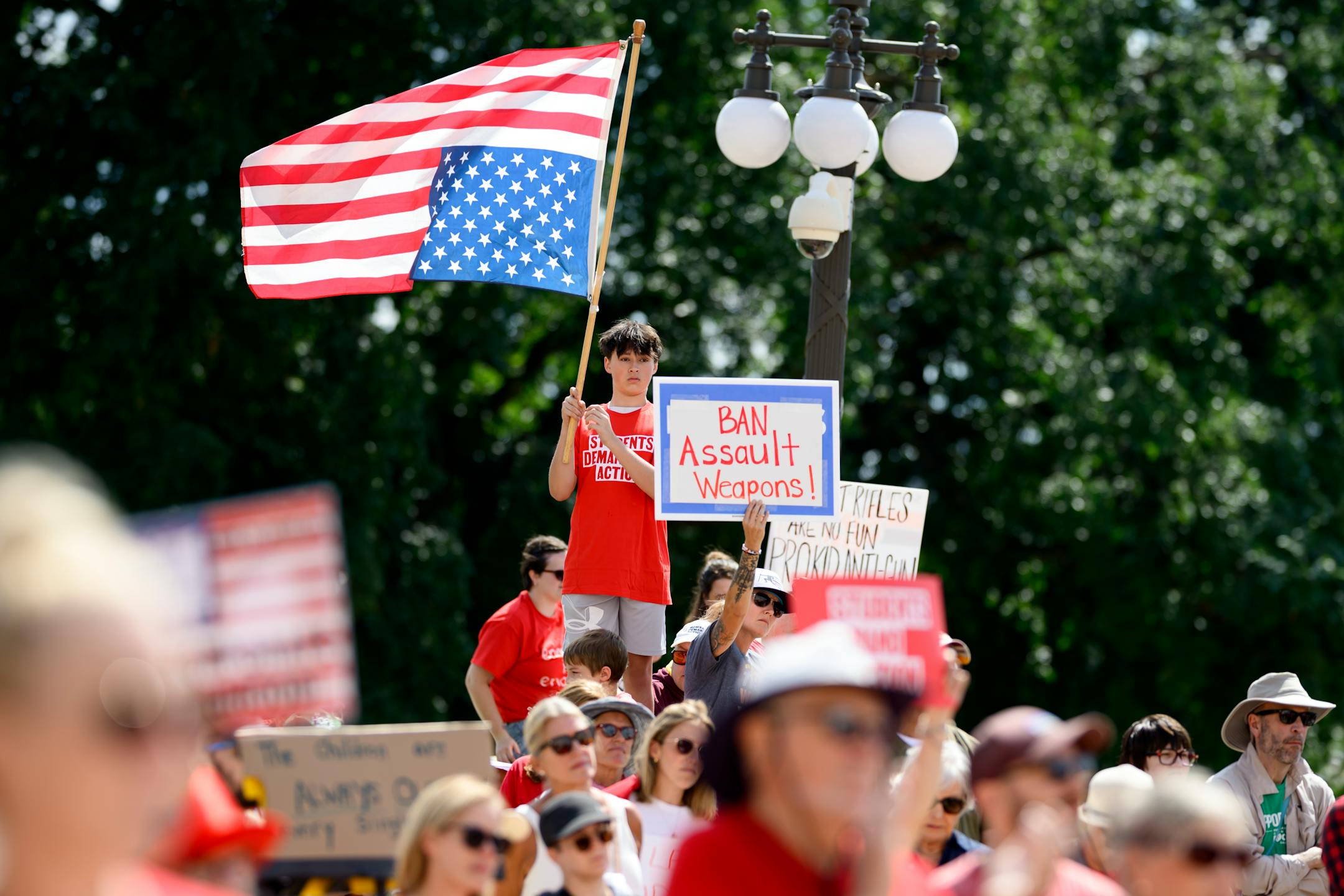
Drake Warnke, 15, of Richfield, holds an upside-down U.S. flag during a rally on Sept. 1 at the Minnesota State Capitol in St. Paul to demand action on gun violence prevention to honor the victims of the mass shooting at Annunciation Catholic Church. (Aaron Lavinsky/The Minnesota Star Tribune)

Opinion editor’s note: Strib Voices publishes a mix of guest commentaries online and in print each day. To contribute, click here.

•••

My children, ages 4 and 5, were victims of the Annunciation Church shooting last week. So were classmates, teachers, neighbors, families, parishioners and many more.

I’m heartbroken this happened. That the third day of school was marred by something my kids may carry forever, even though they weren’t physically harmed. That the joy of a new school year gave way to fear almost instantly. That children died in a place they felt safe.

I’m sad knowing this will happen again — in another school, in another town — and we’ll do it all again. The GoFundMes. The social posts. The trauma interviews.

None of it lands. The stories, the tears, the sound bites — they fade. And then it happens again. Like it always does. Like this is just what it means to live here now.

I’ve watched children recount the day. I’ve seen horrific footage. I’ve heard from neighbors who ran toward the sound of gunfire. My kids are alive, and for that I’m deeply grateful — but my sense of their safety is gone, and I don’t know how to get it back. One child shielding their first-grade buddy from bullets should be enough. One parent saying, “I heard shooting, so I ran to save my children,” should be enough.

But it’s not. Not even close.

I’m still angry. But I’m also exhausted — because deep down, I don’t believe any of this will lead to change. And that exhaustion runs deeper than sadness. Because when we all know it will happen again, and we still don’t act, what are we saying?

Some politicians — and the people who keep them in power — have decided guns matter more than kids. More than life. We let political posturing take priority over collective safety.

So they deflect. They stall. And children die.

I’m angry that the Constitution has become a convenient excuse to avoid real solutions. That even when we know this will happen again, somehow that’s not enough.

I’m angry that society has a playbook for reacting to dead children — but still can’t answer the only question that matters: How do we stop it from happening again?

We’re asked to treat “getting back to normal” as healing. But real healing, for me, would mean knowing this won’t happen again — and I don’t believe that. So how am I supposed to heal? Still, normalcy calls, and we must answer — not because we’re ready, but because we don’t have another choice.

So here we are.

The day after the shooting, my HR director called me. About an hour before the call, I saw the first victim’s name and cried for the first time. Until then, the tragedy felt abstract.

When she asked how I was doing, I started sobbing.

I was in a park, watching my kids splash in water and run around, happy as can be, while I cried and asked about how to bill for my absence on my timesheets.

She told me I could take the week off to process this, to be with my family.

It was generous, and I’m grateful. But it also made me think: Is this what trauma response looks like in this country? If the shooting had happened on a Monday, would I have gotten five days off? Is there some magical healing property in a weekend that makes trauma easier to bear?

I’ve tried to make sense of it. I swing between wanting to know everything — motives, timings, descriptions — and shutting it all out. Details only make it worse, more real. As time passes, the narratives take shape: Sides are drawn, discourse settles and each camp clings to its version of the truth.

How many dead children are we willing to tolerate to protect some notion of freedom?

Is there any location — a church, school or theater — where we believe it is appropriate for innocents to be injured, or killed?

My kids attend a Catholic school. We knew what came with that — the prayers, the lessons, the moral messaging. But religion was never our driving reason. I’ve always respected the faith of those around me — even if it wasn’t something I claimed for myself. It felt like a harmless bonus, not the reason we enrolled.

I know others chose this school for different reasons, and I’m not trying to speak for them. But for our family, this shooting — or at least why it affected us how it did — comes down to practicality. We enrolled because it worked with our schedule and our kids’ morning energy levels. Early start, preschool on-site, close to home — it all made sense. We paid tuition because it met our needs. That felt worth it. Until it wasn’t.

I understand this is being investigated as a hate crime — Christians were killed while praying, and that context matters. But it wasn’t a calculated strike on Catholic mission or clergy. The shooter left a manifesto filled with antisemitic, anti-religious vitriol and hateful slogans scrawled on weapons. The hatred was broad, indiscriminate. There was contempt for many, devotion to none. No one was spared based on faith — the goal was death. This was mass terror cloaked in a Catholic setting, not an ideological crusade. What makes it so tragic is that any place of safety should be a sanctuary — especially for children.

My kids don’t identify as religious. They know a few prayers, a few stories — they once asked if Jesus dies every Friday or just on the good ones. We opted into the rituals and rhythms of Catholic school life because it worked for our family — not because we were devout.

If your instinct is to turn this into a debate about school choice, faith or parenting — stop. That’s not the conversation. Unless your argument begins and ends with one goal — fewer dead children — you’ve missed the only point that matters. Mental health? Worth discussing, if it leads to fewer dead kids. Public vs. private protections? Let’s talk, if the outcome is fewer dead kids. Gender identity and inclusion? That too — but only if the conclusion moves us toward fewer dead kids.

And let’s be honest about the real issue here: guns.

It always comes back to the guns.

We are not the only country with mental illness. Or social media. Or divided politics. But we are the only one where this happens again and again — and we shrug and stall because regulating weapons of war is somehow off the table. If the right to own these guns matters more than children’s right to live, then say that out loud. Let the rest of us decide how to live in a country like that.

For me, though, this is not OK. This is not normal.

We need to stop pretending it is and start deciding what we’ll do about it.

Sam Hasler is an Annunciation School parent, and lives in South Minneapolis. A version of this commentary first ran on Hasler’s blog.

about the writer

about the writer

Sam Hasler

More from Commentaries

See More
card image
Leila Navidi/The Minnesota Star Tribune

In government leadership, young people need to be ready to accept the torch, but previous generations can’t slow down their leg, or delay the pass.

card image
card image