
Advertisement

Burcum: Feds want Minnesota to cooperate? You first.

Why won’t the federal government work with state law enforcement to investigate the deaths of Alex Pretti and Renee Good?

Columnist Icon
The Minnesota Star Tribune
February 24, 2026 at 11:00AM
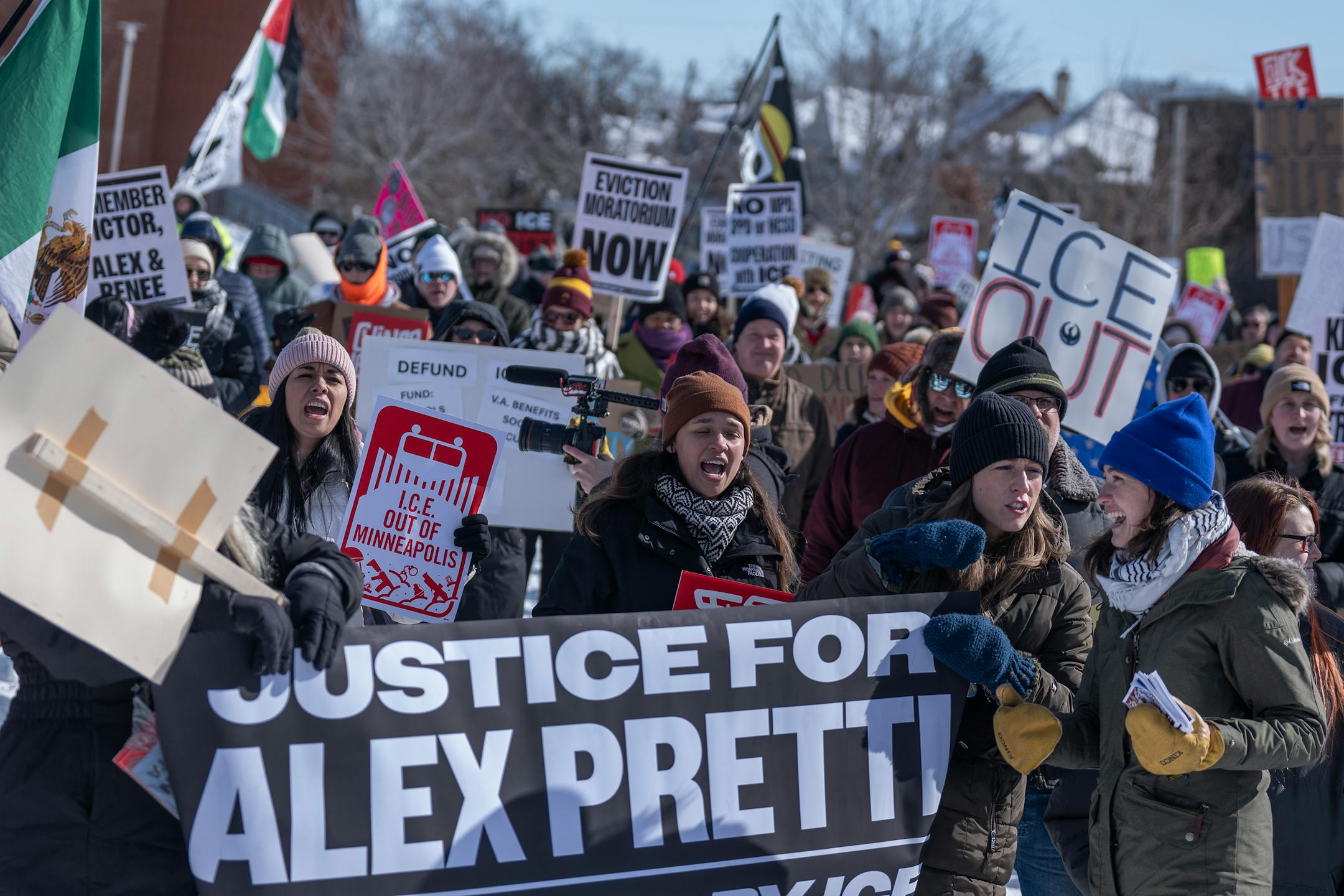
Protesters marched from Whittier Park down Lyndale to the Alex Pretti memorial site in honor of the one-month anniversary of his death on Feb. 21. (Richard Tsong-Taatarii/The Minnesota Star Tribune)
Advertisement

Opinion editor’s note: Strib Voices publishes a mix of commentary online and in print each day. To contribute, click here.

•••

Throughout Operation Metro Surge the Trump administration repeatedly berated Minnesota for its lack of cooperation in this deportation operation. But if it wants more assistance from Minnesota and other states, it ought to try cooperating with state law enforcement agencies in investigating the homicides of Alex Pretti and Renee Good.

Intergovernmental teamwork ought not be a one-way street that works only to Washington’s advantage.

Unfortunately, federal officials have spurned the usual state and federal partnership on high-profile cases when it comes to the two Minnesotans shot and killed during encounters with federal immigration agents in January.

If there are good reasons to keep state law enforcement in the dark during the investigation of these deaths, the public deserves to know what those are.

Otherwise, the shutting out of state law enforcement raises serious questions about the investigations’ integrity. Why keep evidence secret from our trusted state agencies? What’s there to hide?

A recent statement from the Minnesota Bureau of Criminal Apprehension (BCA) put a spotlight on feds’ shameful stonewalling. On Feb. 13, the FBI provided formal notification “that it will not provide the BCA with access to any information or evidence that it has collected in the Jan. 24 shooting of Alex Pretti,” said BCA Superintendent Drew Evans.

Advertisement

Evans went on to say that the BCA “reiterated” its request for the same information for Good and for the nonfatal shooting of Julio Sosa-Celis, a Venezuelan man shot Jan. 14 by immigration agents in north Minneapolis. But it remains unclear if there will be any cooperation for these two investigations, Evans added, calling this “concerning and unprecedented.”

The BCA and Hennepin County Attorney Mary Moriarty merit commendation for vowing to press on in investigation of Good and Pretti’s deaths. Last week, Moriarty announced that other “investigative materials” are available to the state and that prosecutors will leverage the info as they consider state charges against federal agents.

But as Moriarty noted, “it certainly would be much easier if the federal government were not hiding evidence from us and obstructing our ability to do the investigation.”

Among the evidence Moriarty said her office lacks access to: Good’s SUV and the gun that federal agents allegedly took from Pretti. The BCA also says it had no information regarding the status of the two immigration officers involved in Pretti’s shooting.

The pair were put on leave in late January after the nurse’s death. Are they still on leave or back on the job? It’s unclear. A BCA spokesman told me the agency requested “information related to the officers and have not yet received a response.”

I reached out to the U.S. Department of Justice and the FBI’s Minneapolis office last week with a straightforward question: Why aren’t they cooperating with state law enforcement?

Advertisement

The DOJ did not respond. The FBI Minneapolis office referred me to video of U.S. Deputy Attorney General Todd Blanche posted to YouTube on Jan. 30. It’s a news conference. Blanche is not asked about the lack of cooperation with Minnesota law enforcement and does not address the issue.

In an interview, University of Minnesota law professor Amy Sweasy confirmed that the lack of cooperation is unusual. Sweasy also served for 28 years as a prosecutor in the Hennepin County Attorney’s Office.

She cited three prior Minnesota cases involving a fatal use of force by law enforcement as evidence that joint federal-state investigations are the established norm. The cases are: the Jamar Clark shooting in 2015, the George Floyd murder in 2020 and the Winston Smith shooting in 2021.

The current stonewalling, she said, has no real precedent in Minnesota and stands in stark contrast to what the BCA has come to expect — and what the community has come to demand — in use-of-force cases involving law enforcement.

“We are a pretty sophisticated community when it comes to police use of force incidents, and a lot of that is due to the work of the BCA and all of their transparency,” Sweasy said.

She notes that once the BCA is done investigating a use-of-force case involving law enforcement, the agency shares on its website the data they collected.

Advertisement

Sweasy identifies several key advantages to joint federal-state investigations. Having multiple agencies share leads and run down evidence simultaneously improves the overall quality of the investigation.

The federal government brings far greater resources and faster forensic capabilities than state agencies can match. Local law enforcement contributes something the feds can’t replicate — knowledge of the community and the geography, and awareness of who might have useful information. And because some witnesses are more willing to talk to one type of agency than another, having both at the table maximizes the chances of gathering testimony.

Her bottom line: There is simply no downside to collaboration, and every reason to pursue it.

She also had a succinct answer to the following question: Should Minnesotans worry that the lack of cooperation by the feds suggests something suspicious is going on?

“I think that is a reasonable thing for people to think,” Sweasy said.

All of Minnesota’s U.S. congressional delegation should champion a call for a joint federal-state investigation into the deaths of these two Minnesotans.

Advertisement

U.S. Sens. Amy Klobuchar and Tina Smith, both Democrats, have admirably already done so. Most recently, the pair sent a highly critical letter dated Feb 19. to U.S. Attorney General Pam Bondi. In it, they note that the administration’s actions raise “serious questions about its objectivity, particularly after administration officials have made statements, including calling Mr. Pretti a ‘domestic terrorist,’ that prejudged the matter and conflicted with videos and other evidence that has already become public.”

The state’s Republican delegation, particularly Rep. Tom Emmer, who represents the state’s Sixth Congressional District and serves as House Majority Whip, should wield their clout as well.

I reached out to Emmer’s office for comment last week and did not get a response.

The deaths of Alex Pretti and Renee Good deserve a full, transparent investigation — one that Minnesotans can trust. That requires an immediate, good-faith partnership between federal and state investigators, with evidence shared in the open. All who believe in accountability and the rule of law should be demanding exactly that, at full volume, right now.

about the writer

about the writer

Jill Burcum

Editorial Columnist

See Moreicon

More from Columnists

See More
card image
Richard Tsong-Taatarii/The Minnesota Star Tribune

Why won’t the federal government work with state law enforcement to investigate the deaths of Alex Pretti and Renee Good?

card image
card image
Advertisement