
Opinion | The line between authority and trust

Democracies do not need strongmen. They need strong institutions and citizens willing to defend them.

January 26, 2026 at 6:52PM
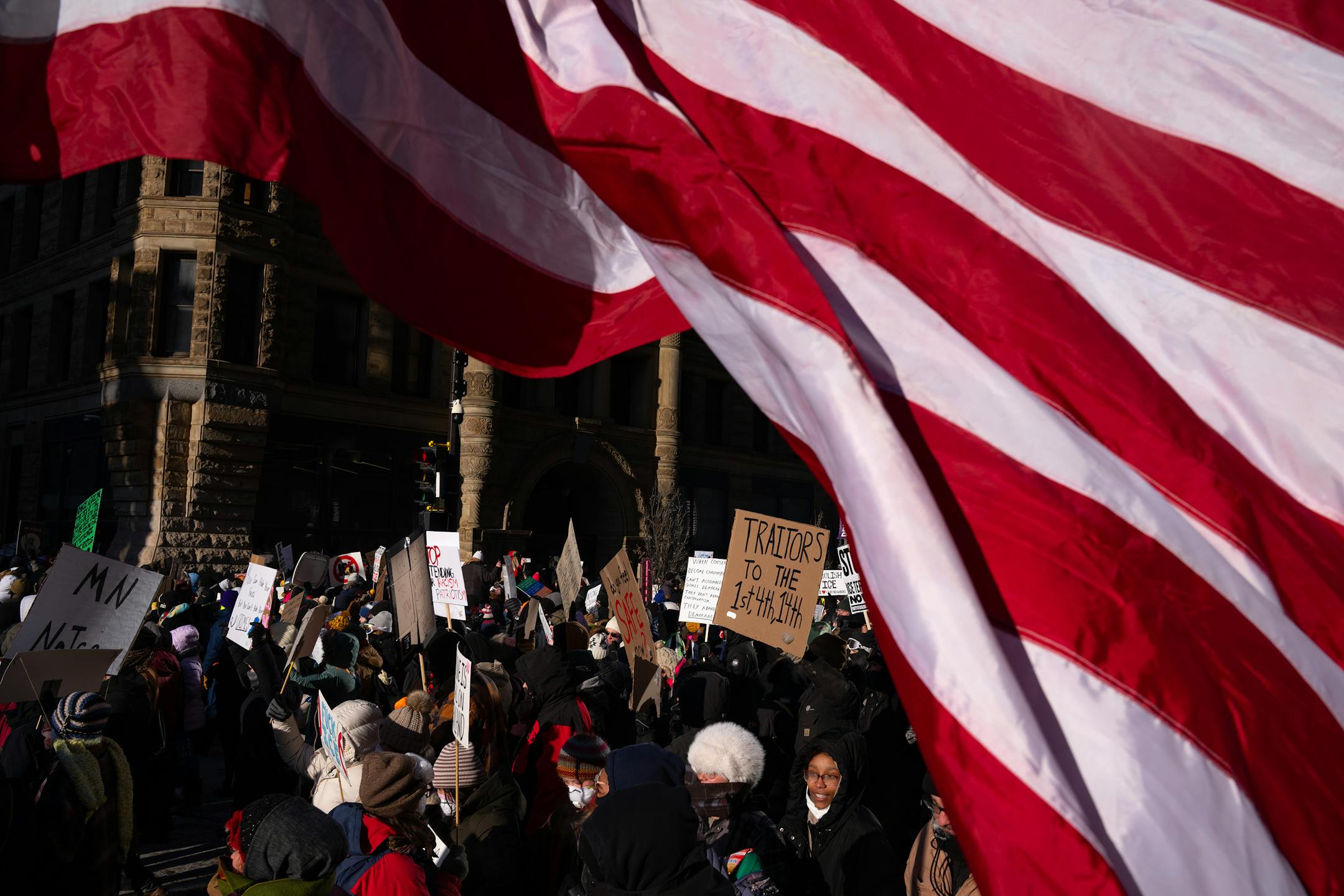
Thousands of people protest ICE and Operation Metro Surge by marching through downtown Minneapolis on Jan. 23. (Alex Kormann/The Minnesota Star Tribune)

Opinion editor’s note: Strib Voices publishes a mix of guest commentaries online and in print each day. To contribute, click here.

•••

In Minneapolis, Alex Pretti, an ICU nurse, was fatally shot during a federal immigration enforcement operation on Jan. 24. On Jan. 7, Renee Good, a mother and poet, was killed during a separate Immigration and Customs Enforcement (ICE) operation in the same city. These are not isolated tragedies. They are a civic alarm. If this is what state power looks like up close, what happens to our trust in government, and where does that take us?

Trust is the hidden foundation of leadership. It is what causes people to follow laws without constant force. It is what keeps societies stable when leaders falter. It is what allows citizens to accept short-term sacrifices, trusting in tomorrow. Every political system relies on some form of trust. But democracy and authoritarianism build it in fundamentally different ways.

In one system, trust is built through institutions. In the other, it is demanded through fear. That difference is not abstract. It shapes how power is exercised, how mistakes are corrected, and how societies respond when the state uses force.

I have lived under both systems. I know what it means to speak freely. I also know what it means to measure every sentence. I have seen how trust functions when it is voluntary and how it looks when it is performed. Those experiences sharpen a simple conclusion: The relationship between leaders and the public depends less on personality than on the architecture surrounding power.

In a democracy, trust works like a renewable contract. Leaders are not the state. They are temporary stewards of public authority. Legitimacy flows upward from citizens. Power is constrained by courts, legislatures, oversight bodies and a free press.

Trust here is not blind faith in a person. It is confidence in a system. Citizens can withdraw support without destabilizing the country because the country is anchored in rules rather than individuals.

This kind of trust is not automatic. It must be earned. Leaders build it by telling hard truths, admitting errors and respecting limits on their power. Citizens, in turn, can criticize leaders without being treated as enemies.

The process is slow. It is noisy. It can feel frustrating. But it produces something essential: correction. Democracies can withstand flawed leadership because institutions outlast individuals. Peaceful turnover may be uneasy, but it is a core source of democratic stability.

Authoritarian systems reverse this logic. Power is personalized. Loyalty to the leader replaces accountability. Institutions that might restrain authority are weakened. Dissent becomes costly.

What appears to be trust in these systems is often compliance. Public displays of support replace genuine consent. Silence stands in for agreement.

When people fear punishment, public speech diverges from private belief. Politics becomes performance. Leaders hear praise instead of truth. Errors compound. Corruption spreads quietly. The system may appear stable — until it isn’t.

Authoritarian leaders often call themselves strong. But coercion is not strength. A leader who must silence critics is not confident. A leader who cannot tolerate accountability is not secure.

Democracies do not need strongmen. They need strong institutions. And they need citizens willing to defend them.

Trust is not a mood. It is an outcome. It is produced by rules, incentives and limits on power. Democracies cultivate trust by making authority replaceable. Authoritarian systems cultivate obedience by instilling fear of authority.

The choice societies face is not between order and chaos. It is between two kinds of trust. One is rooted in fear. The other is rooted in freedom.

Only one of them lasts. And in moments like this, Minnesotans are right to ask which kind we are building.

Bedassa Tadesse is a professor of economics at the University of Minnesota Duluth.

about the writer

about the writer

Bedassa Tadesse

More from Commentaries

See More
card image
Anthony Souffle/The Minnesota Star Tribune

Pursuing criminal investigations for political and retaliatory motives is anathema to generations of federal prosecutors like us.

card image
card image