The last bite: Plant-based pioneers from Miyoko’s, Impossible see a vegan future

Also, cheaper Totino’s pizza rolls, AI is finally finding acceptance at food and ag companies, and CHS pulls back in Ukraine because of ongoing war with Russia.

The Minnesota Star Tribune
October 17, 2025 at 12:31PM
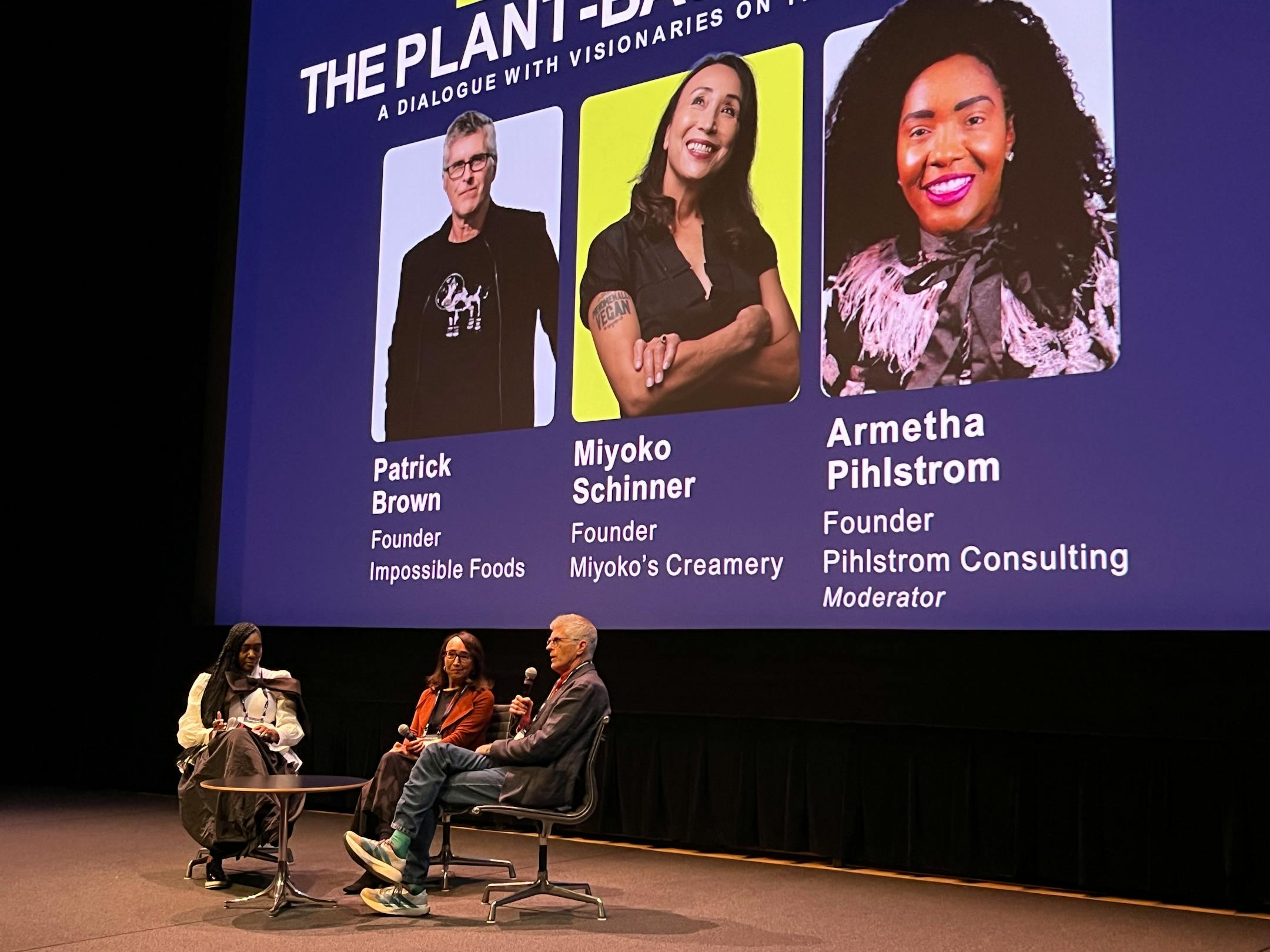
Armetha Pihlstrom hosts the kickoff conversation for Food Ag Ideas Week on Monday at the Walker Art Center featuring Impossible Foods founder Pat Brown and Miyoko's Creamery founder Miyoko Schinner. (Brooks Johnson/The Minnesota Star Tribune)

Welcome to “the last bite,” an end-of-week food and ag roundup from the Minnesota Star Tribune. Reach out to business reporter Brooks Johnson at brooks.johnson@startribune.com to share your news and surprising ways you’ve encountered AI at work.

A solid way to convince the world to go vegan is through economic incentives, according to Impossible Foods founder Pat Brown.

“The best possible product at the lowest possible price,” said the meat-substitute maven.

Brown spoke alongside Miyoko Schinner, founder of vegan dairy company Miyoko’s Creamery, at Food Ag Ideas Week on Monday in Minneapolis. And both shared their prognostications on the future of the nonanimal-product food industry.

“Economics is the biggest driver of behavior change, and, in fact, is probably the biggest driver of changes in cultures,” Brown said. “I still believe it’s completely realistic that within a couple of decades, driven purely by innovation and consumer choice, animal-based food production will be ... in the rearview mirror.”

Schinner sees a similar fate, but she no longer shares the same faith in the market to deliver it.

“The approach has to be through the embracing of culture and the embracing of community,” she said. “Changes happen only through awareness [and] our adoption of certain foods and developing them, not just top-down, but bottom-up from a grassroots setting, from just ordinary people in their kitchens, cooking.”

The plant-based pioneers, who are no longer with their companies, agreed the shift needs to happen to prevent and reverse climate change and preserve the planet’s ability to provide food and habitat for future generations of people and animals.

Schinner said she didn’t have all the answers yet, but her outlook essentially involves “reinventing the food system.”

Though their exchange was cordial, the differing paths were obvious.

“You have a very idealistic notion about what the world can look like,” Brown told Schinner, “and I feel like I’m more pragmatic. I would love if your vision came true, but I’m not counting on it.”

Data dish

Pizza roll lovers rewarded General Mills handsomely when the price of a large bag of Totino’s dropped earlier this year.

By getting under an unspecified “price cliff” — a psychological value threshold where demand abruptly drops off — the brand was able to sell 20% more pizza rolls, company leaders said Tuesday during an investors’ day event at the company’s Golden Valley HQ.

“The truth is, we can have the best product with the most compelling brand campaign, but if we’re priced too high, the consumer simply won’t put us [into] consideration,” said Dana McNabb, head of the company’s North America retail and North America pet businesses.

Based on the current going rate for the large Totino’s bags at Target and Walmart, it looks like consumers prefer their pizza rolls under $12 for a 130-pack. That’s marginally better than the “10 for about a dollar” campaign that led up to the Totino’s Super Bowl ad spot earlier this year.

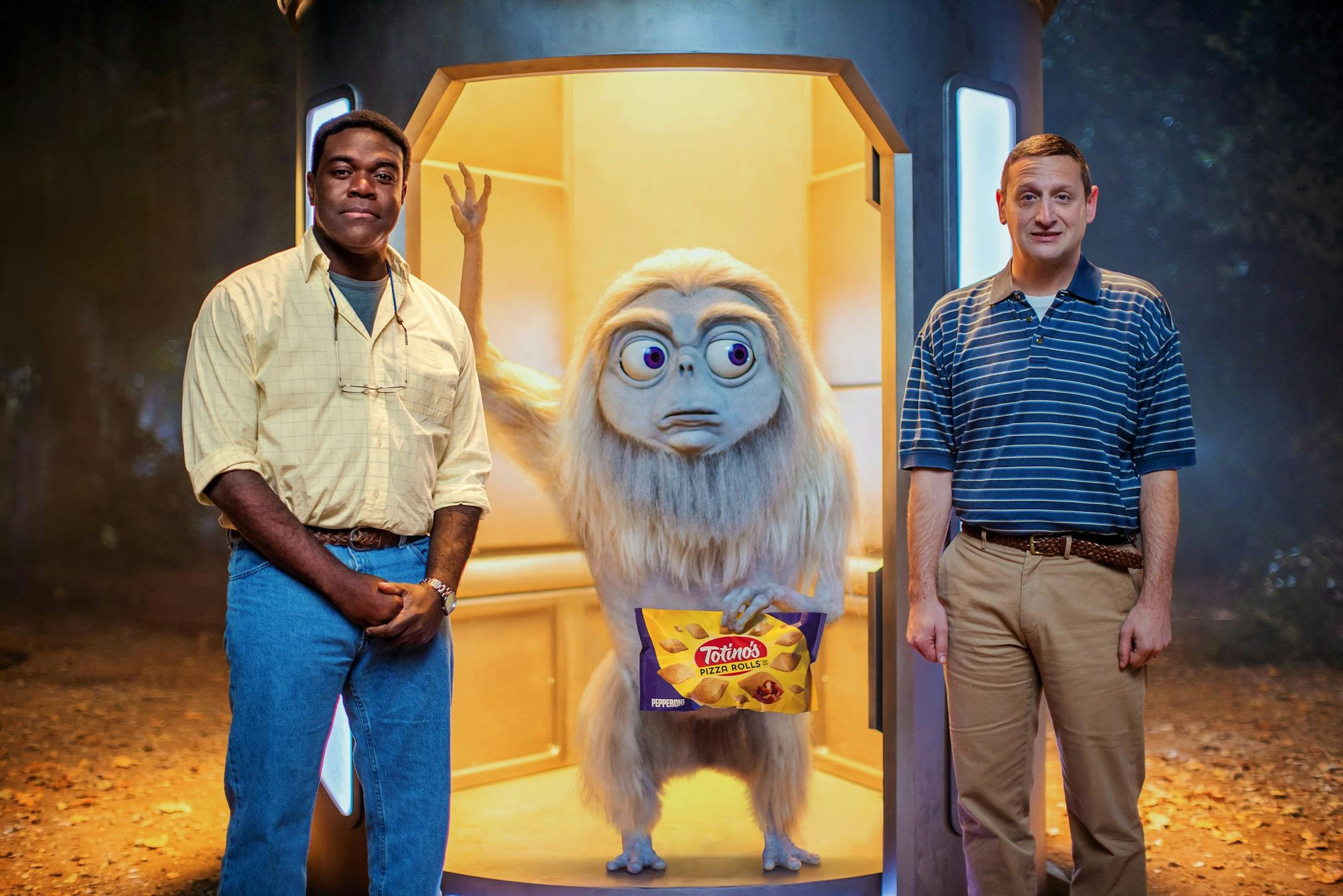
Sam Richardson, Chazmo the alien and Tim Robinson star in the Totino's Super Bowl ad. (General Mills)

Tech taste

Between Food Ag Ideas Week, General Mills’ investor day and Reuters’ Transform Food and Agriculture event, food industry players really descended on the Twin Cities this week.

At the latter event, Bread & Butter Ventures managing partner Brett Brohl shared a key observation on artificial intelligence: It has been around longer than folks realize (under the old term “machine learning”).

“How do we save money in R&D by predicting the thing that’s actually going to work or the ingredient that’s actually going to work?” Brohl said. “There were 20 of those companies in 2016 that I talked to, and most of them failed. Most of them didn’t get early adoption.”

Only now that there is broader understanding of the benefits and, sure, lower costs, is AI finding its place in food and ag companies.

“I work with a company that’s using artificially intelligent robots to make pizzas better,” he said. But it’s supply-chain management that is “the most likely place that you will see mass adoption.”

International nugget

CHS is largely backing out of Europe’s breadbasket, Ukraine, as the major grain-producing country remains under Russian attack.

“After careful consideration, CHS is adjusting its presence in Ukraine to align with current market conditions,” the Inver Grove Heights-based cooperative said in a statement. “As part of this change, we are reducing our workforce in Ukraine, but we will maintain a presence in the country.”

The nation’s largest ag co-op buys and moves grain around the world, with terminals in South America, Australia and the Black Sea in addition to its North American operations.

The Ukrainian agribusiness site Latifundist broke the news and quoted a CHS employee saying: “In a country at war, our risk profile is too conservative.”

And current market conditions are not conducive to risk. Grain prices remain depressed around the world, prompting agribusinesses to cut costs where they can. CHS recently closed its Lake Superior terminal, while the pullback in Ukraine is more about reducing personnel.

“We remain committed to serving both our U.S.-based owners and international customers who rely on consistent access to grain,” the company’s statement read. “Rather than depending on a third-party export facility in the Port of Odessa [Ukraine], we are leveraging our CHS-owned Silotrans terminal at the Port of Constanta [Romania]. This ownership gives us greater control, efficiency and reliability in moving grain through the Black Sea region.”

about the writer

about the writer

Brooks Johnson

Business Reporter

Brooks Johnson is a business reporter covering Minnesota’s food industry, agribusinesses and 3M.

See Moreicon

More from Agriculture

See More
The Abbey Church is a landmark on the St. John's University campus located in Collegeville.
The Minnesota Star Tribune

Local nonfiction: “Greater Minnesota” travelogue details a home-grown returnee’s conversion.

card image
card image