Review: He had to move away from Minnesota to begin to figure it out

Local nonfiction: “Greater Minnesota” travelogue details a home-grown returnee’s conversion.

Columnist Icon
The Minnesota Star Tribune
December 3, 2025 at 8:00PM
The Abbey Church is a landmark on the St. John's University campus located in Collegeville.
The Abbey Church, a landmark on the St. John's University campus in Collegeville, Minn., provides an epiphany in new book "Greater Minnesota." (The Minnesota Star Tribune)

“Unofficial Minnesota ambassador” remains an unfilled position since the departure of Garrison Keillor’s “A Prairie Home Companion."

A bevy of good writers live here, but it’s been awhile since someone with a writer’s eye has taken us on a tour of the state.

Into the breach, others have stepped: the TikTok answer to Rick Steves of John O’Sullivan’s “OneMinuteTours,” conversing on the Mall of America’s history or broadcasting with a selfie stick from the flood-ravaged dam collapse in Mankato. And there are books from J. Ryan Stradal — quiet dramas in Midwestern kitchens and supper clubs — to keep Lutefisk Nation happy.

Now comes Patrick Hicks, writer-in-residence at Augustana University, just over the border in Sioux Falls, and a native of Stillwater-on-St.-Croix. Hicks wrote “Greater Minnesota: Exploring the Land of Sky-Blue Waters,” an 11-chapter odyssey through Minnesota’s landscapes — from Lake Superior to the red rock petroglyphs of Cottonwood County — that at times feels as ambitiously piled-up as a Sweet Martha’s cookie bucket of state history.

But the book is never, exactly, over-sweet. Hicks, a dual Irish citizen who left home after graduation, grew up without the Swedish-German-Norwegian ancestral cultural passport that doubles for insider status in Minnesota. His observations come from the remove of a middle-aged man, rediscovering home.

“I immediately liked the idea of getting to know my home state as if it were a foreign country,” Hicks writes.

Like a taster tour of some corner of Europe, Hicks packs a lot in: from an obligatory Bob Dylan boyhood home visit to a world-renowned sacred image archive in Collegeville to a 19th century tornado that led some nuns to persuade Dr. William Mayoto open a clinic in a small town along the Zumbro River.

What makes Hicks’ literary campaign far better than a glossy travel pamphlet is that he doesn’t take anything too preciously.

Hicks begins along the North Shore where he marvels at Naniboujou Lodge’s famed psychedelic walls. Later, in a chapter on the Iron Range, Hicks meets a volunteer at the U.S. Hockey Hall of Fame who replies to his inquiries with one-syllable responses while devouring a tower of saltine crackers. When Hicks discovers that an ornamental hockey stick isn’t technically the world’s biggest, the writer deadpans, “Whatever. I still wanted to see the stick in Eveleth.”

Such enjoyable travelogues as John Steinbeck’s “Travels with Charley” or Bill Bryson’s “The Lost Continent,” are never overly excited about what they find, either.

But Hicks has serious moments. There’s a chapter on the U.S.-Dakota War and the hanging of Dakota men on the day after Christmas, 1862. There’s the writer’s summer homecoming to St. John’s University, his alma mater, where he sits alone in the modernist Abbey Church, believed to be the fictional inspiration for the 2024 film “The Brutalist,” before hearing an impromptu organ rehearsal.

“It was like a musical dam had broken open and notes were flooding the church,” he writes.

Sure enough, Hicks comes under the influence of his butter-sculpting home state. By the time he reaches the Great Minnesota Get-Together — which he compares to “Brigadoon” — Hicks is converted.

“We wanted to see the hogs,” he writes determinedly, as he and his sister navigate State Fair crowds.

Minnesota is no longer the Lake Wobegon set piece long popularized by Keillor. It’s more complicated politically than the flannel-clad progressivism embodied by its most recent, albeit short-lived, export to the national consciousness, Gov. Tim Walz.

But in social media hyperspace, where we can watch someone making a ham sandwich in Brussels, it’s nice to sit with a book and know regionalism still encourages community. Did you know about the Lost Forty old-growth woods in the Chippewa National Forest? Or that Ernest Hemingway spent some of his final, troubled days in Rochester?

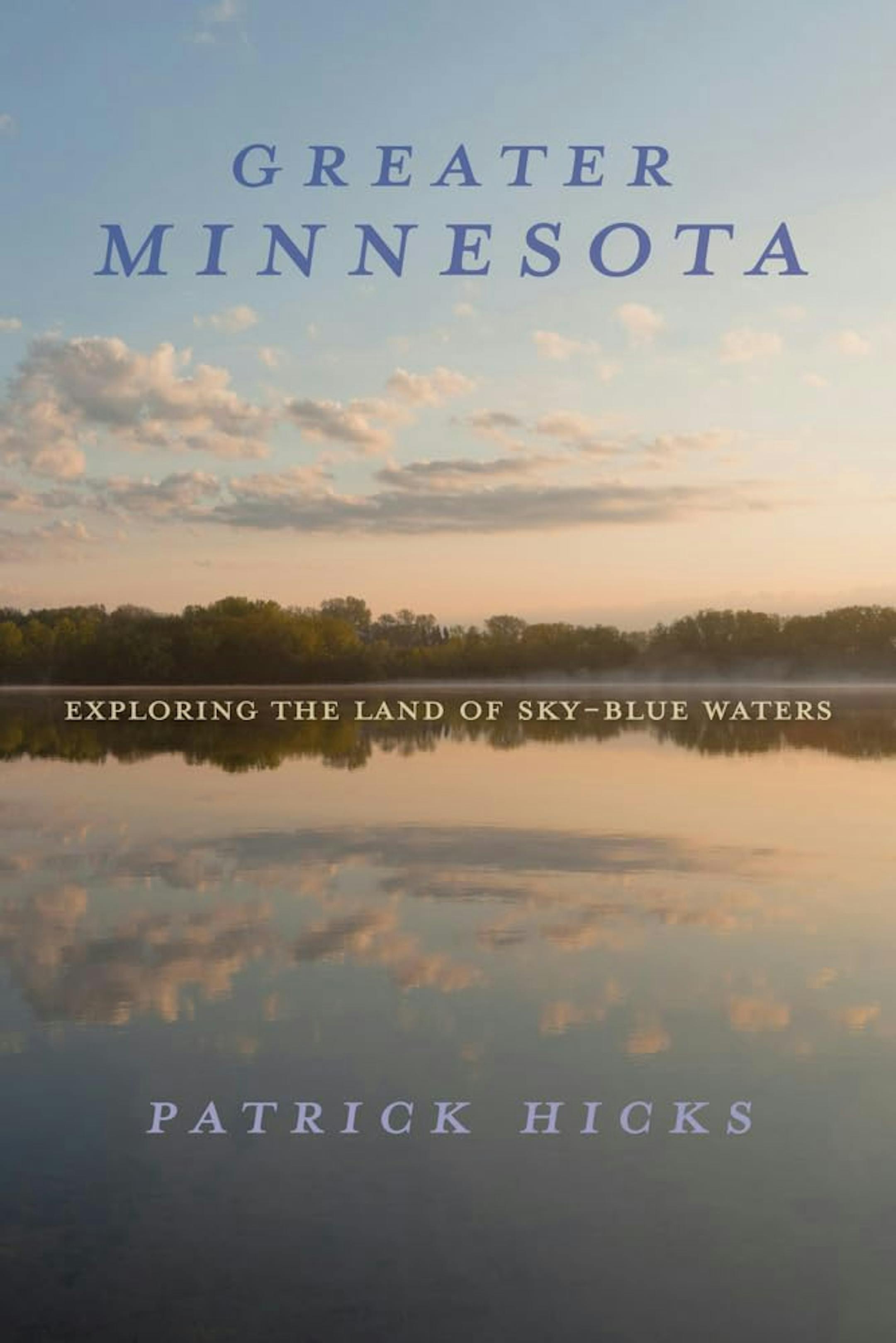
cover of Greater Minnesota is a photo of land and sky reflected in a lake
Greater Minnesota (Indiana University Press)

There’s plenty Hicks, who’s donating proceeds of the book to offset the carbon footprint that many miles in his Subaru logged, doesn’t get to, too — the Red River Valley, for instance.

But we’re grateful for his efforts at keeping us focused. His final chapter on the new flag design, which he says resembles a Dakota quilt (and yes, there’s a laser loon reference), illustrates the impossibility of this task.

We live beside each other and hold so much in common, regardless of whether we’re in a tractor outside Blue Earth or a mansion in Duluth. It’s a marvel to go so deep into our state and not once get reminded of what divides us.

Greater Minnesota: Exploring the Land of Sky-Blue Waters

By: Patrick Hicks.

Publisher: Indiana University Press, 208 pages.

about the writer

about the writer

Christopher Vondracek

Washington Correspondent

Christopher Vondracek covers Washington D.C. for the Minnesota Star Tribune.

See Moreicon

More from Books

See More
The Rootsí drummer Ahmir ìQuestloveî Thompson on the Main Stage Sunday evening at Soundset 2016. ] JEFF WHEELER ï jeff.wheeler@startribune.com The ninth annual Soundset hip-hop festival took place in its new location at the Minnesota State Fairgrounds Sunday, May 29, 2016 in Falcon Heights.
Jeff Wheeler/The Minnesota Star Tribune

Nonfiction: “Backbeats” shows how 15 drummers changed the rock ’n’ roll world.

photo of woman in front of lavender flowers
card image