
In social media posts, Trump targets Somali community in Minnesota after National Guard shooting

The messages posted late Thanksgiving night on social media blaming immigrants for social issues came as the president intensified anti-immigrant rhetoric.

November 28, 2025 at 6:27PM
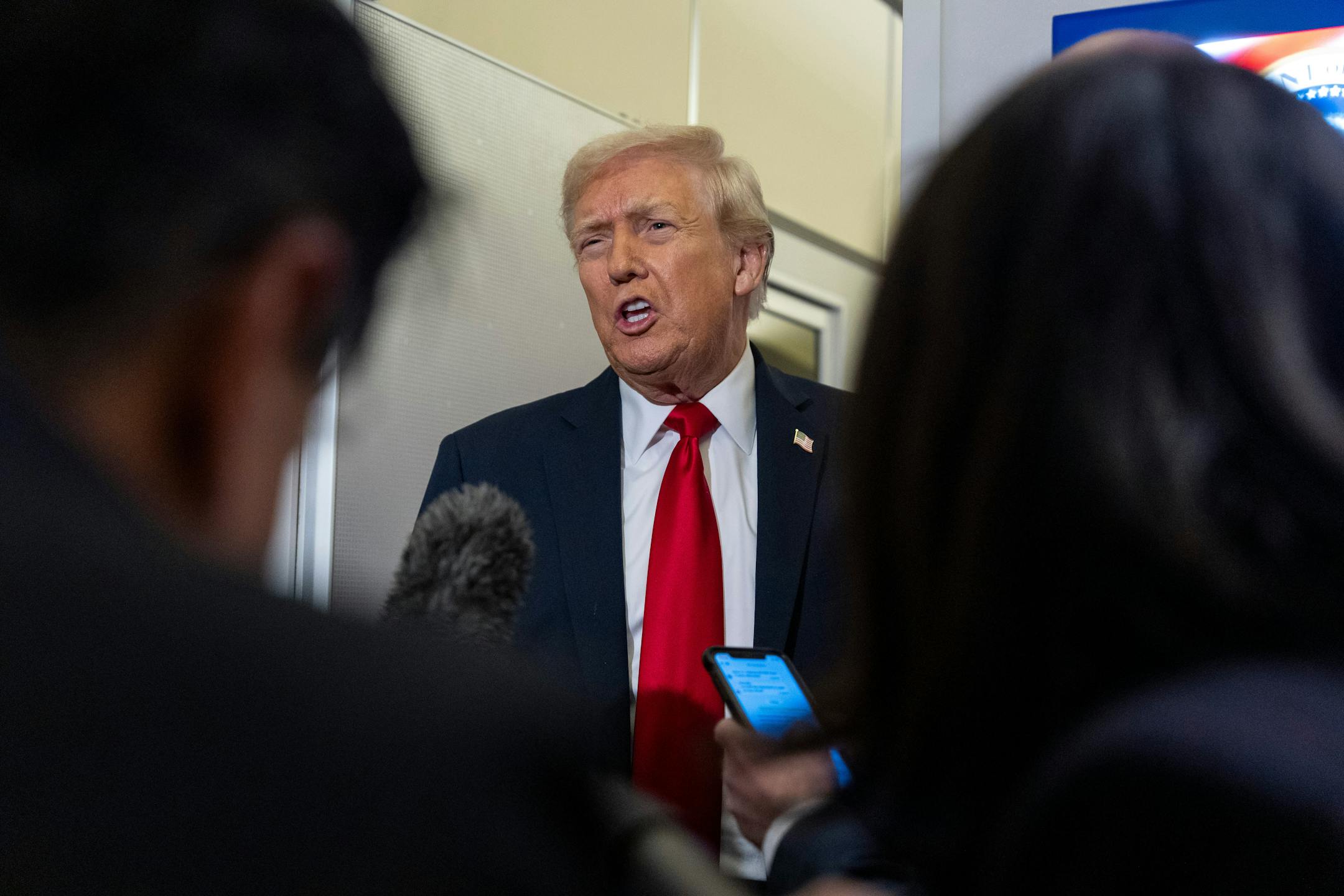
President Donald Trump also used a slur to criticize Walz as ineffective and repeated an unfounded claim that Rep. Ilhan Omar married her brother. (Alex Brandon/The Associated Press)

Minnesota Democrats and immigrant advocates rebuked President Donald Trump on Friday, after he ramped up anti-immigrant rhetoric Thanksgiving night by criticizing the state’s Somali community on social media.

In a series of posts on Truth Social around 10:30 p.m. Thursday, later shared on X, Trump characterized Somali refugees as “completely taking over the once great State of Minnesota,” falsely saying that Minnesotans are locking themselves in their homes to avoid roving Somali gangs. He punctuated his argument with derogatory language about Gov. Tim Walz and U.S. Rep. Ilhan Omar.

The comments about Minnesota came as Trump said he wanted to “permanently pause migration” from poorer nations and promised to expel millions by revoking their legal status. He criticized immigrants as a drain on resources and called refugees “the leading cause of social dysfunction in America.” The post follows Trump’s recent pledge to end Temporary Protected Status for Somalis in Minnesota.

His posts represent an escalation of anti-immigrant rhetoric, and come after the shooting of two National Guard members who were patrolling Washington, D.C., under his orders. One died and the other is in critical condition.

The suspected shooter is an Afghan national who worked with the CIA during the war in Afghanistan. He came to the U.S. after it withdrew from Afghanistan as part of a program to resettle those who helped American troops.

Also on Thursday, the Trump administration’s director of U.S. Citizenship and Immigration Services pledged to conduct a review of each green card holder from what he termed a “country of concern,” appearing to refer to a list of 19 countries that includes Somalia, Laos and Myanmar. Minnesota is home to a significant number of immigrants from those three countries.

In a statement Friday, Jaylani Hussein, executive director of the Minnesota chapter of the Council on American-Islamic Relations (CAIR), said Trump’s rhetoric puts Somali Minnesotans in danger.

“When politicians turn entire communities into symbols in their political battles, they stop talking about policy and start playing with people’s lives,” he said. “This rhetoric doesn’t stay on television or social media. It shows up in our neighborhoods, our mosques, our schools, and our workplaces. It creates fear, and it puts Somali and Muslim families in real danger.”

In a fundraising email Friday morning, Walz criticized Trump’s comments.

“While families across Minnesota and the rest of the country were celebrating Thanksgiving, Donald Trump used the moment to launch a barrage of attacks on Minnesota — using deeply offensive language and spreading lies about our immigrant community,” Walz said.

Minnesota immigrants on edge

Trump’s Thanksgiving posts blamed immigrants for everything from crime to crowded hospitals to the housing shortage. Among other things, he said he would “remove anyone who is not a net asset to the United States,” claimed he will end federal benefits to non-citizens and “denaturalize migrants who undermine domestic tranquility,” and deport any foreigner who “is a public charge, security risk or non-compatible with Western Civilization.”

It is not clear how Trump would carry out some of his proposals. Denaturalization is a rare and lengthy legal process, according to the Immigrant Legal Resource Center.

Still, the increasingly negative rhetoric in recent days has left some members of Minnesota’s immigrant communities feeling on edge.

Mahdi Surosh, 32, a Fulbright scholar from Afghanistan who arrived in Minnesota days before the fall of Kabul in August 2021 and has an active asylum case, said he felt sad when he heard about Wednesday’s shooting of National Guard members.

When he learned the culprit was Afghan, he said felt a wave of fear and worry about what would happen to his community. He said he saw what people were saying about Afghans on social media, and he put his phone away for the night.

“I believe that Afghan did a very, very bad thing, but that is not defining of who Afghans are,” Surosh said.

Other Afghans in Minnesota are scared that their immigration statuses will be upended, said Surosh, a project manager for the Center for Victims of Torture in Minnesota.

“We are just like any other humans, we are humans who are trying to work hard, make our life, contribute positively in society,” Surosh said. “Those acts of violence that have happened — unfortunately — those acts of violence are exactly the things that we have fled from.”

Walz and Omar respond

Trump’s posts began Thursday with criticism of the Afghanistan airlift under President Joe Biden, before ranging into broad criticism of immigration and landing on Minnesota’s Somali community.

The widespread nature of Trump’s comments underscores the scope of the president’s ambitions to scale back immigration.

At Mar-a-Lago, reporters asked Trump what Minnesota Somalis had to do with the suspected Afghan shooter of National Guard members. “Ah, nothing. But Somalians have caused a lot of trouble,” Trump replied.

On social media, he used a slur to criticize Walz as ineffective and repeated an unfounded claim that Omar married her brother.

Walz, who is running for a third term as Minnesota governor, responded on his personal X account overnight with a jab at Trump.

“Release the MRI results,” Walz wrote, referring to a recent MRI test Trump has said he underwent.

Omar has frequently defended Minnesota’s Somali community against Trump’s rhetoric in posts in the last week, pointing out that she and a majority of Somalis in America are U.S. citizens.

Asked to respond Friday to Trump’s most recent comments, Jackie Rogers, a spokesperson for Omar, said, “The congresswoman thinks his obsession with her is unhealthy and hopes he gets help.”

Roughly 9% of Minnesotans are foreign-born, according to census data, a share similar to Utah, Colorado, Pennsylvania and Nebraska. Foreign-born people made up 37% of Minnesotans in the late 1800s, according to Minnesota Compass.

Minnesota is home to more Somalis and Somali Americans than any other state, and has welcomed more than 26,000 Somali refugees since 1993.

The state is also home to the country’s largest Karen community. More than 20,000 Karen have come to Minnesota as refugees from Myanmar.

Christopher Vondracek of the Minnesota Star Tribune contributed to this story. This story contains material from the Associated Press and the New York Times.

about the writers

about the writers

Greta Kaul

Reporter

Greta Kaul is the Star Tribune’s built environment reporter.

See Moreicon

Jp Lawrence

Reporter

Jp Lawrence is a reporter for the Star Tribune covering southwest Minnesota.

See Moreicon

Ryan Faircloth

Politics and government reporter

Ryan Faircloth covers Minnesota politics and government for the Star Tribune.

See Moreicon

More from Politics

See More
card image
Renée Jones Schneider/The Minnesota Star Tribune

“His immigration policy was cruel in his first administration, and now it’s just outright dangerous,” she says.

card image