
ICE isn’t just tracking your phone. The surveillance technology goes further.

The advanced surveillance tools allow ICE agents to scan people’s faces to determine their citizenship, access highly sensitive personal data and monitor entire neighborhoods all at once.

Sahan Journal
February 7, 2026 at 8:00PM
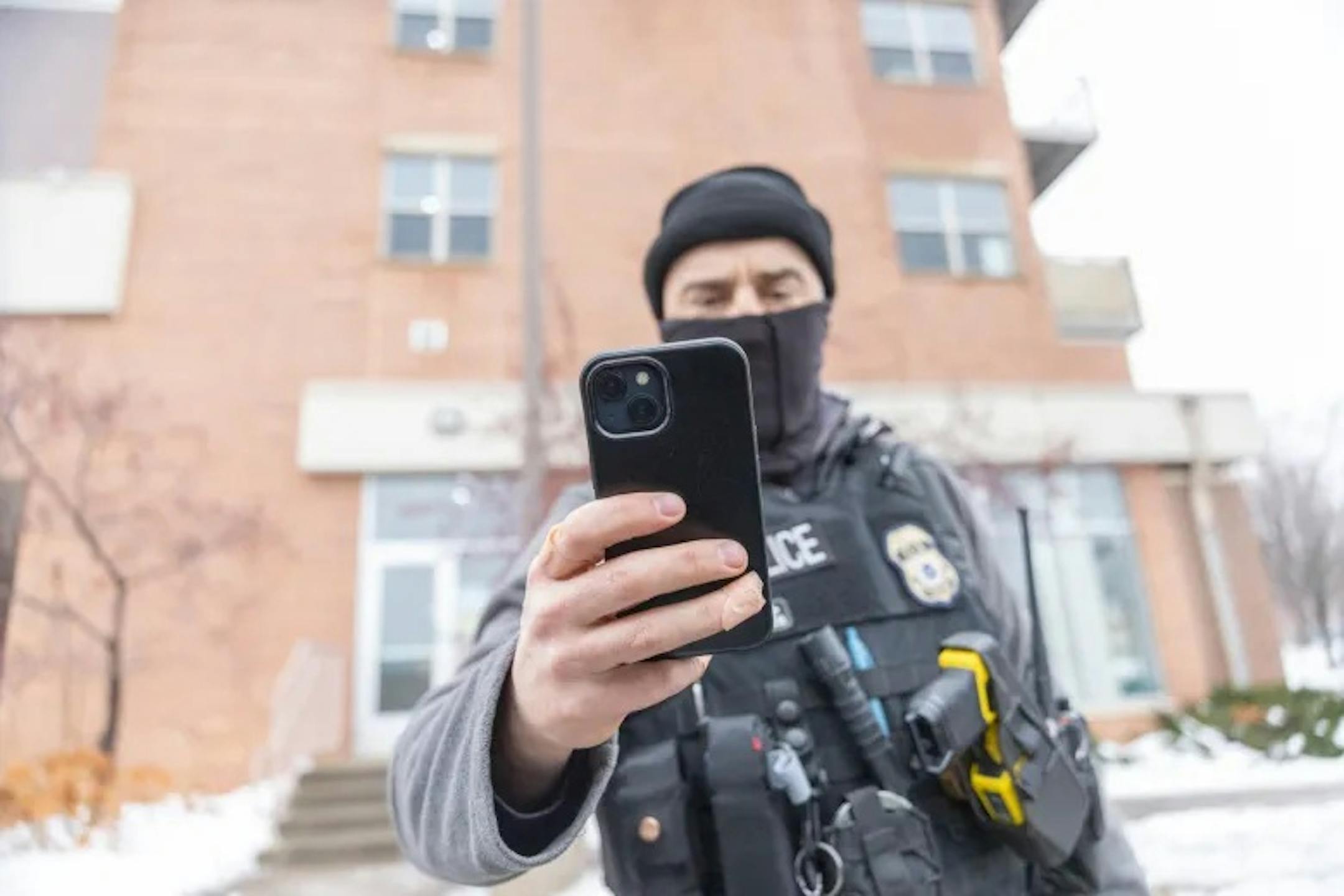
An immigration agent holds up his phone to a journalist in Minneapolis on Jan. 6. (Chris Juhn/Sahan Journal)

By now, the videos of immigration agents holding up their phones to people’s faces or scanning license plates are everywhere.

While the exact reasons may seem murky, experts say one thing is clear: The federal crackdown is being powered by a vast surveillance network that has spread far beyond immigrant communities.

Surveillance technology experts and digital rights advocates told Sahan Journal that they are alarmed about the ability of the thousands of Department of Homeland Security and Customs and Border Protection agents in Minnesota to surveil, monitor and collect data during field operations — from facial recognition technology to “stingrays” that collect information from phones by impersonating cell phone towers.

Experts say these tools not only help agents identify specific targets to detain, but also allow them to monitor entire neighborhoods at once, sweeping citizens and non-citizens alike into a broad surveillance dragnet.

That “should be concerning to everyone,” said Cooper Quintin, senior technologist at the Electronic Frontier Foundation.

Quintin said that ICE can synthesize a vast array of data, including government databases, such as tax and immigration records, and data collected through airport security screenings, Transportation Security Administration (TSA) facial scans and interactions with customs at borders.

ICE also buys data from commercial and media databases, and private-sector data, including location data collected from mobile phone advertising, license plate reader systems that track vehicle movements, and large aggregated databases run by companies such as LexisNexis and TLOxp. These private databases compile and link multiple types of personal information, such as vehicle records, home addresses, and other identifying data, into detailed individual profiles.

It also has access to a database of health and auto insurance claims and is using it to locate people targeted for deportation, 404 Media reported. The database contains personal data including names, home addresses, phone numbers, tax identification numbers and license plate information.

On the streets, ICE and CBP have access to Mobile Fortify, an app that scans people’s faces to determine their citizenship in a matter of seconds.

“For years, ICE has had mechanisms by which they are able to, either by using facial recognition technology or fingerprints, do a quick scan of individuals in the street to determine whether or not they are already within the Department of Homeland Security system, and whether or not they are arrestable,” said Amy Fischer, director of refugee and migrant rights at Amnesty International USA.

In a video posted on Instagram by Minneapolis resident Nimco Omar, CBP agents appear to be using that technology on her. They can be seen scanning her face after she refused to show identification, saying she is a U.S. citizen. An agent held up his phone to her face, and moments later, they walked away, probably because they determined her citizenship.

ICE has no real reason to be collecting biographical information on U.S. citizens, Fischer said. “It is beyond the mission of what they do,” she said.

Many immigrants are already under some type of electronic surveillance — like ankle monitors, special cellphones and watches. ICE says these alternatives to detention “ensure compliance with release conditions and provide important case management services for non-detained aliens.”

That was the case for Liberian immigrant Gibson Garrison, who was arrested at his home. He had had a check-in with his ICE supervisor two weeks before his arrest and wore an ankle monitor for about two years.

Surveillance technology that once was deployed by the U.S. in countries such as Iraq and Afghanistan and used along the U.S. border have now been redirected domestically, according to experts.

Earlier this month, 404 Media reported that ICE is using an app called ELITE (Enhanced Leads Identification & Targeting for Enforcement) that populates the map with potential deportation targets, and brings up a dossier on each person.

Another tool, Weblock, has the locations of millions of phones because of advertising data generated from apps. Weblock is able to surveil the locations of millions of people’s phones, and ICE is able to get that data without a warrant, Quintin said.

Federal agents also use stingray tracking devices, known as cell-site simulators, which mimic cell towers to force nearby phones to connect, allowing agents to locate a target’s device. In the process, the technology also captures data from bystanders’ phones.

A 2022 report by Georgetown University found that, in 2022, ICE had scanned the driver’s license photos of 1 in 3 adults, and had access to the driver’s license data of 3 in 4 adults, among other findings.

Yet there is probably much more technology that remains largely hidden. Last year, ICE paid $30 million to Palantir to build ImmigrationOS, a surveillance system that streamlines the identification and deportation of immigrants.

Because much of this data is collected without a warrant, there is little to no oversight or accountability.

“We’ve built this horrifying Orwellian surveillance industry over the last 10 to 20 years, and now ICE is buying access to all of it,” Quintin said.

And it’s not error free.

Chris Weiland, the chair of Restore the Fourth Minnesota, said that agents are prone to believe these tools rather than a person who presents actual documents. Plus, Fischer said, facial recognition technology itself is also inherently racist, not accurately reading faces of certain races or ethnicities. Invasive surveillance technologies like these violate Fourth Amendment rights, which protects individuals against unreasonable searches and seizures by the government, Fischer said.

CNN reported that the DHS asked federal agents temporarily assigned to the city to “capture all images, license plates, identifications, and general information on hotels, agitators, protesters, etc., so we can capture it all in one consolidated form.”

Weiland theorized that they could be building a database of people they might target, or could simply be trying to intimidate them.

About the partnership

This story comes to you from Sahan Journal, a nonprofit newsroom dedicated to covering Minnesota’s immigrants and communities of color. Sign up for a free newsletter to receive Sahan’s stories in your inbox.

about the writer

about the writer

Shubhanjana Das

More from News & Politics

See More
card image
Carlos Gonzalez/The Minnesota Star Tribune

Gov. Tim Walz and Minneapolis Mayor Jacob Frey said they were both told by White House officials that a drawdown of federal agents was imminent.

card image
card image