
‘Never seen anything like this’: ICE delving deep into Minnesota workplaces

Immigration lawyers say ICE is focusing on smaller employers in workplace enforcement under President Donald Trump’s second term.

The Minnesota Star Tribune
January 15, 2026 at 11:00AM
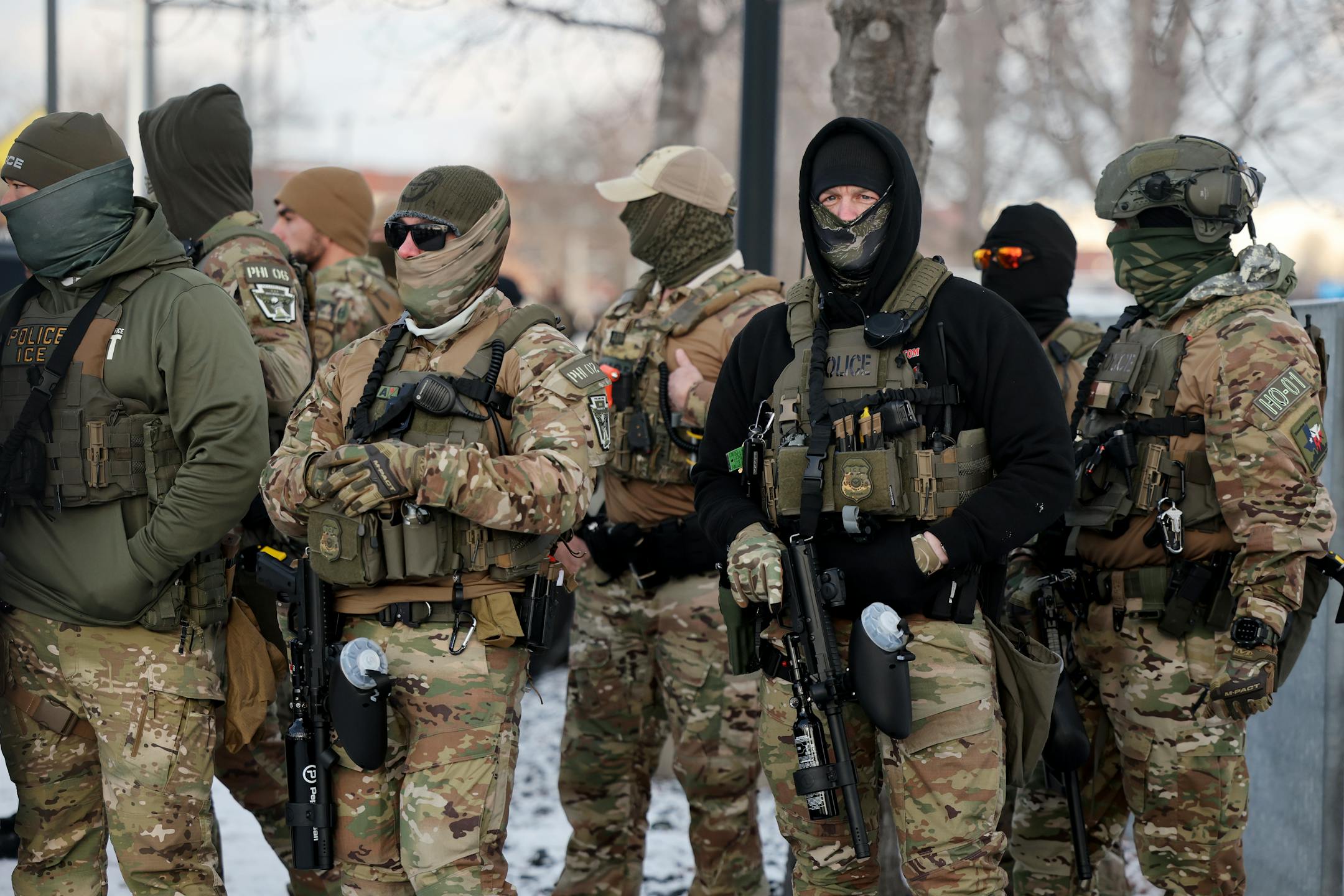
Agents with federal immigration law enforcement stand outside the Whipple Federal building at Fort Snelling on Jan. 10. (Elizabeth Flores/The Minnesota Star Tribune)

Immigration and Customs Enforcement is increasingly targeting small and mid-sized businesses in Minnesota, broadening workplace enforcement beyond the large-employer raids of the past to include smaller workplaces and, at times, individuals.

Attorneys who specialize in immigration workplace enforcement say ICE now appears to be prioritizing volume over the size of the businesses involved. The agency’s investigative arm, Homeland Security Investigations, is issuing more subpoenas for employment records and pursuing fines against smaller employers at a scale the attorneys describe as unprecedented under President Donald Trump’s second term.

“We’ve never seen anything like this before in terms of sheer quantity,” said Michael Davis, who has practiced immigration workplace enforcement law for more than three decades.

His St. Louis Park–based firm, Davis Immigration Lawyers, once handled only a handful of workplace enforcement cases each year but is now handling several every week. Instead of a limited number of large, high-profile raids, Davis said, ICE is carrying out a much higher volume of audits, subpoenas, fines and, at times, raids— often without regard to the size of the business.

Much of that enforcement, Davis said, centers on paperwork violations tied to employment verification documents rather than allegations of employing unauthorized workers. In two recent cases he worked on, he said, separate businesses were each assessed fines of about $100,000 for paperwork errors alone, penalties he described as “a significant hit for a small business.”

“This is part of the administration’s overall effort not just to ensure compliance, but to make it more difficult for businesses to operate,” Davis said.

The Department of Homeland Security did not respond to the Minnesota Star Tribune’s requests for comment.

A shift toward smaller businesses

Historically, high-profile immigration workplace enforcement focused on large employers such as agricultural operations, food processors or factories employing hundreds of workers.

During Trump’s first term in August 2018, federal agents raided Christensen Farms, one of the nation’s largest pork producers, serving search warrants at multiple locations in Minnesota and Nebraska and issuing arrest warrants for more than 130 workers suspected of being in the country illegally.

The current approach looks markedly different.

In November, federal agents conducted an immigration raid at Bro-Tex Inc., a paper distribution company in St. Paul that employs between 51 and 200 people, according to its LinkedIn page. Federal officials said 14 workers were arrested. Company officials declined to share additional information about the raid or the immigration status of the workers who were arrested.

Workplace raids often begin from information gathered through audits, as paperwork inspections can provide the basis for search warrants and arrests. ICE has increasingly served notices of inspection — formal demands that businesses turn over employment verification paperwork, known as I-9 forms, within three days — on companies that sometimes have only a handful of employees. Those notices are often paired with subpoenas for additional records.

A former senior Department of Justice official, who requested anonymity to speak candidly, said it is unusual for ICE to serve notices of inspection without regard to a business’s size, noting that the process takes a lot of work, requiring agents to deliver the notice, review records with auditors and determine whether fines or litigation are warranted.

Despite the labor-heavy nature of the process, ICE is carrying out these inspections more frequently than in the past, Davis said.

“They’re out for the number of audits, the number of arrests, the number of fine assessments,” he said. “We never saw a numbers-based system in the past. It was more of a compliance-based system. Now it’s just pure numbers.”

ICE does not regularly publicly disclose how many inspections it conducts, how many fines it issues or how much money it collects from employers. ICE and Homeland Security Investigations did not provide aggregate data on workplace enforcement in 2025 despite repeated requests from the Star Tribune.

In fiscal year 2018, the last time the agency publicly reported workplace enforcement data, ICE reported that HSI opened 6,848 worksite investigations — a sharp increase from 1,691 in 2017 — and conducted 5,981 I-9 inspections that year.

Employers caught in the middle

A lack of transparency from the federal agency, attorneys say, has left employers struggling to understand both their risk and their obligations.

For years, the Department of Homeland Security promoted E-Verify, the federal electronic system used to check workers’ employment eligibility, as a safe harbor. Recent enforcement actions, however, have undercut that message.

In one high-profile case reported by the Associated Press, a Nebraska meatpacking company that used E-Verify still saw workers arrested — prompting ICE officers to say the E-Verify system “is broken.”

In another situation in Maine, DHS stated to local news outlets that verifying a noncitizen’s documentation through federal E-Verify is not enough to confirm someone’s legal immigrant employment status.

“The fact that the government itself might be saying, ‘Don’t rely on it,’ is problematic,” Davis said. “It’s a government system. If you can’t rely on that, what can you rely on?”

The shift leaves employers in a precarious position. Federal law requires them to verify work authorization, but also prohibits discrimination against workers who are legally authorized to work but are not U.S. citizens.

The former DOJ official said employers can face penalties on either side: risking discrimination claims or ICE enforcement. They said that unpredictability can heighten fear — and that fear can function as deterrence.

Davis warned the stakes extend beyond compliance, particularly for smaller businesses that cannot absorb the sudden loss of workers, including employees who are legally authorized to work but afraid of being unlawfully detained, or the cost of steep fines.

“It goes beyond legal compliance,” Davis said. “It’s actual financial survival for many companies.”

about the writer

about the writer

Emmy Martin

Intern

Emmy Martin is an intern at the Minnesota Star Tribune.

See Moreicon

More from Business

See More
card image
Elizabeth Flores/The Minnesota Star Tribune

In today’s newsletter: Bill George, Kevin O’Connell, Angie Lee, Meghan Gencev, Dr. Allisa Song, Dr. Sina Fateh, Dr. Robert Kinast, Danny King, Kenny King, Ted Kozlowski and Reed Robinson

card image
card image