How did Hubert Humphrey’s time as mayor change Minneapolis?

Humphrey was the city’s leader before he headed to the U.S. Senate and White House.

The Minnesota Star Tribune
November 14, 2025 at 12:00PM
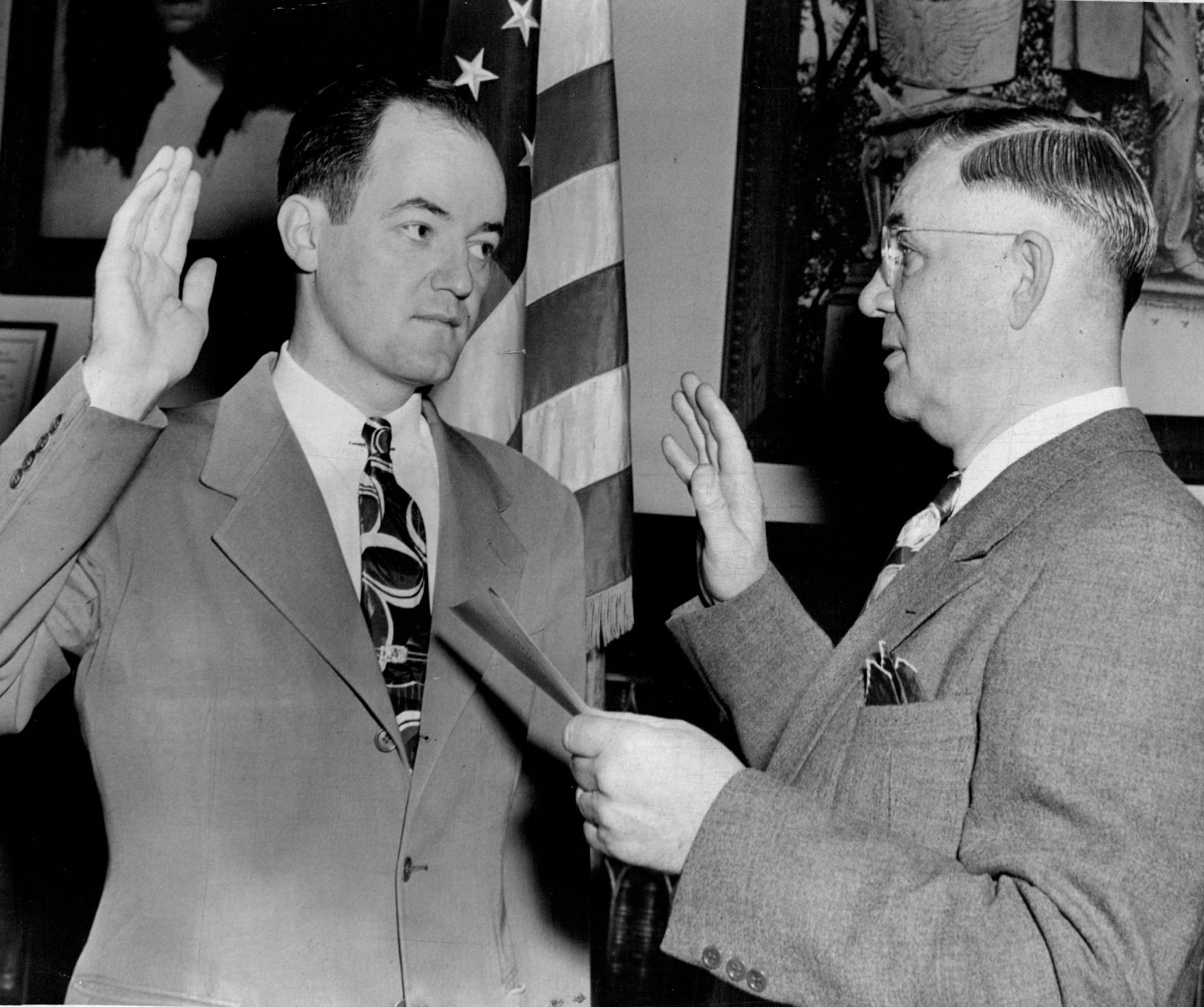
Hubert H. Humphrey was sworn in as mayor by city clerk Charles Swanson. (Roy Swan/The Minnesota Star Tribune)

Listen and subscribe to our Curious Minnesota podcast: Apple Podcasts | Spotify

A Minneapolis-St. Paul International Airport terminal is named for him. So is the University of Minnesota’s School of Public Affairs.

He’s arguably one of Minnesota’s most significant politicians of all time — but mayor of Minneapolis isn’t the role that most think of when they hear the name Hubert H. Humphrey.

Minneapolis resident Jeff Goldenberg has been wondering about Humphrey — who rose to become vice president in 1965 — and his first years in politics. Goldenberg wrote to Curious Minnesota, the Strib’s reader-powered reporting project, to ask: What kind of Minneapolis mayor was Humphrey in the 1940s?

According to historians, Humphrey experts and newspaper reports, Humphrey was one of Minneapolis’ most popular and consequential mayors. He served just three years in office, but took on racism and antisemitism, ushering in fair employment laws and police reform.

And he was re-elected by a margin that, at the time, was the widest in city history.

Minneapolis would not be the city it is today without him, said Samuel Freedman, author of the Humphrey biography “Into the Bright Sunshine.”

“Minneapolis as this solidly liberal city, that comes from Humphrey’s mayoralty forward, no question about it,” Freedman said. “He transformed Minneapolis from a national symbol of bigotry to a national symbol of progress on civil rights.”
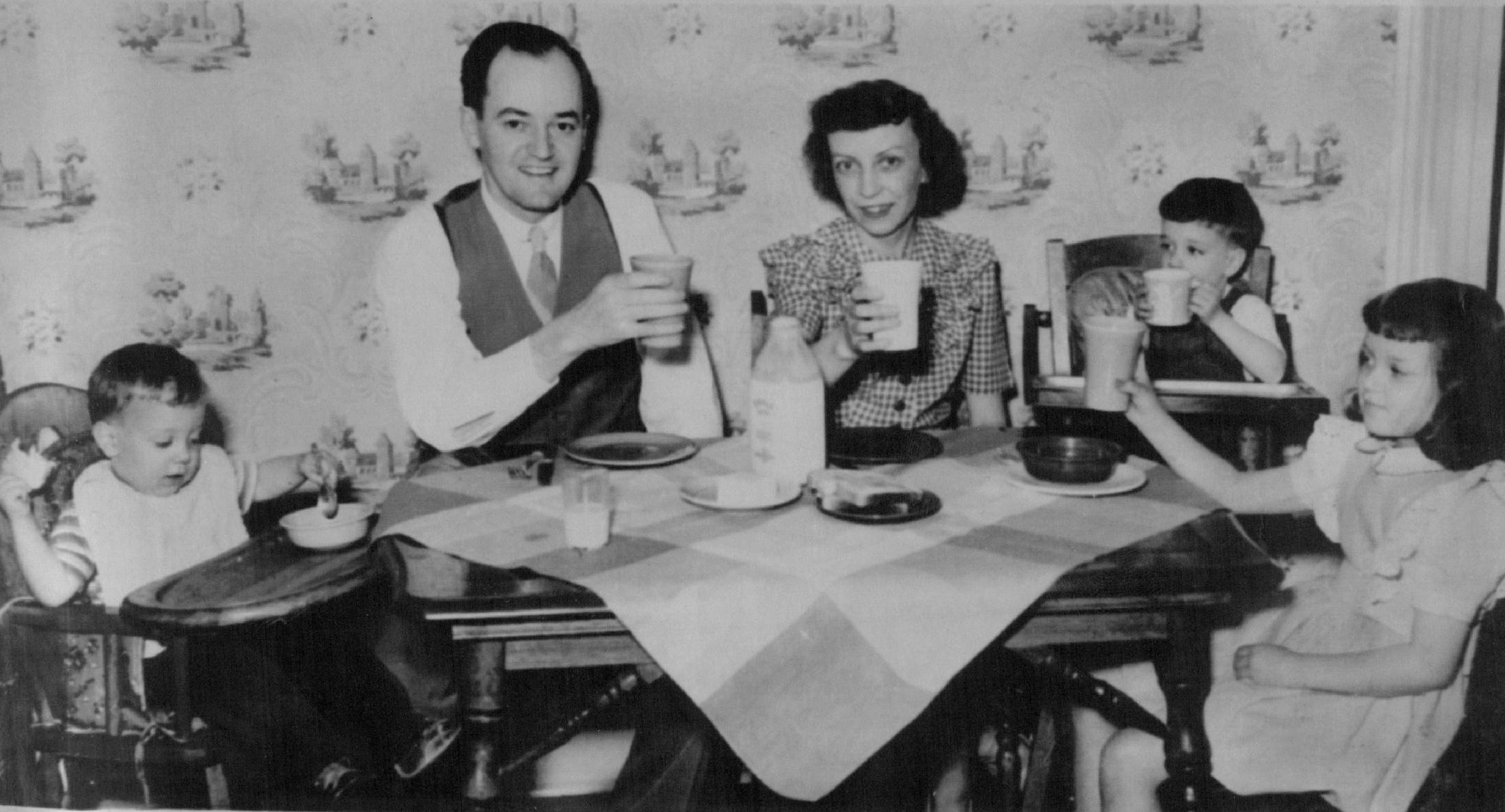
Hubert Humphrey, his wife, Muriel, and their children after he won election as mayor of Minneapolis. (The Associated Press)

Getting to City Hall

Humphrey, who was originally from South Dakota and worked as a pharmacist for a few years, found his path into politics in the classroom. He graduated from both the University of Minnesota and Louisiana State University with degrees in political science.

He was pursuing a Ph.D. in the same field when political science professors and party leaders approached him about taking his passion outside of academia, said Bill Convery, the Minnesota Historical Society’s director of research.

“He was essentially drafted for his [1943] mayoral run,” Convery said. “He had no political experience at all, and he made some pretty blatant missteps in his first campaign that reflected his inexperience.”

During Humphrey’s first run for mayor, he could not keep up with incumbent Mayor Marvin Kline’s negative attacks, Convery said.

While Humphrey was a strong proponent of civil rights during his first campaign, it was not his primary focus. As an unknown, Humphrey tried a “conventional” approach to the mayor’s office during his first foray into politics, said Freedman.

“He was running on fixing the city charter and dealing with crime downtown,” Freedman said. “It was a standard platform and it did show his really great skills as being a stump politician: his energy, his connectedness, his ability to connect to audiences.”

While he received more votes than expected, Humphrey lost to Klein, a Republican, in the 1943 election.

Following that campaign, Humphrey got busy. The unseasoned politician poured his heart into building a stronger campaign over the next two years, Convery said.

He helped merge the Minnesota Farmer-Labor Party and Democratic Party into the DFL in 1944.

When the 1945 election rolled around, Humphrey put civil liberties and equal rights at the center of his campaign. In the Minneapolis of that era, this was a bold move.

“Minneapolis was notorious for its racism and its anti-Semitism,” Freedman said of the city in the 1940s. “And not just the conservative business forces that wouldn’t hire Black workers, [but] the labor unions wouldn’t have Black members. It was even people who thought themselves as being liberal who indulged in many elements of racism and anti-Semitism.”

The election was a landslide, with Humphrey earning more than 60% of the votes. He was elected at 34, making him the youngest Minneapolis mayor at the time. He also made history by winning the office by the largest margin the city had ever seen.

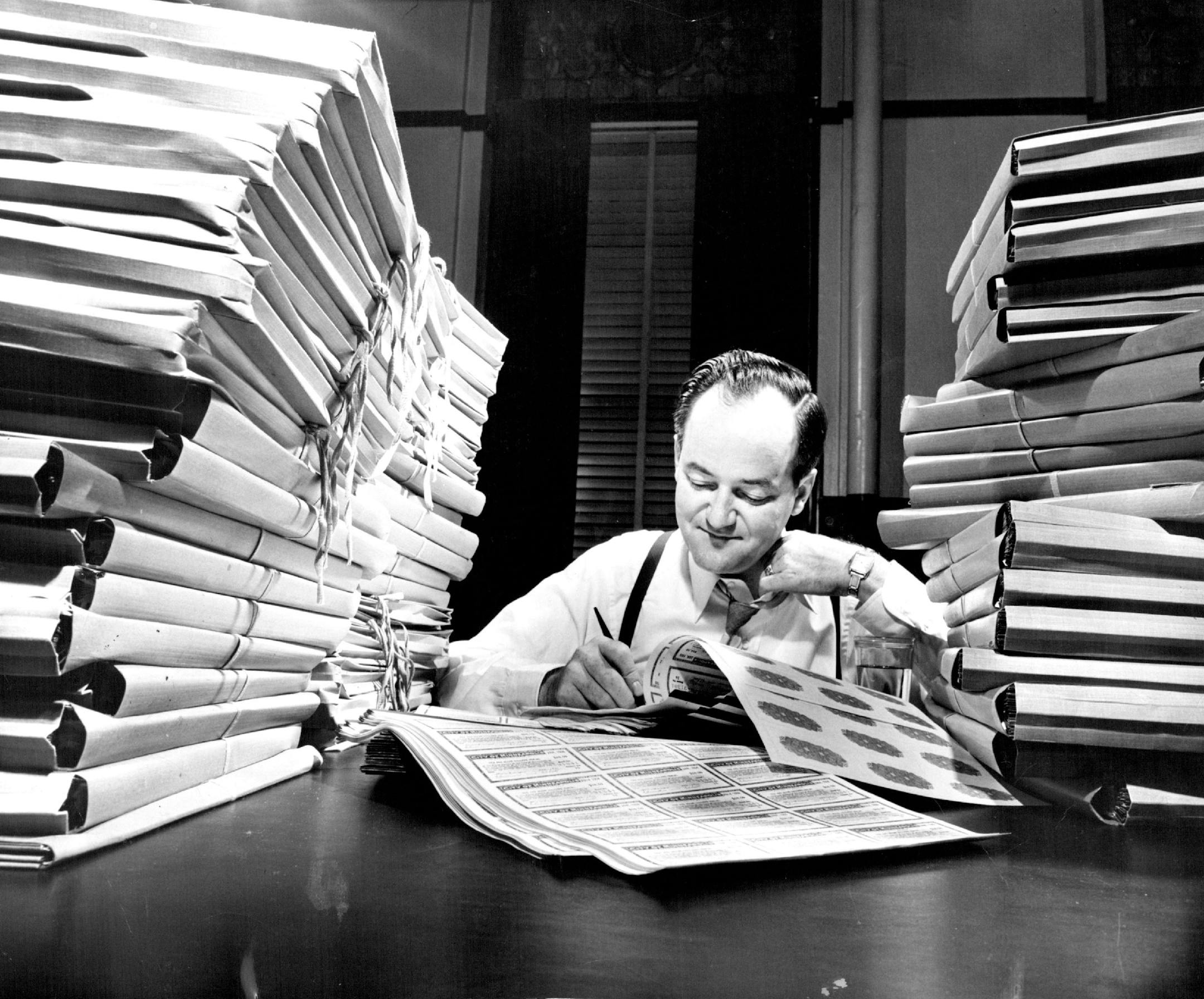
Mayor Hubert Humphrey pauses to contemplate a serious case of writer's cramp as he begins to sign thousands of bonds. (Bonham Cross/The Minnesota Star Tribune)

Mayor Humphrey

The mayor’s office was “weak” when Humphrey entered office in 1945, Freedman said. The Minneapolis City Council held more power.

Humphrey found his way around the council by creating citizens committees to push his agenda forward.

“He got private funding to work on issues like civil rights and police reform and fair employment, and basically built public demands for reform on issues,” Freedman said. “That put pressure on members of the City Council to support Humphrey’s programs. He successfully and quite brilliantly circumvented them.”

Those committees helped Humphrey’s agenda succeed. In his years in office, Humphrey passed one of the nation’s first fair employment laws and began to dismantle the city’s discriminatory housing policies.

Humphrey also reformed the police, bringing in a new, FBI-trained police chief.

“He mandated that the Minneapolis police force take university courses on racial sensitivity and dealing with minority communities,” Convery said. “He also increased the number of social workers and juvenile policemen to help address social problems that were leading to juvenile delinquency.”

Humphrey also built bipartisan coalitions, supporting veterans and focusing on economic development, Convery said.

But the mayor‘s policies did not make him popular with everyone.

On a freezing night in February 1947, Humphrey returned home from a dinner with Hennepin County officials. He passed on being walked to his front door by a police officer to ensure those traveling with him got home sooner.

As he fumbled with his keys at his door, three gunshots rang out. Humphrey wasn’t hit.

He went inside but came out minutes later and looked for the assailant, the Minneapolis Morning Tribune wrote at the time. No one was around. The attempt on Humphrey’s life was never solved, and the mayor and police kept it quiet for three weeks.

“I wanted to avoid any publicity,” Humphrey said at the time. “I’m sorry all this had to come out, it has my youngsters and my parents pretty well stirred up now.”

Humphrey received hate mail and threats often, Freedman said. “It’s a testament, in a certain way, to how much moral courage Humphrey showed in taking up civil rights as an issue because it could get you killed,” he said.

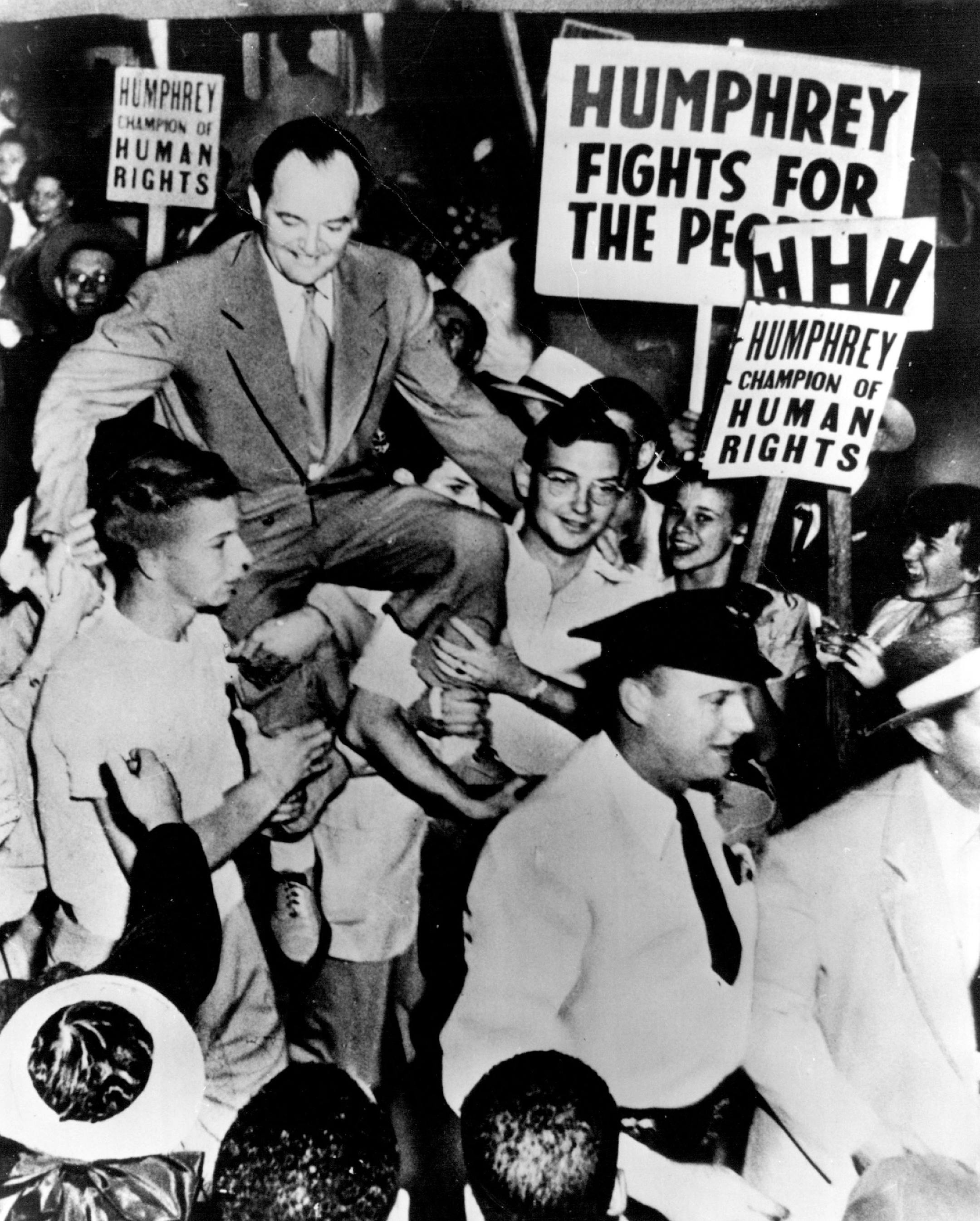
Young supporters carry the Minneapolis mayor — and candidate for the U.S. Senate — through the Minneapolis railway station on his return from the Democratic National Convention in Philadelphia. (Wally Kammann/The Minnesota Star Tribune)

Rising to national acclaim

Humphrey continued to push for civil rights. In 1948, he delivered a speech at the Democratic National Convention in Philadelphia that paved the way for the party to put civil rights on its agenda.

“To those who say that we are rushing this issue of civil rights, I say to them we are 172 years late,” Humphrey said in the speech. “To those who say that this civil program is an infringement on states’ rights, I say this: The time has arrived in America for the Democratic Party to get out of the shadow of states’ rights and walk forthrightly into the bright sunshine of human rights.”

Humphrey, at just 37, faced opposition and threats from party leaders about the speech, but it ended up being a turning point for the Democratic Party at a time of racial segregation across the U.S.

The speech earned Humphrey national attention, and he soon was elected to the U.S. Senate, where he became known as the “Happy Warrior.” In 1964, he was elected vice president under President Lyndon B. Johnson.

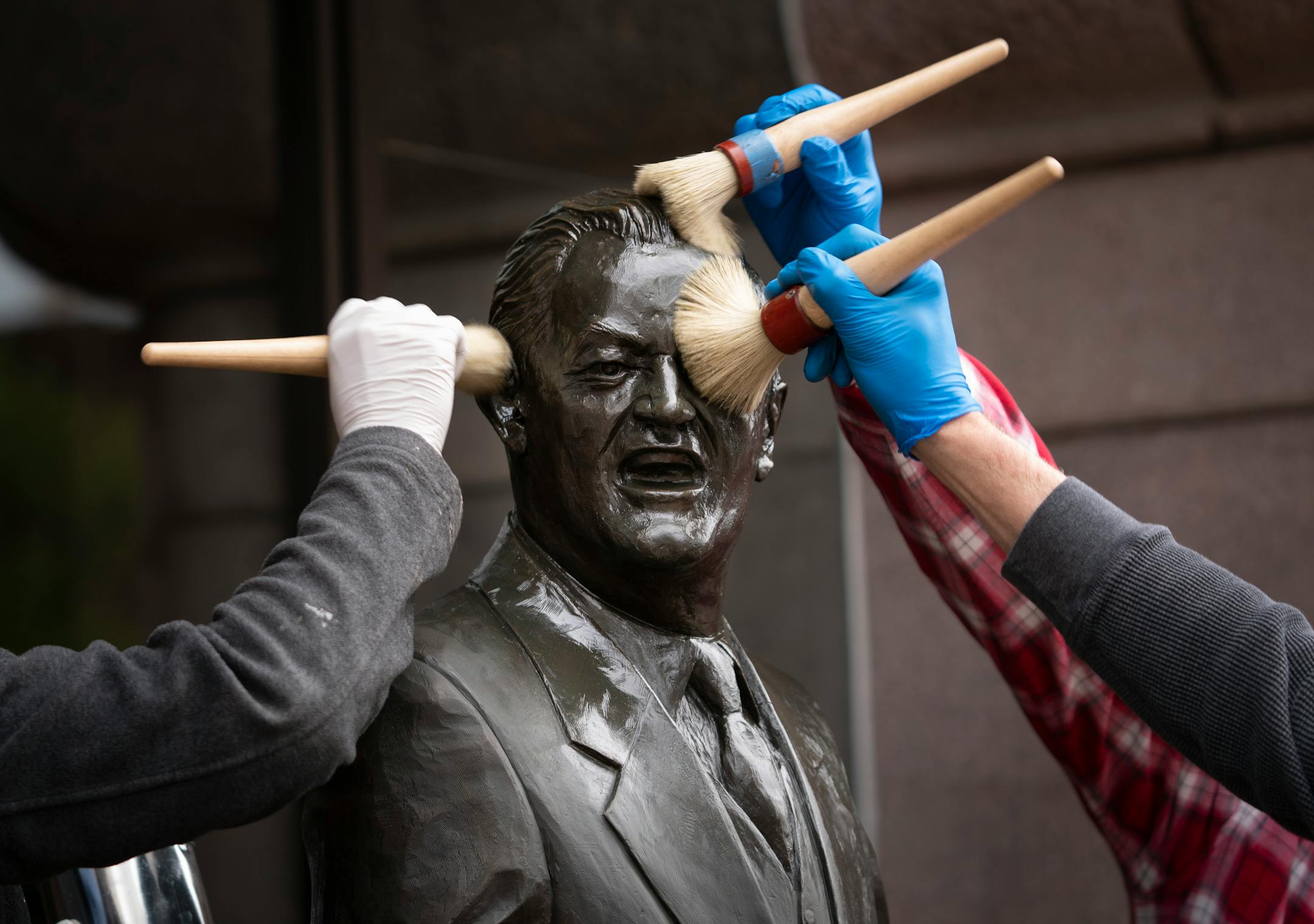
Wax is brushed on the bronze statue of Hubert Humphrey in front of city hall in Minneapolis in 2019. (Renée Jones Schneider/The Minnesota Star Tribune)

Humphrey often said being mayor of Minneapolis was his greatest job, Convery said. It’s also where he had the quickest success.

“Humphrey ranked his time as mayor of Minneapolis as one of the greatest times in his political career,” Convery said. “I suspect he felt that, even though he had not achieved everything he wanted, he’d achieved more as mayor than he was able to achieve, at least initially, in the US Senate.”

If you’d like to submit a Curious Minnesota question, fill out the form below:

Read more Curious Minnesota stories:

Correction: This article was updated to correct the spelling of Mayor Marvin Kline's name.
about the writer

about the writer

Eleanor Hildebrandt

Reporter

Eleanor Hildebrandt is a reporter for the Minnesota Star Tribune.

See Moreicon

More from Curious Minnesota

See More
card image
Hennepin County Library

Composer of “The Music Man” flew in to participate in the event. There were way more than 76 trombones.