
Investors including Bezos purchase majority stake in tumor-fighting medtech company for $2.25 billion

The purchase is a massive investment in HistoSonics, which has led Minnesota startup fundraising in recent years.

The Minnesota Star Tribune
August 7, 2025 at 1:00PM
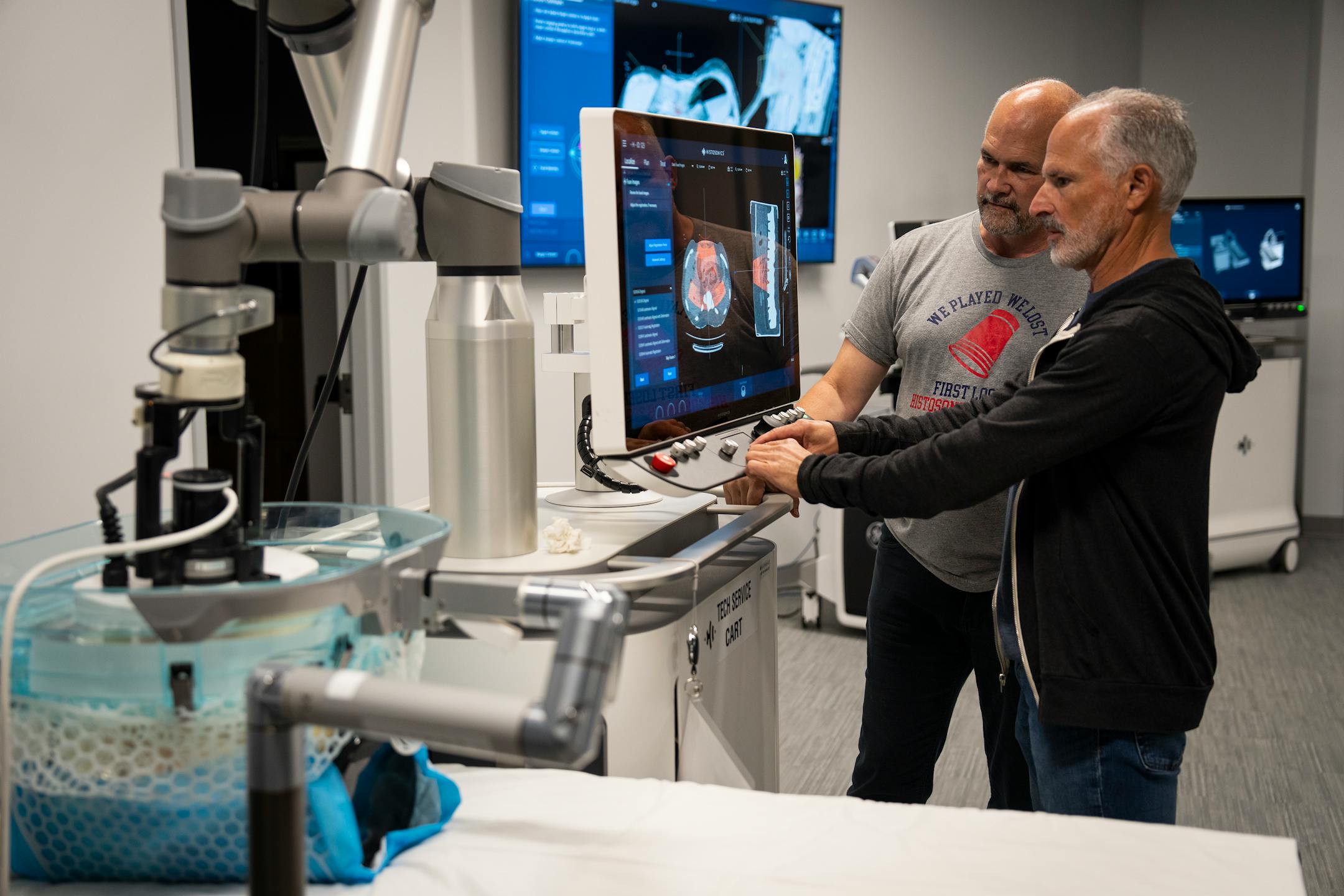
Frank Precopio, right, a clinical education specialist, works with John Stratmann, principal education specialist, on a part of the user interface called fusion which blends a CT scan with the live ultrasound to make tumor targeting easier with the Edison system at HistoSonics in Plymouth on Aug. 9, 2024. (Leila Navidi)

Amazon founder Jeff Bezos and a group of high profile investors are paying $2.25 billion for a majority stake in a Minnesota firm that has developed a novel, nonsurgical way to destroy harmful liver tumors with bubbles.

The company, Plymouth-based HistoSonics, will use the funds to develop additional uses of the device with other organs.

In an interview, CEO Mike Blue said the real opportunity here is to take its noninvasive sonic therapy and “accelerate all the different ways that it can be used throughout the body.”

The sale allows the company to delay going public until the time is right, Blue said. HistoSonics now has runway to grow its value, which will drive up its share price on an initial public offering.

Pursuing a majority-stake purchase and delaying an initial stock offering is unconventional in medtech.

The purchase comes after reports circulated that the company was eyeing an IPO or sale to a large medtech firm. Blue said he hopes to grow the company in a similar way to robotics company Intuitive Surgical, whose total company value is about $170 billion today.

The existing executive team will continue with the company after the acquisition, with Blue becoming chair of the board.

The investors include Bezos’ personal investment firm, Bezos Expeditions, along with venture capital firm K5 Global, Wellington Management and others. There will be a new financing round following the majority acquisition, Blue said.

The company, founded in 2009, had previously raised more than $300 million, and since 2020, its fundraising has outpaced other Minnesota medtech startups.

Massive medtech firms Medtronic, GE HealthCare and Johnson & Johnson — the latter of which has invested in HistoSonics — considered purchasing the business, the Financial Times reported citing unnamed sources.

Blue said he believes the long-term potential of the company is worth more than a traditional $3 billion to $5 billion acquisition, contending it is defining an entirely new category in health care.

“We’re really the only ones in this space,” Blue said, “and so our ability to recognize that [incremental value for shareholders] wouldn’t exist if we were owned by” a major medtech company.

The idea behind HistoSonics’ technology began decades ago at the University of Michigan.

In 2001, Zhen Xu, co-inventor of the treatment HistoSonics uses to kill liver tumors with focused ultrasound, was a Ph.D. student at the university’s Biomedical Engineering Department. She said a cardiologist visited the department one day with a question: Is it possible to invent a technology that can noninvasively remove heart tissue from a child with a life-threatening condition?

“I didn’t really have much of a background, but I thought that was so cool,” Xu said. It shaped her Ph.D. dissertation. Her adviser, Charles Cain, banned her from reading scientific papers in the beginning, telling her he didn’t want her restricted by conventional thinking, she said.

“I spent the next year going to a slaughterhouse getting pig heart tissue, then coming back and using all kinds of ultrasound parameters on it,” Xu said. “And nothing worked.”

She cranked up the power on the department’s largest ultrasound amplifier to its highest setting. Then she zapped pig heart tissue with microsecondslong ultrasound pulses at extremely high pressure.

The result? Microbubbles that tore through the tissue, creating a visible hole within a minute.

“I thought I was dreaming,” said Xu, now a biomedical engineering professor at the University of Michigan. After spending nearly a decade developing the technology, she co-founded HistoSonics in 2009.

The company’s Edison system creates a cluster of microbubbles that rapidly expand and collapse, the company has said. These volatile bubbles produce mechanical strain to pull apart cells in targeted tissue. The liquified tissue debris then gets reabsorbed by the body through a metabolism process, Xu said.

The bubbling only generate within a focal zone of 2-by-4 centimeters, preventing damage to healthy tissue.

HistoSonics has had setbacks. A 2016 human trial to treat enlarged prostates produced mixed results, Xu said. The procedure was safe and the technology worked as intended, but there wasn’t the expected liquifying of debris because “we think we were severely underdosing” due to the tissue being tougher than expected, she added. The company switched strategies to focus on the liver.

In 2023, it won U.S. Food and Drug Administration De Novo classification, which allows for the commercialization of devices tending to be lower-risk and novel, for the noninvasive destruction of liver tumors, including ones that are inoperable, according to a decision summary. The clearance came after a 44-patient study that met safety and effectiveness endpoints.

In the past year, the company has sold more than 100 systems, Blue said. It continues to work with the University of Michigan’s Biomedical Engineering Department and medical school. Years from now, he hopes people will use the technology, known as histotripsy, to extend lives of people left without other options.

“The future should be using histotripsy noninvasively without any toxicity or side effects throughout the entire body, whether it’s for malignant or benign” tumors, Blue said. “And I know this group of new investors shares in that vision with us.”

about the writer

about the writer

Victor Stefanescu

Reporter

Victor Stefanescu covers medical technology startups and large companies such as Medtronic for the business section. He reports on new inventions, patients’ experiences with medical devices and the businesses behind med-tech in Minnesota.

See Moreicon

More from Health Care

See More
card image
Leila Navidi/The Minnesota Star Tribune

Following concerns that Medtronic was overspending on the high-tech system and not developing it fast enough, FDA clearance is a major victory for the Minnesota-run medtech company.

Nancy Ingham gives newborn Sophia Rash a hepatitis B shot several hours after she was born, Jan. 17, 2006.
card image