
Olson: Moriarty will stop with one term. Candidates and voters, you’re up.

The 2026 election is still likely to determine whether Hennepin County residents liked what they saw with a progressive lead prosecutor. Those who didn’t should at least know these things.

Columnist Icon
The Minnesota Star Tribune
August 10, 2025 at 1:00PM
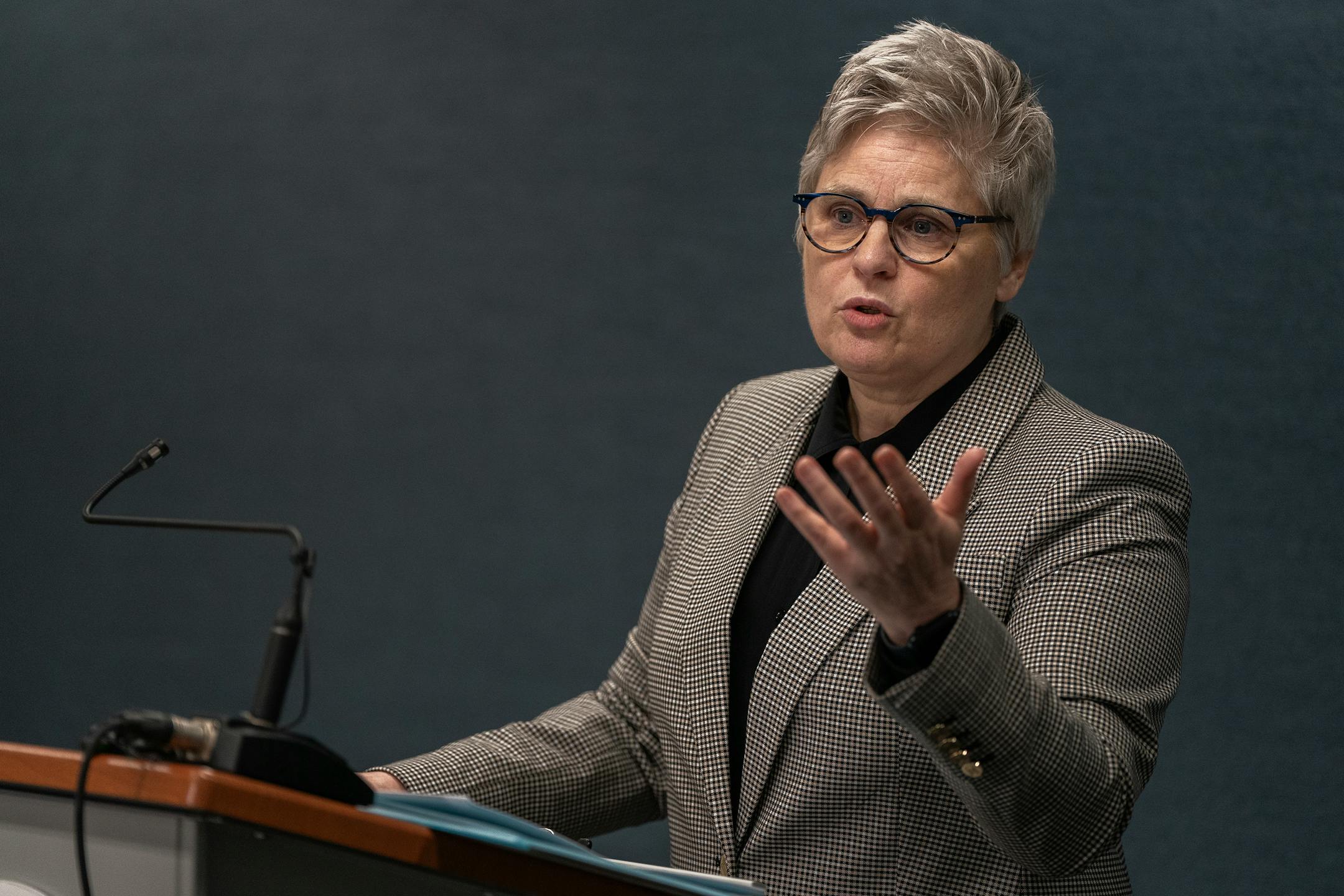
Hennepin County Attorney Mary Moriarty dismisses murder and manslaughter charges against State Trooper Ryan Londregan in Minneapolis, on Monday, June 3, 2024. (Richard Tsong-Taatarii/The Minnesota Star Tribune)

Opinion editor’s note: Strib Voices publishes a mix of commentary online and in print each day. To contribute, click here.

•••

Hennepin County Attorney Mary Moriarty, who announced this week that she won’t seek a second two-year term in 2026, described herself as one of the most stubborn people on the planet.

That’s a claim few would dispute. But Moriarty is also determined, accomplished and deserving of praise.

After 31 years as a public defender, including several as the chief of the busy Hennepin County office for that role, she was elected to the top prosecutor’s job in 2022 on her pledge to run the office as a progressive reformer.

And she did. Moriarty delivered on that promise and made no apologies for it.

“Mary Moriarty ran for Hennepin County with very strong, clear views on how she wanted to change the criminal justice system,” former U.S. Attorney Andy Luger said last week in an interview. “While I don’t share many of her views, I’ve always respected that she did exactly what she said she would do.”

Moriarty’s main goal was to prevent violence before it happened. She launched an early intervention youth auto theft program, a collaboration among prosecutors, law enforcement and social workers, to fight recidivism. The effort was part of her quest to ground office policy in research and evidence-based outcomes.

Her work aimed to balance individual and system accountability benefiting young people, families and communities while “centering victims and their healing.”

She addressed systemic issues. Within the office, she created the Division of Professional Standards to ensure compliance with state and federal requirements that exculpatory evidence be disclosed to the defense before trial.

She righted past wrongs, establishing the Conviction Integrity Unit and supporting the exonerations of Marvin Haynes and Edgar Barrientos-Quintana.

Was her tenure flawless? Of course not. Could she have done a better job communicating how the changes she made translated into safer communities? Yes.

Moriarty was often maybe too quick to call out would-be allies for perceived and actual slights. Those people range from Gov. Tim Walz and Attorney General Keith Ellison to acting U.S. Attorney Joe Thompson and Minneapolis Police Chief Brian O’Hara, whom she recently said is not taking her calls.

Was she treated differently because, as she’s claimed, she’s a gay woman? Hard to say for certain, but maybe.

In the courtrooms, the biggest controversies of her tenure so far came in the prosecutions of the killers of Zaria McKeever and the charging of trooper Ryan Londregan in the death of motorist Ricky Cobb II.

Retired Hennepin County Judge Kevin Burke, a longtime ally of Moriarty’s who hired her as a legal clerk years ago, said judgment calls, and ensuing criticism, are the nature of public legal work involving high-stakes decisions.

He defended her handling of the McKeever case. “She made a deal with two young kids to get testimony. That happens all the time,” he said, asking rhetorically, “Did she pay too much? Did she pay too little?”

Those cases — Londregan’s ultimately was dropped — will be part of her legacy. Their wisdom and weight debated along with the rest of her work, but they won’t be as definitive as her ability to reshape the workings of the office both in structure and through the hiring of up-and-coming lawyers.

Burke said we should not underestimate Moriarty’s tenacity in embedding the changes. “What do we know? She’s not afraid of a fight. No question, zero,” he said.

Moriarty’s stated goal for not running is to focus on the transformational changes until she walks out the door Jan. 4, 2027.

“I think she’s very committed to the idea that she’s going to make lasting improvements in the office driven by data,” he said. “And I think she may be right that her successor will largely keep what she’s put in place.”

Moriarty has said in several interviews that she believes Hennepin County’s voters will select a reform-minded successor who continues her work.

Her decision to bow out now, well in advance of the election, gives ambitious lawyers the gift of an open field for an influential position in the state’s busiest courthouse.

The Hennepin County Attorney’s Office is a prominent perch one could hold for decades or use as a launchpad for higher office, as evidenced by the Moriarty’s two most recent predecessors. Mike Freeman was the top prosecutor for 24 years over two stretches. Amy Klobuchar leveraged her eight years in the job into a successful U.S. Senate run.

With Moriarty, Hennepin County has had a sampling of progressive reform. Moriarty thinks she could win again, and who’s to doubt her? One clue will be whether a candidate proudly and unabashedly lays claim to her lane and legacy.

I would expect numerous candidates to enter the race from an array of backgrounds and visions that span the spectrum from right-leaning law-and-order types to middle-of-the-road runners and leftist reformers.

Was electing a reformer a primal scream amid the upheaval of COVID-19 pandemic and the murder of George Floyd by a Minneapolis police officer? Was Moriarty’s 16-point victory a result of hard work, a mediocre opponent or a combination? Is there a talented successor out there willing to do the work to claim her coalition, or was Moriarty a blip in time?

I have a hard time seeing Hennepin County voters taking a hard right and tearing it all down, but there’s plenty of middle ground to be claimed.

We can also hope that Moriarty doesn’t disappear — that she continues to be a strong voice for the progressive cause for years to come.

about the writer

about the writer

Rochelle Olson

Editorial Columnist

Rochelle Olson is a columnist on the Minnesota Star Tribune Editorial Board focused on politics and governance.

See Moreicon