Debates over development, taxes drive suburban Twin Cities election contests

Voters will cast ballots Nov. 4 for city leadership in several cities, including Bloomington, Lino Lakes, Minnetonka and White Bear Lake.

October 7, 2025 at 11:00AM
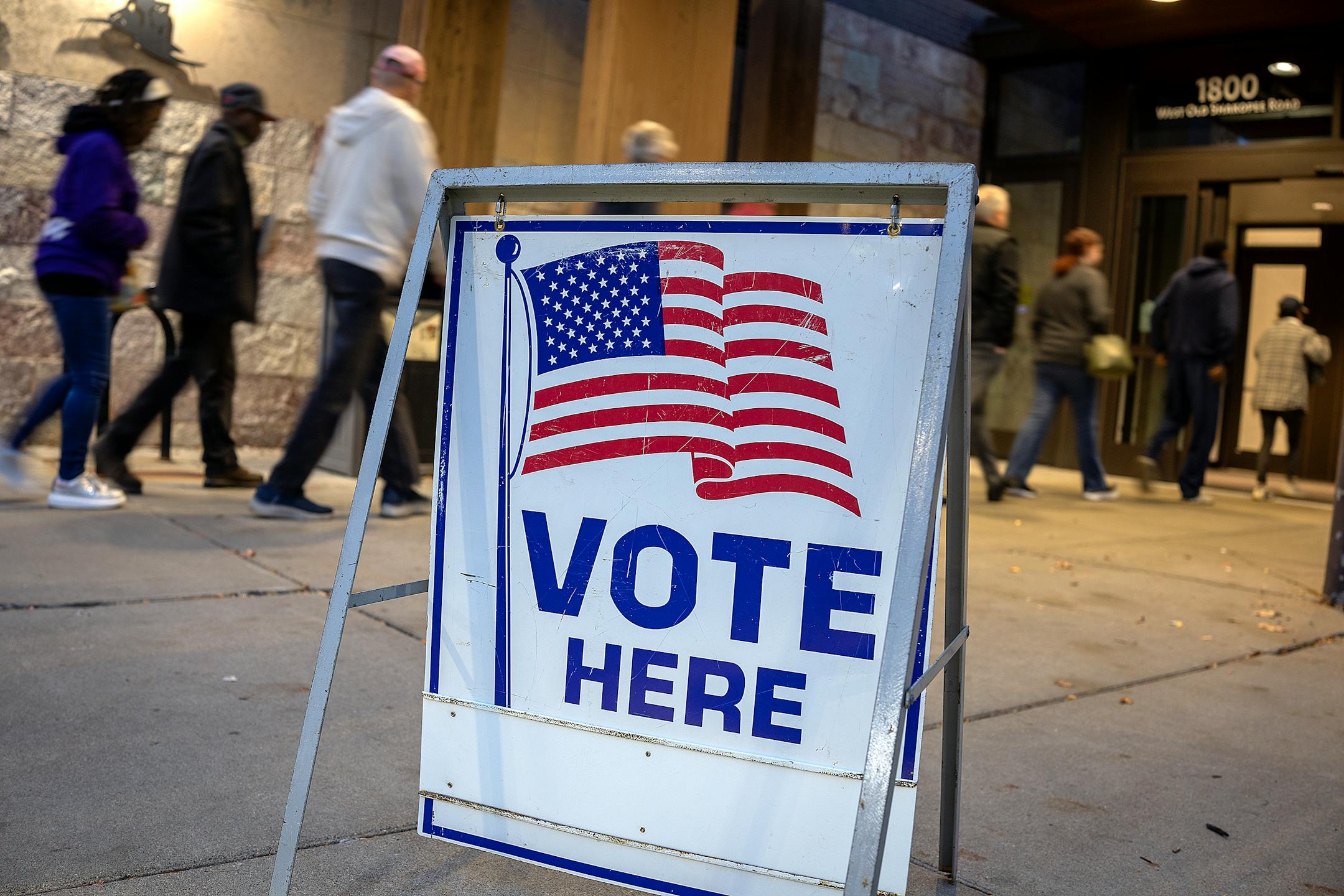
Bloomington voters, pictured here on Election Day 2024, will cast ballots for City Council seats on Nov. 4. (Elizabeth Flores/The Minnesota Star Tribune)

Questions about how to best manage booming development and address rising costs are driving election contests this fall across the Twin Cities suburbs, where voters on Nov. 4 will pick the mayors and City Council members to tackle those challenges.

In an election cycle where partisan politics has seeped into school board races and endorsement drama has grabbed headlines in the Minneapolis mayor’s race, many of the suburban contests are focused on bills and what’s going on beyond residents’ backyards. That includes debate over property taxes in Bloomington and housing density in Lino Lakes, plus elections that will usher in new leadership in suburbs where mayoral incumbents have decided not to run.

Early voting has started and runs through Nov. 3. On Election Day, polling places are open from 7 a.m. to 8 p.m.

Here are some key suburban races to watch.

Bloomington

The three candidates vying for an at-large Bloomington City Council seat are advancing different plans for keeping the city affordable as a possible 9.5% property tax hike looms over residents.

Jonathan Minks, a bicycle shop owner who also chairs Bloomington’s parks commission, said the city can save money by cutting the number of consultants it hires to advise projects. Minks, who unsuccessfully ran for an at-large seat in 2023, said the relatively high salaries of some city leaders, and the growth of Bloomington’s government, have also bloated the budget.

Danielle Robertson, a stay-at-home mom and licensed attorney, said she was pleased the city reduced the preliminary tax levy from an initial proposal of nearly 18%, but she called the possible 9.5% hike “still high.” Before identifying specific items in the budget to cut, Robertson said she wants to “see the whole pie in action and see what works and what doesn’t.”

Isaak Rooble, a small business owner who has helped elect DFL candidates, said he’s concerned about creeping housing unaffordability in the city, from rising rents to slimming housing stock. Elected officials, he said, should ask, “Is this something we need or is this something we want?”

Two other City Council seats representing portions of the city are also up for grabs. Incumbent Dwayne A. Lowman is facing Jessica Keehan and Aaron C. Smith to represent a southern area of the city along the Minnesota River. To the west, incumbent Shawn Nelson is running against Andrew Luckraft.

Minnetonka

Minnetonka voters will choose a new mayor — the first race in nearly a decade without an incumbent on the ballot — and two at-large City Council members.

Mayor Brad Wiersum is stepping down after two terms, opening the door for five candidates to seek the city’s top seat. The contenders are Michael Briles, Ellen Cousins, Jon Kayser, Jonathan Kent and City Council Member Rebecca Schack.

Only Cousins’ and Schack’s campaigns have reported raising money. In August, Cousins reported raising $800 in cash and Schack reported $10,000.

Schack has served on the council since 2018 and has focused on affordable housing, environmental preservation and inclusive community engagement. Cousins, a longtime volunteer and former Economic Development Authority commissioner, has emphasized fiscal restraint and resident input.

Kent is campaigning on mutual aid, anti-racism and reimagining city systems. Briles has criticized the city’s proposed 8% tax levy increase. Kayser has centered his campaign on cutting taxes and improving emergency response times.

In the City Council races, Deb Calvert is running unopposed for re-election to one of the at-large seats. In the other at-large contest, Kimberly Wilburn faces Craig Alciati and David Biesboer.

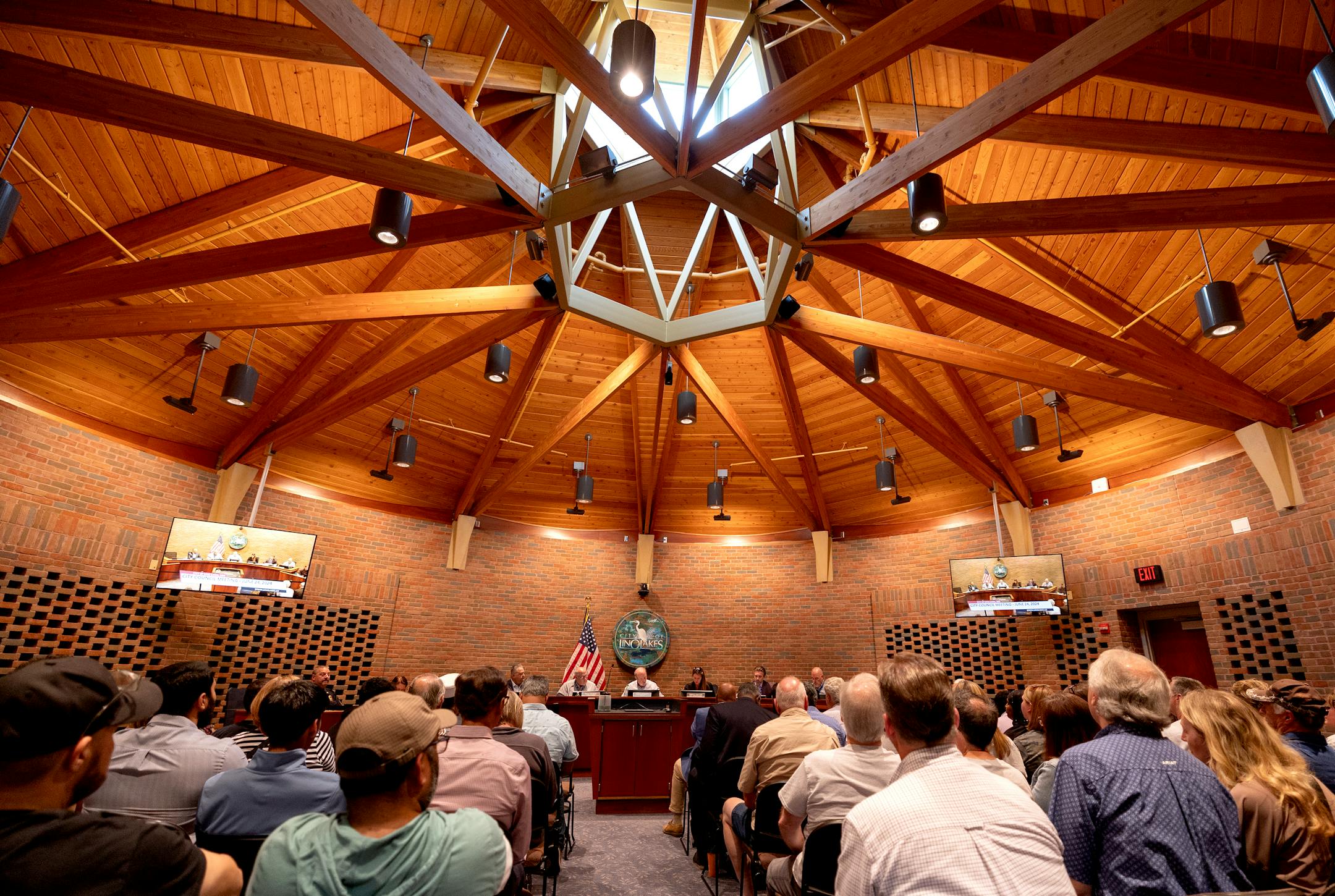
The city election in Lino Lakes is driven by debate over development, which has been drawing crowds, like the one pictured here in 2024, to City Council meetings. (Carlos Gonzalez/The Minnesota Star Tribune)

Lino Lakes

Lino Lakes candidates are sharply focused on how to control development in the northern suburb, after concerns about the city growing too quickly led to packed meetings this last year.

Mayor Rob Rafferty, a former council member first elected as mayor in 2019, faces a challenge from Catherine Decker, who runs a local mortgage business and previously ran for a council seat. Luke Walter is on the ballot but is not campaigning and threw his support to Rafferty.

Rafferty said he prioritizes “quality over quantity in development,” adding that the city has been proactive in expanding the tax base by building out utilities to bolster commercial development.

Decker has spoken out against recent property tax increases — including a proposed 16% jump in the levy next year — and argued the city could curb spending and do more to listen to residents.

Residents also will elect two council members from five candidates.

Incumbent Dale Stoesz said development should reflect the vision of residents, not developers, with priority given to keeping natural spaces and community character.

Julia Nelson, who serves on the city environmental board, said she wants the council to keep commercial development to the business districts, plus make the city more walkable and bikeable by requiring builders to add more trails.

Tere O’Connell, who previously ran for council, is focused on maintaining wetlands and healthy lakes. She said the city should do more to follow up with developers on their commitments after projects are approved.

Randy Rennaker serves on the city’s Economic Development Advisory Committee and helped organize residents opposing a major housing project. He said the city should ease the burden on taxpayers by attracting more businesses.

Chris Stowe, a plumber, said the city is out of control with spending, pointing to the raising of council salaries while taxes are going up. He also advocated for slowing down the city’s growth.

Stowe faced scrutiny in 2018 when he was charged with felonies related to possessing guns after his son allegedly made threats at school. But prosecutors dropped the charges after lab results showed that authorities had misidentified a gun taken from his home as a fully automatic weapon.

White Bear Lake

Voters in White Bear Lake will pick a new mayor to plot the east metro lakeside city’s future priorities.

Stephen Laliberte, said he would bring his business background to the role. While he called White Bear Lake a well-run city with relatively low per-capita taxes, he said residents are concerned about cost of living.

“Our taxes have gone up 10% to 15% every year for the last three years,” and that especially concerns residents on fixed incomes, he said.

He said he would push the city to focus on providing services outlined in its city charter —“police, fire, sewer and water, parks, streets,” and urge the city to contract out other work, including forestry.

Mary Nicklawske, now retired, spent her career working in human services and has been active in nonprofits.

She said White Bear Lake’s next mayor should focus on public safety, with a fully staffed department, plus quality training and mental health services for police fire and EMS. She said she would also prioritize fixing sidewalks, making street crossings safer and controlling speeding in residential areas.

She said she would ensure residents, including seniors and people outside the city’s downtown — often the focus at City Hall — feel heard. “I will listen to all our neighborhoods and be open and available for questions, concerns and ideas that will help our city,” she said.

As of late July, Laliberte had reported raising $1,100 to Nicklawske’s $7,700.

Two council seats are up for election, but Ellen Gurrola and incumbent Kevin Edberg are running unopposed.

about the writers

about the writers

Sarah Ritter

Reporter

Sarah Ritter covers the north metro for the Minnesota Star Tribune.

See Moreicon

Eva Herscowitz

Reporter

Eva Herscowitz covers Dakota and Scott counties for the Star Tribune.

See Moreicon

Sofia Barnett

Intern

Sofia Barnett is an intern for the Minnesota Star Tribune.

See Moreicon

Greta Kaul

Reporter

Greta Kaul is the Star Tribune’s built environment reporter.

See Moreicon

More from Elections

See More
card image
Anthony Soufflé, Alex Kormann

The two-term mayor started too late and had too weak of a ground game. Kaohly Her capitalized.

card image
card image