
Editor's Pick

Editor's Pick

Gov. Tim Walz, Democrats tap influencers to spread political message

After Republicans outmaneuvered Democrats online in the 2024 election, Walz and fellow Democrats are trying to build their own network of content creators.

The Minnesota Star Tribune
December 28, 2025 at 11:00AM
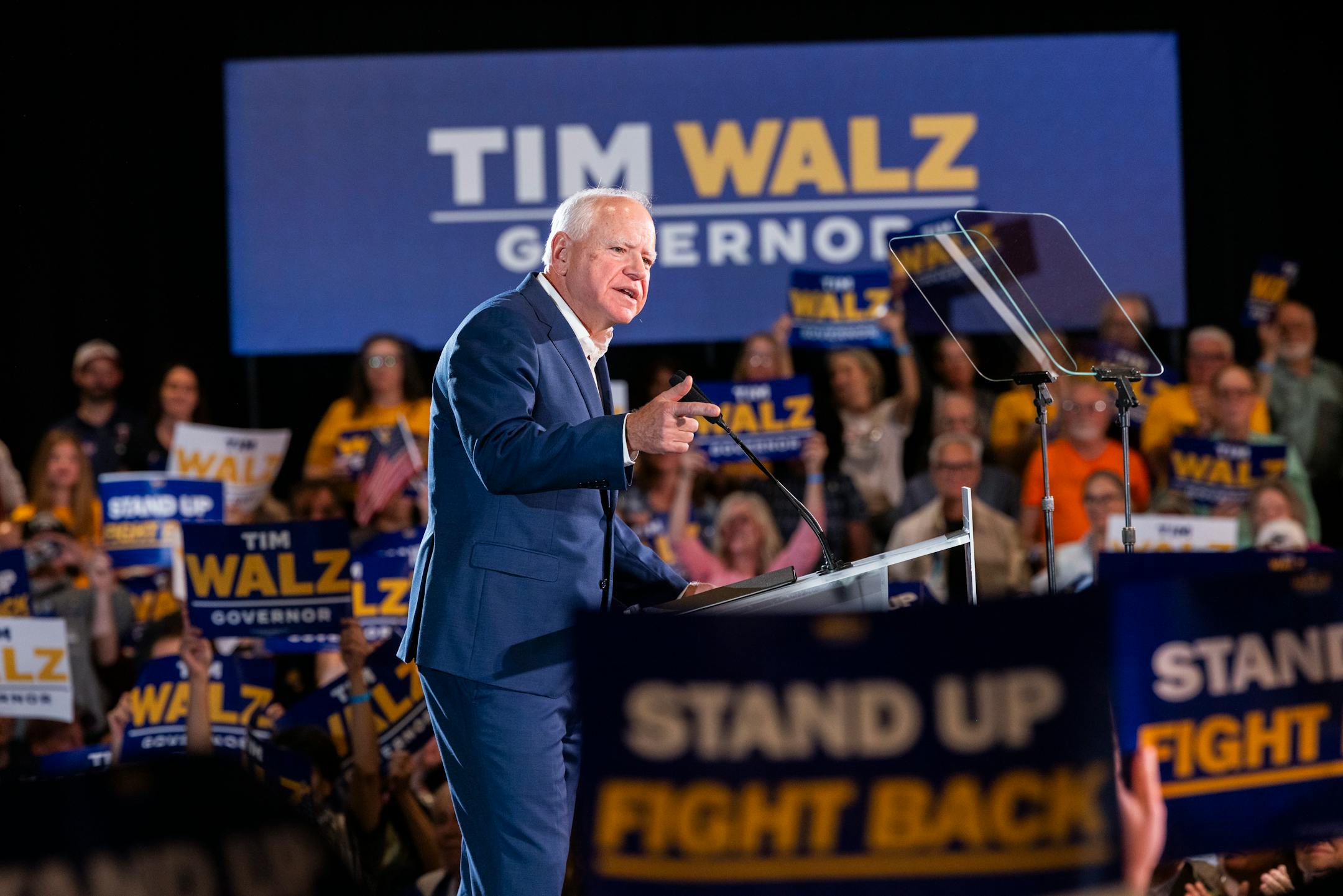
Minnesota Gov. Tim Walz speaks at his campaign launch rally in Minneapolis, Sept. 19, 2025. (Jaida Grey Eagle/For the Minnesota Star Tribune)

To spread the word about his run for a third term, Minnesota Gov. Tim Walz sat for interviews with social media influencers at a St. Paul bar in September.

One of the content creators handed the DFL governor a bottle of his favorite soft drink, Diet Mountain Dew, and asked him to share something people didn’t know about him. Another asked Walz about providing reliable information on vaccines to families, and she thanked him for making Minnesota “one of the best places to raise a family.”

A third influencer who spoke to Walz created an Instagram post afterward to rebut Republicans who’ve criticized the governor and Democrats for spending a previous $17.6 billion budget surplus. “Using surplus cash when available is actually a conservative fiscal strategy,” she posted.

The interviews were part of a new political strategy — one that many believe is overdue for the left, but which, Democrats are learning, is not always as simple as fielding a series of softball questions.

After Republicans outmaneuvered Democrats online in the 2024 election, Walz and the DFL are trying to build their own network of content creators to reach audiences that don’t consume traditional media. They’ve learned from their party’s electoral beating and the missteps preceding it, such as when Kamala Harris declined an interview with Joe Rogan while President Donald Trump seized the opportunity to appear on the world’s most popular podcast.

“The DFL has to approach our attempts to reach voters differently than we ever have,” said Minnesota DFL Chair Richard Carlbom. “The youth vote is the new swing vote.”

Influencers have gotten exclusive time with Walz and other top Democrats in recent months while the governor’s team has brushed off interview requests from the Minnesota Star Tribune and other legacy local news outlets.

By engaging social media influencers, politicians are going where the audience is larger, the format is more relaxed, and the tone is friendlier. The setting provides an opportunity for candidates to come across more authentically while giving both them and the content creators a credibility boost with the audience.

Democratic National Committee Chair Ken Martin met with a group of Minnesota social media influencers at the State Fair in August. Citing the stinging defeat his party suffered in 2024, Martin told them: Democrats want — and need — to work with you.

View post on Instagram
 

Democrats in Minnesota see an opening to leap ahead of their state GOP rivals in this new media ecosystem that Republicans have dominated nationally. But their efforts have at times rubbed some content creators the wrong way.

The Minnesota DFL Party has been sending a weekly “message memo” to some influencers that includes talking points. In a memo from Dec. 15, the DFL encouraged influencers to refer to rising health care costs as “GOP healthcare cuts.” The memo also urged them to tout the state’s new DFL-passed paid family and medical leave program that will take effect Jan. 1.

“Describe Paid Leave as a work-based protection,” the memo states. “Don’t repeat Republican myths, even when debunking.”

John O’Sullivan, who runs a popular Minnesota TikTok account called OneMinuteTours, said he appreciates that Democrats in the state are taking influencers seriously and making efforts to reach their audiences. But he said Democrats who expect influencers to follow their talking points misunderstand the appeal of the content.

“Content creators are finding an audience because we’re finding a way to speak authentically,” he said. “You’ve got to come to us on our terms.”

An ‘aggressive’ approach

The DFL also recently urged some influencers to share a video clip of a GOP lawmaker lashing out at a TV news reporter after he asked whether she would denounce Trump’s attacks on Somali Americans. Some quickly obliged.

“Republican Minnesota Rep. Mary Franson had some real strong feelings about simply being asked” if she was a racist, TikTok user Off_jawaggon told his 700,000-plus followers, adding a profanity after the word racist, in a video in early December.

The TikToker then shared Franson’s contact information, encouraged his followers to reach out to her and sent her a profanity-laced email.

"I hope you feel better after sending this unhinged email," Franson, of Alexandria, wrote back. “Take a mental health day.”

Franson told the Star Tribune she received a torrent of offensive messages after the video was posted and had to limit comments on her social media pages “because they were pretty disgusting.”

She said the DFL should be more careful about who it works with: “If they’re trying to win elections, that ain’t it.”

A DFL spokesman responded by noting Franson’s own history of inflammatory social media posts, including one in which she suggested that Cecile Richards, the former president of Planned Parenthood who died in January, is “now in hell.”

In a statement to the Star Tribune, the TikToker who emailed Franson said that “direct, assertive pushback is what voters expect when an elected official crosses that line.”

Carlbom said he was not aware of the TikToker’s email to Franson. Some of the content creators working with the DFL are “pretty aggressive,” he said, and the party does not control what they say.

Expanding their reach

The DFL is working with nine content creators who collectively have more than 3 million followers across their social media platforms, Carlbom said.

The party is not paying the influencers, he said. It’s giving them access to elected officials and the opportunity to “get an inside scoop.”

The TikToker who went after Franson interviewed Walz and Attorney General Keith Ellison at the Minnesota DFL’s winter meeting earlier this month.

Adriana Goblirsch, another influencer and postpartum advocate who creates content about motherhood, has interviewed Martin, Walz and Lt. Gov. Peggy Flanagan, who’s running for U.S. Senate.

She spoke with Walz about topics ranging from child care affordability to vaccines and reproductive rights, and she said she talked with Flanagan about “the lack of moms in Congress with children under the age of 18.”

Goblirsch said her audience consists mostly of new moms and young families navigating child care, paid leave and maternal mental health systems for the first time. Her followers benefit from hearing politicians address these issues directly, she said, and the DFL gets access to an audience it otherwise might have missed.

Emmaline Childs, an influencer who creates content about everyday life in the Midwest, was also among those who helped Walz announce his re-election campaign. The video was a hit with her followers and allowed them to see another side of the governor, she said.

“It’s reciprocal. They’re also getting that trust. They are basically being able to play off of that trust that I have,” Childs said. “[Walz] was able to kind of lean into that and expand his audience.”

Childs said politicians need to pursue more opportunities with influencers going forward, including podcast appearances and long-form interviews.

“They need to do it in a way where it doesn’t feel like politics. It needs to feel like you’re just hanging out with a friend,” Childs said.

about the writer

about the writer

Ryan Faircloth

Politics and government reporter

Ryan Faircloth covers Minnesota politics and government for the Star Tribune.

See Moreicon

More from Politics

See More
card image
Aaron Lavinsky/The Minnesota Star Tribune

From a major new paid leave benefit to the end of the deer shotgun zone, Jan. 1 brings several new laws.

card image
card image