
Minnesota startup has found a way to use lasers to reduce energy and water use by data centers

Maxwell Labs says cooling computer chip hotspots with lasers could drastically reduce energy consumption and increase computational power.

The Minnesota Star Tribune
November 26, 2025 at 12:00PM
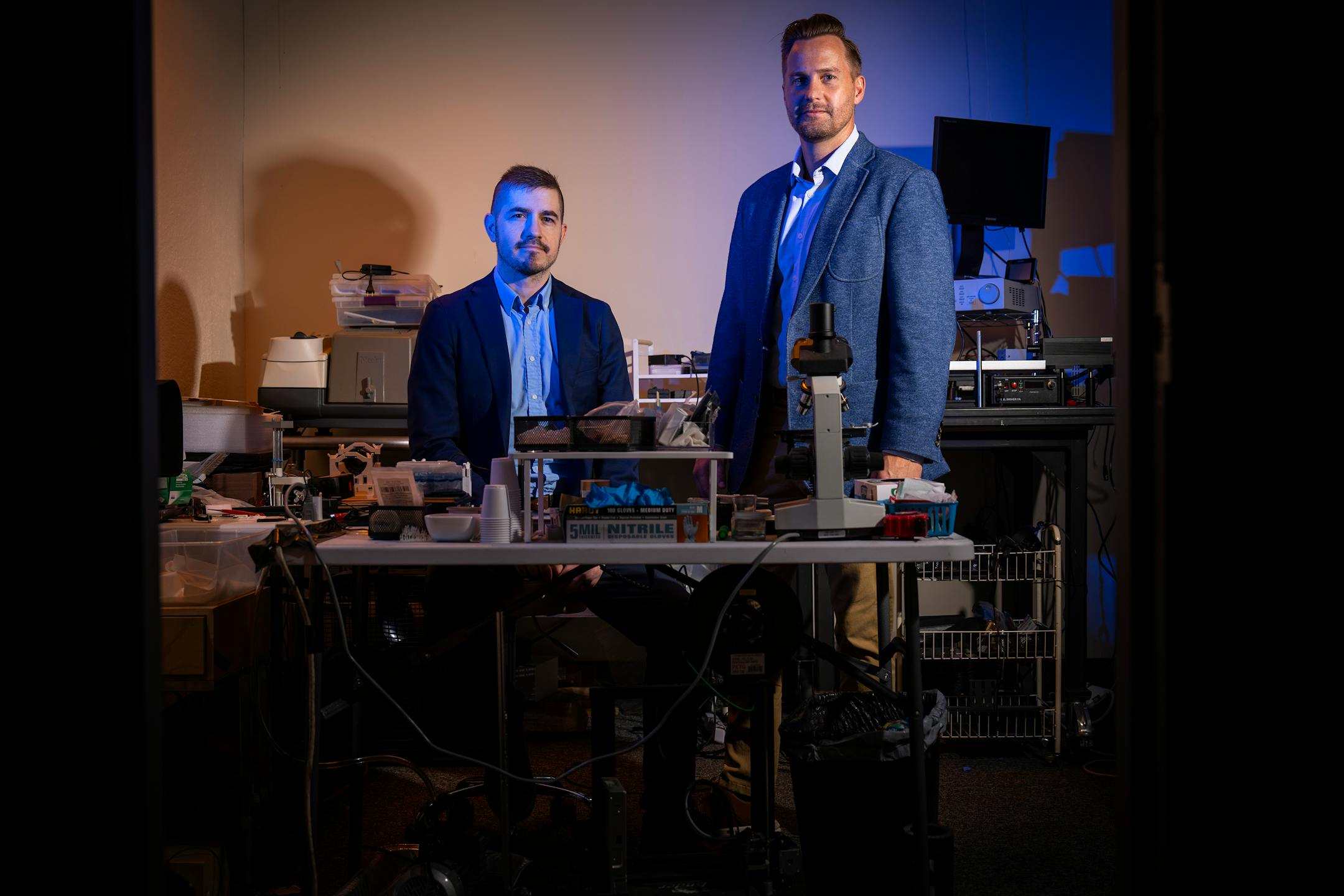
Maxwell Labs co-founders Mike Karpe, right, and Jacob Balma have built Maxwell Labs in Little Canada around laser technology to cool computer chips in data centers. (Leila Navidi/The Minnesota Star Tribune)

Big technology companies have committed hundred of billions of dollars to build out data centers, mainly to process AI.

The data centers represent economic opportunity for communities, but they are also meeting with more vocal resistance from citizens. More people have become concerned about how much power and water these data centers will need to operate.

Companies from 3M to nVent and Ecolab have products and solutions to keep data centers cool, a big problem when you have a building full of machines working 24 hours.

A startup called Maxwell Labs in Little Canada is developing a technology that would cool down the chips using lasers instead of water.

“Three major problems are facing data centers and AI,” said Mike Karpe, the startup’s co-founder and chief revenue officer. ”Energy, heat and performance. And you know this is really going to be coming to the head in the next five years."

Maxwell Labs says the laser technology will save energy and unlock more computing power from today’s ultrahot and fast-running AI computer chips.
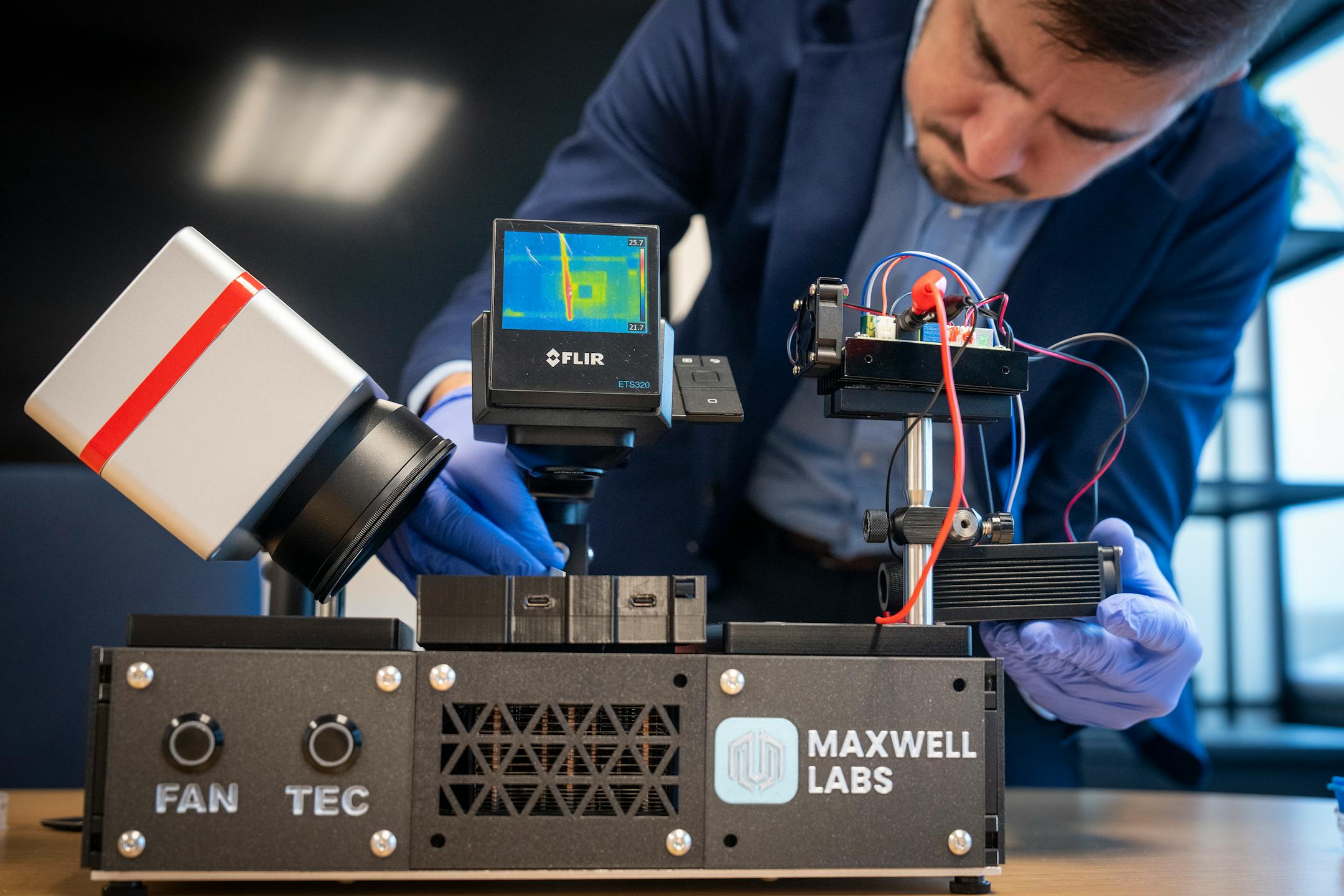
Maxwell Labs co-founder Jacob Balma sets up a prototype demonstration system at the company's facility in Little Canada. (Leila Navidi/The Minnesota Star Tribune)

Maxwell Labs’ technology on cusp

Karpe founded Maxwell Labs in 2020 with Jacob Balma and Alejandro Rodriguez.

Rodriguez, professor of electrical and computer engineering at Princeton University who specializes in photonics, believes the company is at the cusp of commercialization. He believes Maxwell Labs could have a product ready within a year.
“Next step is basically scaling our team, developing the capabilities in the lab and then focusing on this demonstration,” Rodriguez said.

The company has found backers who believe in the technology’s potential.

To date, Maxwell Labs has raised $4.5 million from institutional and angel investors, including $500,000 from a joint program of the U.S. Army Combat Capabilities Development Command Army Research Laboratory, the University of St. Thomas and the Energetics Technology Center Inc.

Now, the company is working on a two-part Series A venture capital round that could land $5 million by January and $25 million by the end of 2026.

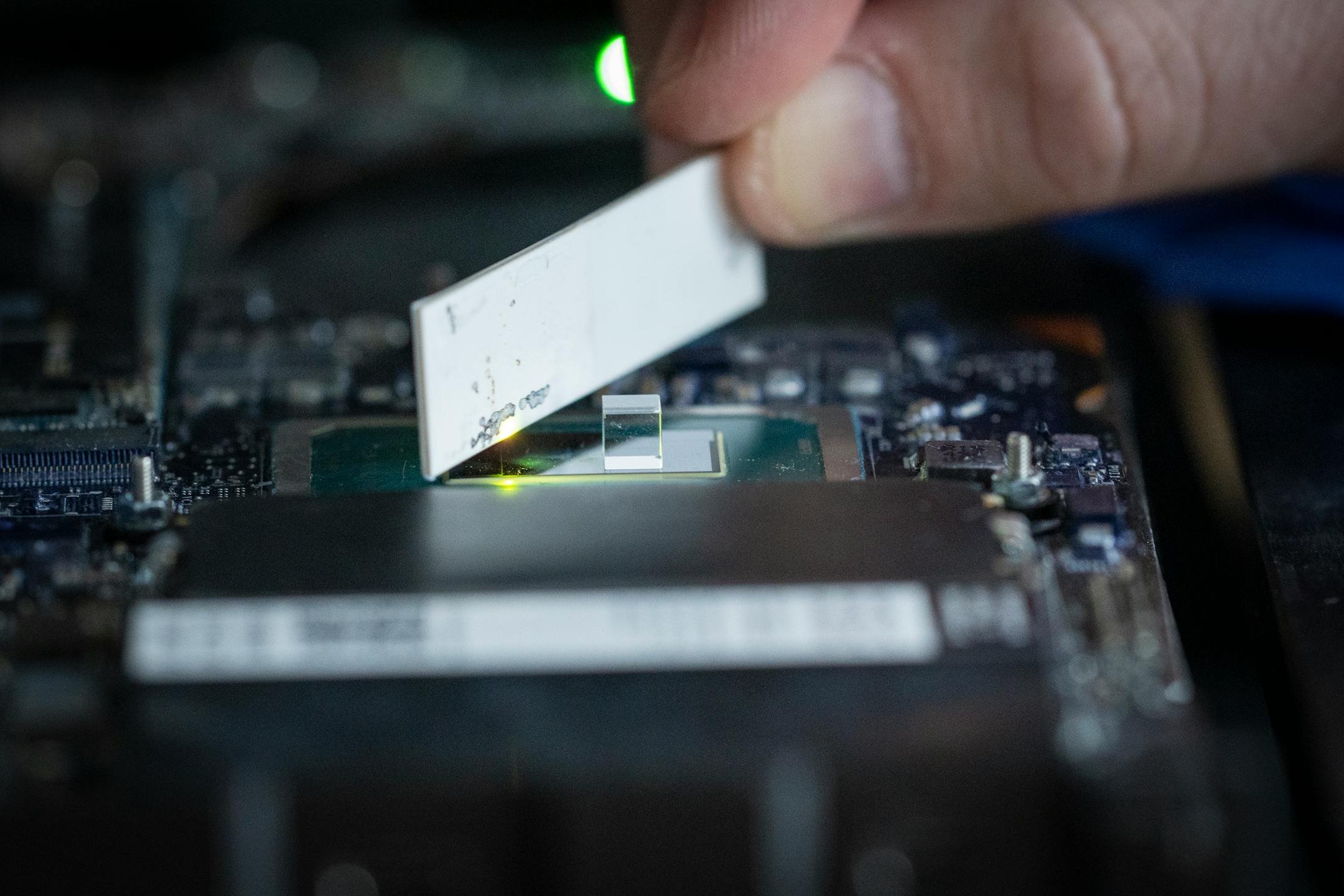
Maxwell Labs' technology uses lasers to cool computer chips, making them more efficient and creating energy from the heat. (Leila Navidi/The Minnesota Star Tribune)

The laser solution

About 6% of the U.S. energy supply goes to serving data centers. The large-scale data center buildouts being proposed right now could double that by 2028.

Chip manufacturers and data centers have gained ground in chip capability and conservation by employing cooling technologies that can keep chips running at optimized levels by switching from air-cooling technologies to more efficient liquid-based solutions.

Air and liquid are types of conductive cooling. But Karpe describes that switch as a Band-Aid approach.

The conductive methods cool the entire chip. They can’t target the roving micro hotspots in the precise way lasers can.

Maxwell Labs’ approach depends on photonics, the study of ways to control wavelengths of light at micrometer and nanometer scale through integration and miniaturization of optical components.

In addition to partnering with Rodriguez and his Princeton team, Maxwell Labs is also collaborating with Sandia National Laboratories and the University of New Mexico on the materials that will best work in the system.

For decades, photonics has contributed to advancements in data transfer, solar cells and LED lights. Only recently has the science explored the right conditions where lasers can be used for cooling.

“The interesting thing about computer chips is that they are very power dense,” said Balma, a graduate of the University of Minnesota Duluth who worked at Cray Inc. and Hewlett Packard Enterprise. “They are some of the most power-dense technologies humans have ever created.”

That power density translates to heat, and it has become a limiting factor in computer chip performance. And fast- and hot-running artificial intelligence chips have created the huge need for power and water to cool the chips.

As a computer chip works, it doesn’t heat up uniformly. Depending on what the chip is asked to do, individual transistors on the chip work and heat up in different areas and different levels, creating micro hotspots.

Using advanced optics and lasers, Maxwell aims to target those roving hotspots and convert that heat to light, recycle that light and turn it back into electricity.

Balma says once you convert the heat to light, you can recover that energy.

“The types of photovoltaics that you use in this scenario are called laser power converters,” Balma said. “And they’re way more efficient than solar panels, so instead of like, 20 percent or 30 percent efficiency, they’re like 80 percent to 90 percent.”

That would allow more of existing chips to be working at once and give chip designers a new tool kit to drive even more performance while significantly reducing energy demands.

It is economical, too.

“It has the possibility of completely covering the cooling cost of data centers with the waste heat recovered,” Balma said.

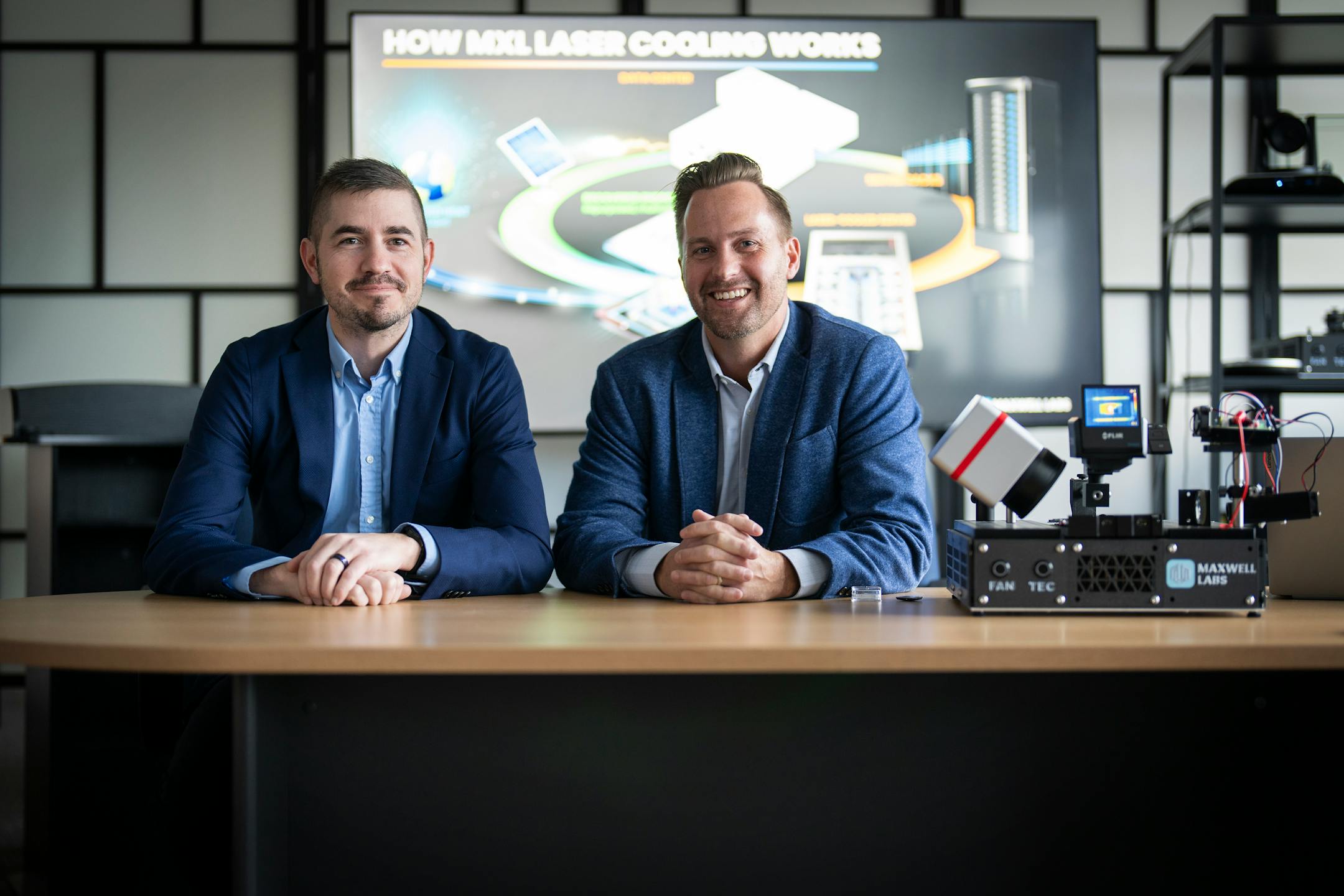
Maxwell Labs co-founders Mike Karpe, right, and Jacob Balma knew each other growing up in St. Michael and would like to keep the company in Minnesota as it grows. (Leila Navidi/The Minnesota Star Tribune)

The road forward for Maxwell

Maxwell Labs believes the key to unlocking even more computer chip capabilities lies in cooling chips more efficiently using radiant properties within photonics as well as conductive cooling.

“Long term, if you want to make chips as fast as physically possible, you have to also start using radiation to get rid of the heat,” Balma said.

Maxwell Labs’ technology is a long ways from working at a hyperscaler or data center level. But Karpe and Balma believe they soon could be working with niche manufacturers or developers seeking high returns on investments.

The company is being pushed to have a prototype ready as soon as possible, including by a key adviser, Henry Newman, a 40-year veteran of the computing industry. Newman got his start with Cray Inc. in the 1980s, worked at Seagate as a chief technology officer and has been an industry consultant.

Newman retired a few years ago and promised his wife he wouldn’t start a new project unless it was for something where he could give back to the industry.

When he met the Maxwell Labs partners in 2023, he became convinced of the technology and became an adviser and investor that December.

Newman credits Balma, Karpe and Rodriguez for staying on track in Maxwell’s development. He’s encouraging them to finish the prototype and show it to the largest chip manufacturers.

He believes that once one large chip manufacturer signs on others will quickly follow.

“They’ve made a hell of a lot of progress in the last two years,” Newman said. “It became obvious to me that this could be humanity changing.”

Karpe and Balma, who met as kids growing up in St. Francis, Minn., would very much like to keep Maxwell Labs in Minnesota where their families are.

Minnesota’s history with supercomputers from companies like Control Data and Cray and local chipmakers Skywater and Polar Semiconductor, Newman and others believe there is a lot of tech talent in the area to draw from.

And the problem Maxwell Labs is trying to solve could become more urgent.

“It’s not like we’re going to be asking less of our of our compute capacity,” said Reed Robinson, a partner with Minneapolis-based Groove Capital and among the first institutional investors in Maxwell Labs.

“So the appetite for a solution is snowballing,” he said.

about the writer

about the writer

Patrick Kennedy

Reporter

Business reporter Patrick Kennedy covers executive compensation and public companies. He has reported on the Minnesota business community for more than 25 years.

See Moreicon

More from Idea Lab

See More
card image
Leila Navidi/The Minnesota Star Tribune

Maxwell Labs says cooling computer chip hotspots with lasers could drastically reduce energy consumption and increase computational power.

card image
card image