Questions, conflicting accounts emerge after St. Paul ICE arrest, protests

City vows full review as DHS, family and witnesses offer sharply different explanations for arrests and police use of force.

The Minnesota Star Tribune
November 26, 2025 at 9:31PM
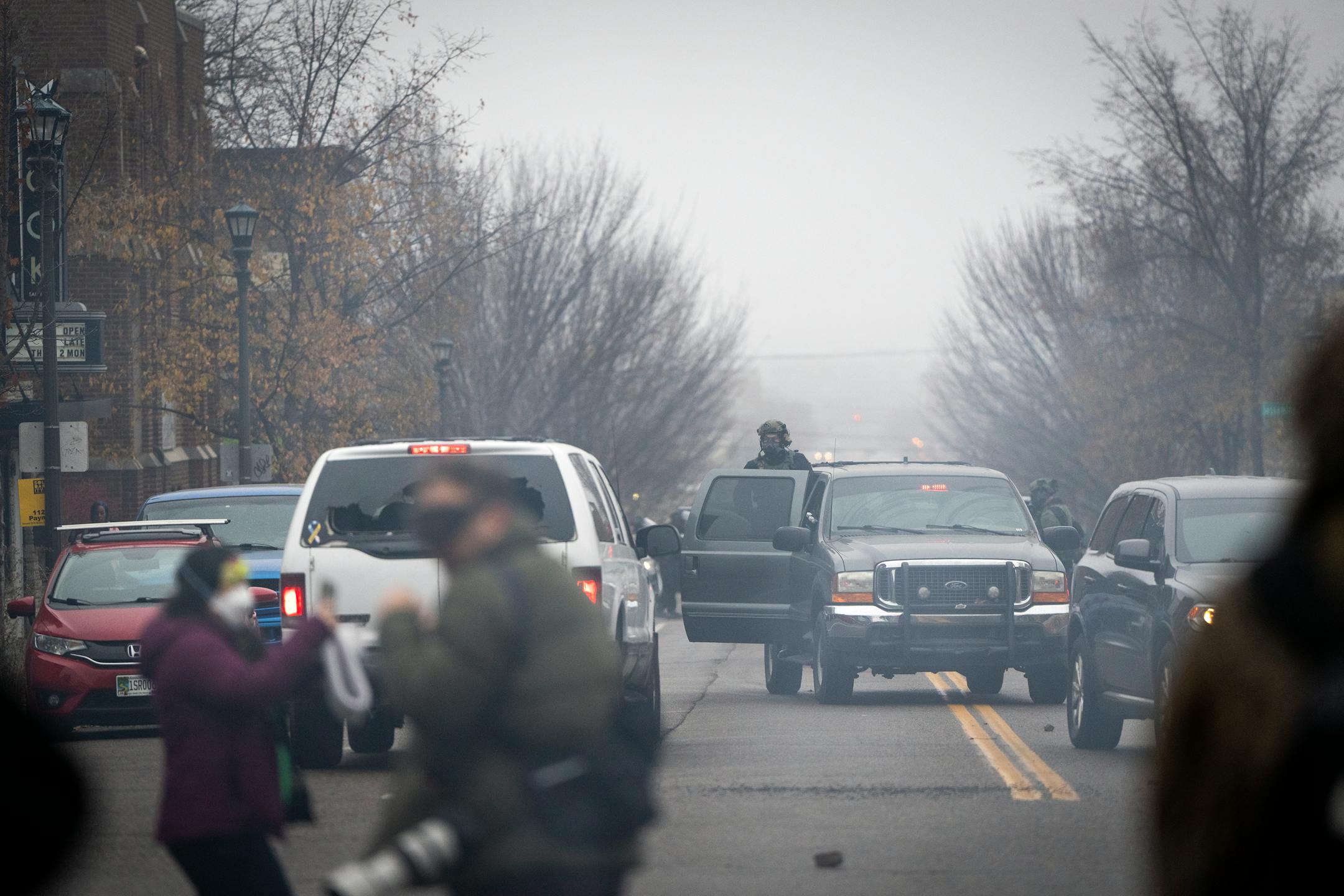
Law enforcement retreat south on Payne Avenue in a cloud of chemical irritants after a federal raid at a home in St. Paul on Tuesday. (Leila Navidi/The Minnesota Star Tribune)

Twenty-four hours after a federal immigration raid at a home on St. Paul’s East Side erupted into protests and a cloud of chemical spray, basic facts about whom federal agents detained remained unclear.

At the community news conference Wednesday, organizers said 26-year-old Jeffrey Suazo was arrested by federal agents. His family described him as a “hardworking and humble” man who fled out of fear when he saw ICE activity while on his way to work.

But in a statement issued Wednesday, the Department of Homeland Security said ICE arrested Victor Molina Rodriguez, whom the agency described as a Honduran national previously removed from the U.S. and now accused of re-entering illegally. ICE said Molina Rodriguez has prior domestic abuse and disorderly conduct offenses.

It is not yet known whether Suazo and Molina Rodriguez refer to the same person under different names, whether more than one person was detained or whether one was questioned and released. Carter said Tuesday that “maybe two” people were detained but offered no additional detail.

St. Paul police have not clarified how many people federal agents took into custody and ICE did not respond to follow-up questions seeking to reconcile the divergent accounts.

St. Paul review underway

City leaders on Wednesday were also forced to confront questions about why police officers were on the scene — and why force was used — despite repeated assurances that the department would not participate in federal immigration actions.

At a Tuesday afternoon news conference, St. Paul Mayor Melvin Carter described the episode as yet another instance of federal agents “showing up in our city unannounced” and “creating havoc in our community.” Carter said agents from Homeland Security Investigations (HSI) contacted St. Paul police after attempting to execute a warrant for a man they were seeking to detain, and after “that person fled from them and somehow ended up at the address on Rose [Avenue].”

“Our officers’ job is not and never will be to enforce federal immigration policy,” he said.
But when HSI reported that “someone had thrown rocks and bricks at them,” city officers were obligated to respond to potential violence — regardless of who made the report.

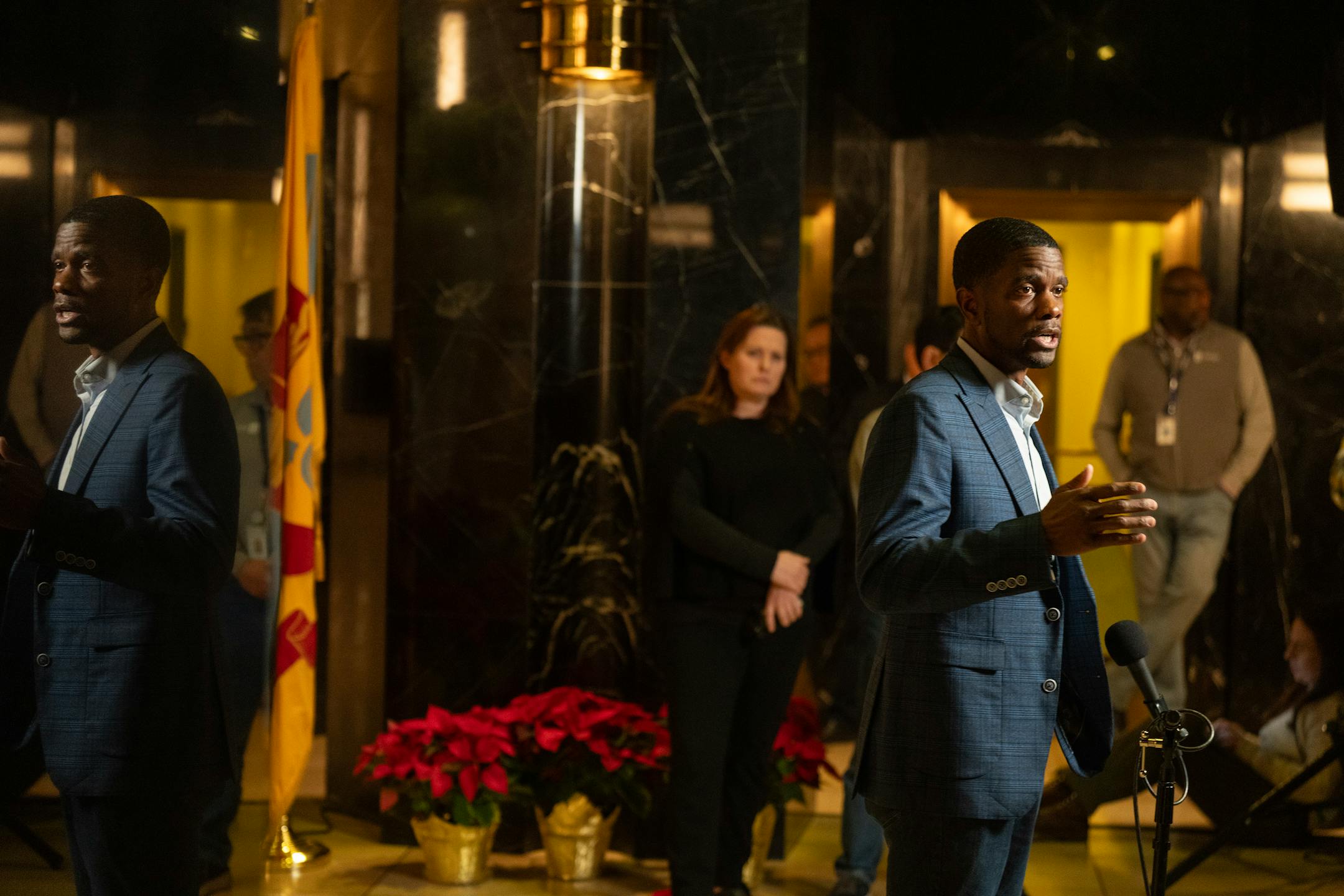
St. Paul Mayor Melvin Carter speaks to reporters about the federal raid that was conducted in St Paul on Tuesday. (Jerry Holt/The Minnesota Star Tribune)

Carter said he is deeply concerned about videos showing officers in gas masks deploying chemical irritants at close range, including footage of a woman “standing still in front of a vehicle and having pepper spray blasted in her face at point-blank range.”

He ordered a full review of every use of force by St. Paul officers, including “hundreds of hours” of body-worn camera footage.

St. Paul Police Chief Axel Henry said Tuesday that federal agents reported an attempted arrest and that “at least one vehicle had been struck and perhaps an agent had been in that vehicle.”

The perimeter around the home “was pulled down by people who were protesting,” he said, and additional officers were called after reports that some protesters were “arming themselves with rocks and sticks.”

“St. Paul police are not doing immigration enforcement,” Henry said. “But we do have a responsibility to make sure laws are not broken in our city.”

He said no city employee violated St. Paul’s separation ordinance.

The raid came one week after ICE and other law enforcement descended on paper distributor Bro-Tex Inc. in an industrial area near St. Paul’s Midway neighborhood while a search warrant was being executed, and protesters soon converged. ICE “arrested 14 illegal aliens on immigration violations,” the agency said.

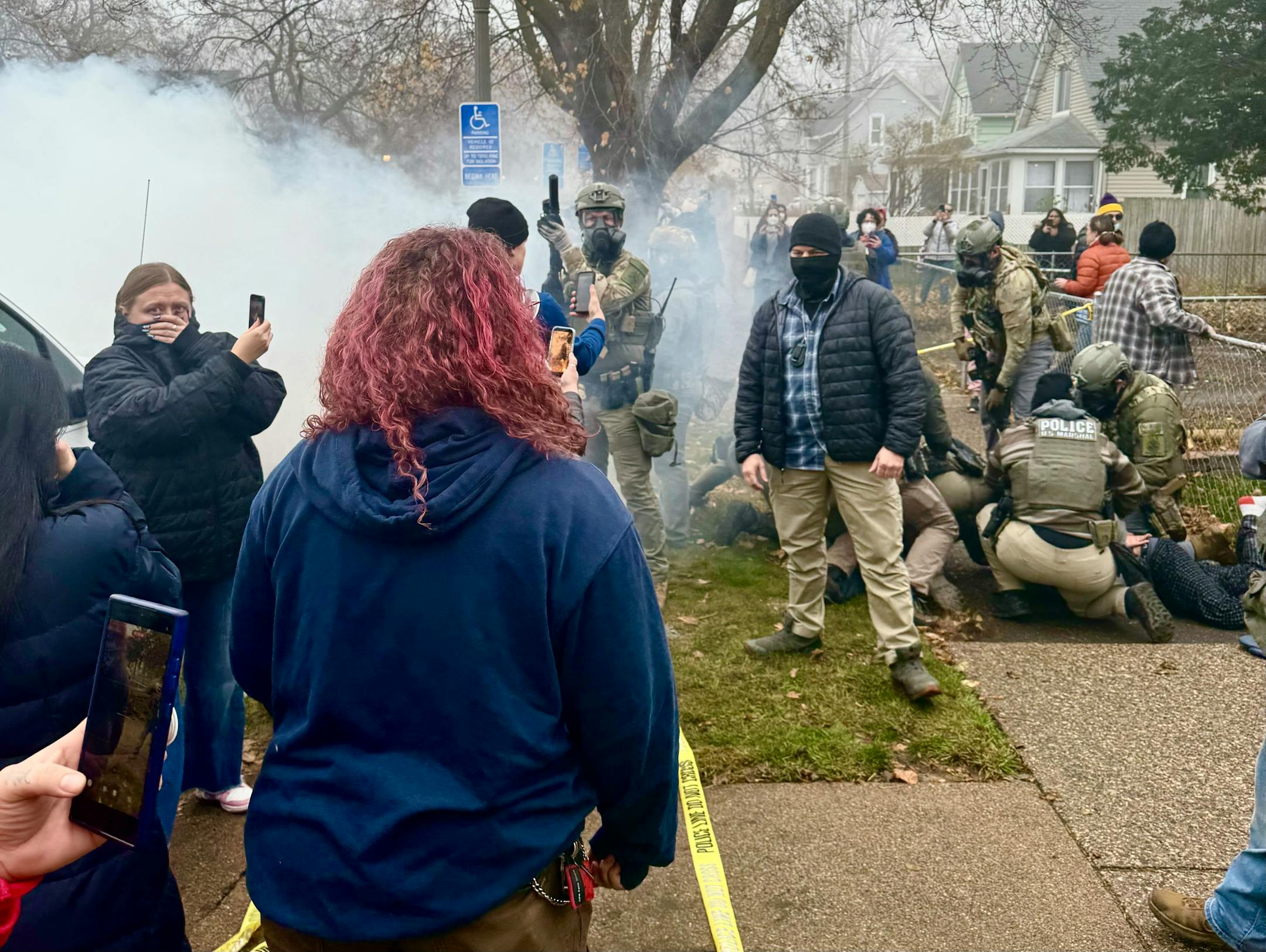
Witnesses look on as federal agents take a person into custody during an operation that drew protesters on St. Paul's East Side Tuesday. (Geoffrey Paquette)

DHS defends raid; community leaders allege abuses

In its statement issued Wednesday, DHS also alleged that “a U.S. citizen weaponized their vehicle and rammed an ICE law enforcement vehicle,” fled on foot and was later apprehended. The agency described the crowd on Rose Avenue as “a large amount of rioters” who “continued to ignore law enforcement commands and aggressively advanced,” saying agents deployed “crowd control measures for the safety of the public and law enforcement.”

The spokesperson added that assaults on ICE officers have increased “1,150 percent,” and included a message attributed to DHS Secretary Kristi Noem: “You will not stop us or slow us down. … If you lay a hand on a law enforcement officer, you will be prosecuted to the fullest extent of the law.”

At the community news conference, Edwin Torres DeSantiago of the Immigrant Defense Network said the family involved had fled “persecution in Honduras” and endured new trauma during Tuesday’s operation.

Mary Anne Quiroz, co-founder of Indigenous Roots, said she arrived Tuesday to find “about a dozen agents” already surrounding the home. She read the family’s statement, which alleged that children and a pregnant woman inside the house spent “five hours under threats, humiliation by HSI agents, mockery and invasion of property,” and that agents entered the home “without a warrant.”

“No one deserves to live the trauma that Jeffrey and the family have experienced,” Quiroz said.

She also said St. Paul police “broke our gridlock” in the yard as community members tried to shelter on neighbors’ property.

“We contribute to the taxes that are paying St. Paul police,” she said. “We demand our city create ICE-free zones and truly stand up for sanctuary spaces.”

Several people who were at the scene on Tuesday also challenged the Police Department’s explanation for why officers advanced on the crowd and deployed chemical irritants. Geoffrey Paquette, who said he was standing at the front of the group of protesters on Rose Avenue, described being sprayed twice — once with what felt like pepper spray and a second time with a “more liquid” chemical he believed was mace.

Paquette said officers formed a line on the east side of the home, “in helmets and gas masks and riot gear,” before ordering the crowd to move west down the block. Paquette said he was standing on the grass near the sidewalk when an officer grabbed him by the front of his jacket, shoved him backward and sprayed him with a chemical irritant “in a plume of gas.”

“I kept asking, ‘Why? What’s going on? Why are you doing this?’” he said. Seconds later, he said, a second stream of liquid spray hit him in the eye from the side.

Paquette also said he witnessed two arrests made by federal agents earlier in the confrontation — one man “slammed into the ground and hogtied,” and another whose head “cracked” against the pavement before being taken away on a stretcher by St. Paul fire medics. Aside from what he described as a single plume of smoke or gas released by federal agents during the first arrest, Paquette said he did not see additional use of chemical irritants by federal officers before St. Paul police advanced.

Journalism group says police injured credentialed media

As officials and advocates disputed what happened on Rose Avenue, the state’s press freedom organization raised its own set of concerns.

The Minnesota Society of Professional Journalists said at least three credentialed photojournalists were struck by less-lethal munitions fired by St. Paul police while covering the raid, despite wearing press badges or vests and carrying cameras. All three, along with several other journalists on scene, were also exposed to chemical irritants, the group said.

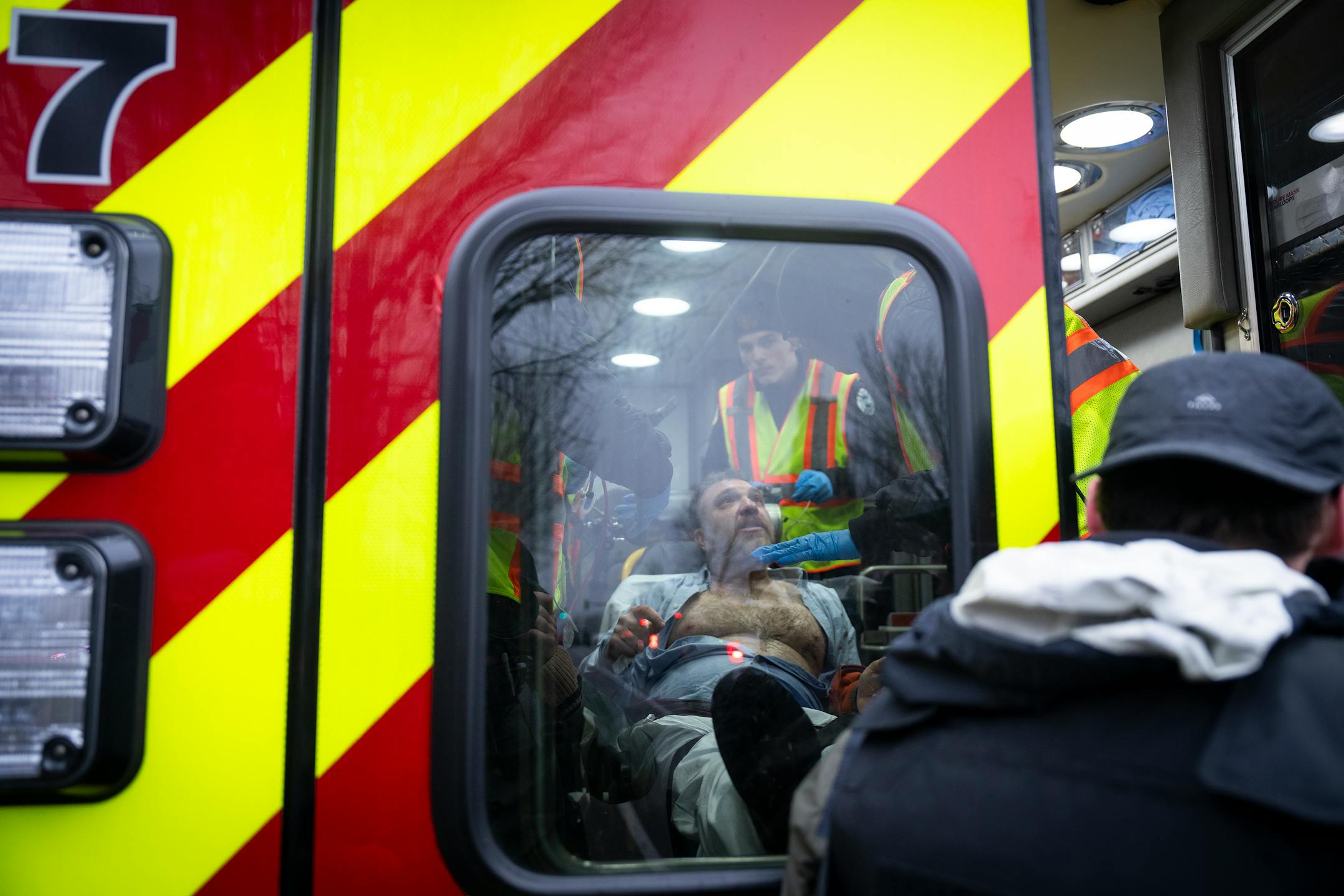
MPR photojournalist Kerem Yücel is attended to by paramedics in an ambulance after coming in contact with tear gas and being hit with a projectile Tuesday in St. Paul. (Leila Navidi/The Minnesota Star Tribune)

Kerem Yücel of MPR News was hit in the shoulder and transported to a hospital by ambulance. Tim Evans, a freelance photojournalist on assignment for Reuters, was struck in the stomach with a pepper ball round. Aaron Nesheim of Sahan Journal was hit in the head with a pepper ball round. Evans and Nesheim did not require hospitalization.

According to MNSPJ, all three told the organization they believed they were targeted “for doing their jobs.”

“Photojournalists are on the frontlines of documenting history and it is imperative that they are kept safe and their First Amendment rights are protected,” the group said. “Attacking journalists sends a message to both journalists and everyday citizens that their First Amendment rights will not be respected.”

MNSPJ called on city officials to explain why journalists were struck by munitions and to commit that “this will never happen again.”

City promises a full review

Carter said Tuesday that that federal operations often leave local residents fearful in their own neighborhoods.

“Families who are trying to decide whether it’s safe to take their children to school tomorrow don’t know,” he said. “People who want to go to work tomorrow are afraid.”

In a statement, the police chief said that in addition to the review, officials are looking to meet with local and federal law enforcement leaders “to create sustainable prevention strategies for our city and the rest of the state.”

Whether officers adhered to St. Paul’s de-escalation and force standards — and how federal agents conducted themselves — will be central to the internal review now underway.

“I am deeply concerned,” Carter said. “We have to be able to ask all of these questions — and they have to be answered.”

Henry said the department’s review has already begun.

Paul Walsh of the Minnesota Star Tribune contributed to this story.

about the writer

about the writer

Sofia Barnett

Intern

Sofia Barnett is an intern for the Minnesota Star Tribune.

See Moreicon

More from St. Paul

See More
.
Tony Cenicola/The New York Times

A Ramsey County jury found Johnson & Johnson products exposed her to asbestos and caused her to develop mesothelioma.

card image
card image