
Burcum: Noem and ICE had a job to do in Minnesota. They blew it.

Instead of careful, limited enforcement, she and ICE chose a chaotic and cruel dragnet.

Columnist Icon
The Minnesota Star Tribune
January 24, 2026 at 10:59AM
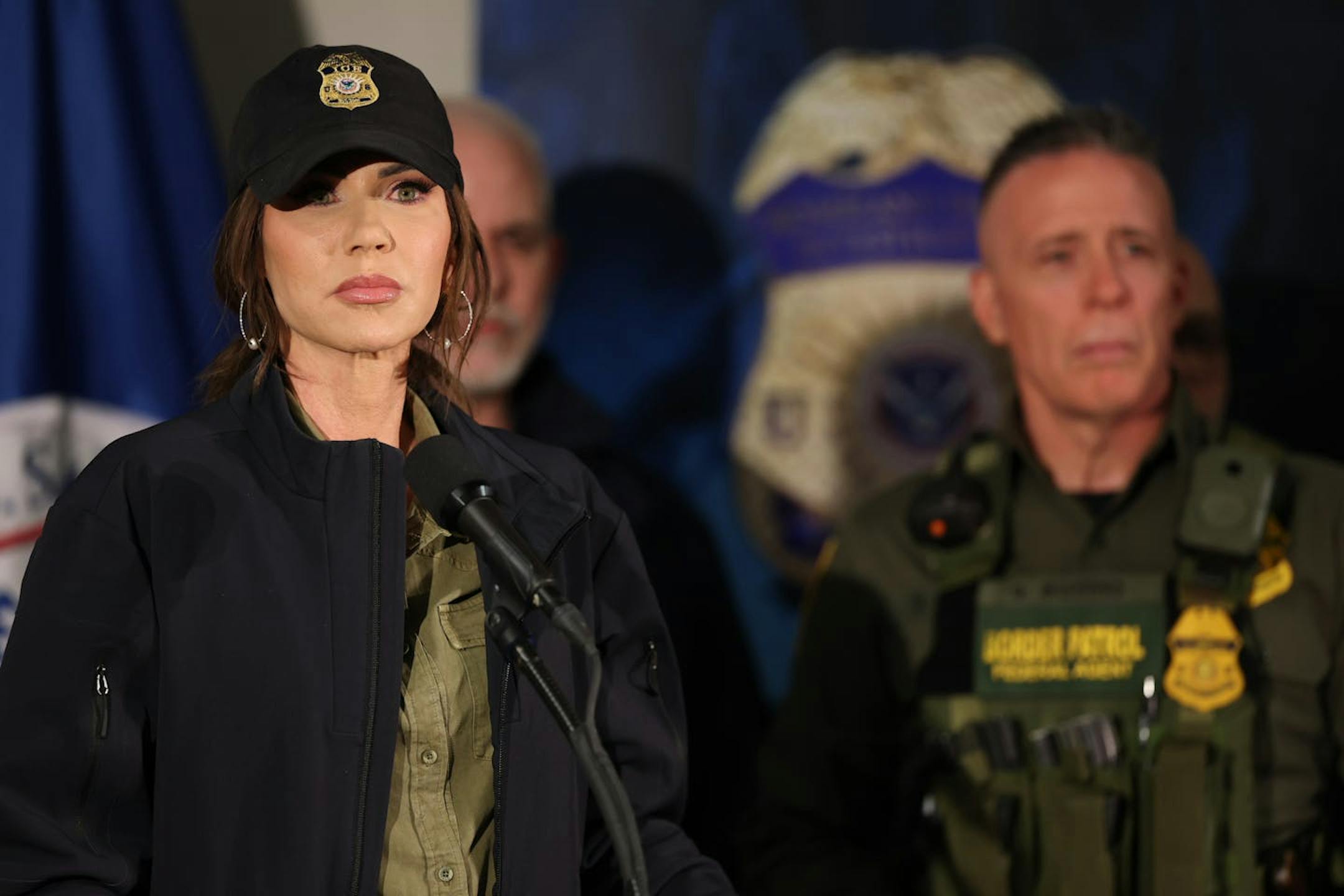
U.S. Department of Homeland Security Secretary Kristi Noem holds a news conference at Fort Snelling on Jan. 7 about the shooting in of Renee Good. (Carlos Gonzalez/The Minnesota Star Tribune)

Opinion editor’s note: Strib Voices publishes a mix of commentary online and in print each day. To contribute, click here.

•••

Minnesota could have been an easy win for U.S. Secretary of Homeland Security Kristi Noem.

Deploy immigration enforcement officers to Minnesota. Conduct surgical strikes on the worst of the worst, call it a success and move on.

Instead, Operation Metro Surge is a messy quagmire that reflects poorly on Noem’s leadership. The hastily trained and ill-equipped federal agents on the ground here raise serious questions about both her competency and stewardship of the extraordinary sum of taxpayer dollars entrusted to her to build out the nation’s ranks of professional immigration agents.

At a minimum, a job review from Congress, and potentially more serious interventions, are imperative for the South Dakota native whose duties include overseeing Immigration and Customs Enforcement. All four of Minnesota’s Democratic U.S. House members are co-sponsors on a measure to impeach Noem.

A decade ago, ICE’s yearly budget was around $6 billion. But in President Donald Trump’s second term, ICE has become the nation’s “highest-funded U.S. law enforcement agency,” according to a recent NPR report, and now controls roughly $85 billion in new and existing funding.

This staggering increase is courtesy of Trump’s signature legislation, the “One Big Beautiful Bill Act” passed last summer. Along with other appropriations, the measure resulted in ICE’s budget being “larger than the annual budget of all other federal law enforcement agencies combined,” a Brennan Center analyst told NPR.

ICE’s action in Minnesota, one of the agency’s first high-profile operations, was a prime opportunity to showcase its prowess. Early evidence of a good return on taxpayers’ massive investment would have looked like this:

Agents representing law enforcement’s best of the best, equipped with cutting-edge gear and technology, quickly taking into custody the most violent offenders with minimal disruption to neighborhoods and security of communities.

Instead, ICE’s agents look like a ragtag force, one that appears to rely on personal or rental cars and lacks uniforms suitable for Minnesota’s extreme winters. From what I’ve seen, these agents aren’t even dressed appropriately to do January chores on my farm.

And instead of using technology to track down violent offenders, they appear to be door-knocking random neighborhoods and swarming schools, health care facilities, Mexican restaurants, child care centers or gas station parking lots all in hopes of finding someone, anyone, to detain. At least two U.S. citizens, Nasra Ahmed and ChongLy Scott Thao, have been swept up in these bungled dragnets.

The ineptitude is almost laughable. So is the idea that ICE agents are combating fraud, something that requires accounting expertise and is investigated with computers, not storm-trooper tactics.

But ICE’s horrendous bumbling is also marked by continued reports of conduct that is unprofessional, cruel, contemptuous of the Constitution and sometimes dangerous, as Renee Good’s tragic death illustrates. Taxpayers are not getting the highly trained professionals that we are paying for.

In the past week, a Minnesota Star Tribune photographer captured ICE agents spraying chemical irritants point-blank into the face of man they’d pinned to the ground.

They detained a 5-year-old Columbia Heights boy, who is believed to be held in Texas along with his father despite an adult living at the home — who reportedly pleaded with agents to leave the child with family. A lawyer for the family claims that the father had no criminal record and was following immigration rules.

ICE’s tactics have drawn the ire of local law enforcement agencies, who took the courageous step of publicly criticizing the agency. Brooklyn Park Police Chief Mark Bruley spoke out Jan. 20 against ICE’s racial profiling tactics, noting that one of his department’s officers was targeted.

ICE has also chosen to flout the Constitution by developing a real-life version of a video game “cheat code,” a secret command players use to give themselves special advantages, in order to allow agents to forcibly enter homes with only administrative warrants, which lack judicial review or a judge’s signature.

Some might be tempted — wrongly — to excuse these tactics if ICE is getting results. But a Jan. 21 Minnesota Star Tribune report casts serious doubt on whether ICE is really protecting Minnesotans from the “worst of the worst.”

The newspaper’s analysis is limited by the amount of data ICE has released publicly. But what the reporters were able to gather casts doubts on what Operation Metro Surge has achieved:

  • Only a small share of all detainees are on the “worst of the worst” list — roughly 8% of the 3,000 immigrants ICE previously claimed it has detained in Minnesota in the past six weeks. (The agency says it has arrested more than 10,000 immigrants total since Trump took office.)
    • Many on the list weren’t actively wanted by police at the time of detention — they were picked up after being released from jail or prison.
      • A notable number have little or no serious Minnesota criminal history.
        • Some individuals committed crimes decades ago and have already served sentences — meaning they were not current threats.
          • Many on the list are in Minnesota simply because they were in federal prison here for crimes committed elsewhere.

            The recent call by the Trump administration for backup from U.S. military forces stationed elsewhere is further evidence that Noem and ICE are fumbling.

            Several thousand ICE agents are in the state. Despite this force, they apparently need an armed forces bailout because of people like Wes Burdine.

            He’s a St. Paul bar owner who helps track ICE activity. Other volunteers he knows include an ice-cream truck owner and middle-aged, project-manager types who have weaponized spreadsheets to keep tabs on the occupiers.

            “These are people just like me, just a dad who takes his kids to soccer and is really mad the whole team isn’t there because the whole team doesn’t feel safe,” Burdine said.

            A focused, professional operation that went after truly dangerous people and didn’t disrupt everyday life could have inspired confidence in ICE. Instead, the chaotic dragnet is likely to create backlash in operations elsewhere.

            Results released Jan. 23 from a New York Times/Siena University poll illustrate political risks from mismanagement in Minnesota. Overall, 61% of respondents said ICE tactics have gone too far. That figure rose to 71% for political independents, a data point that should set off alarm bells for the GOP with midterm elections looming.

            Operation Metro Surge isn’t proof of strength; it’s a mess of Noem’s own making, lavishly funded by you and me.

            about the writer

            about the writer

            Jill Burcum

            Editorial Columnist

            See Moreicon

            More from Columnists

            See More
            card image
            Carlos Gonzalez/The Minnesota Star Tribune

            Instead of careful, limited enforcement, she and ICE chose a chaotic and cruel dragnet.