
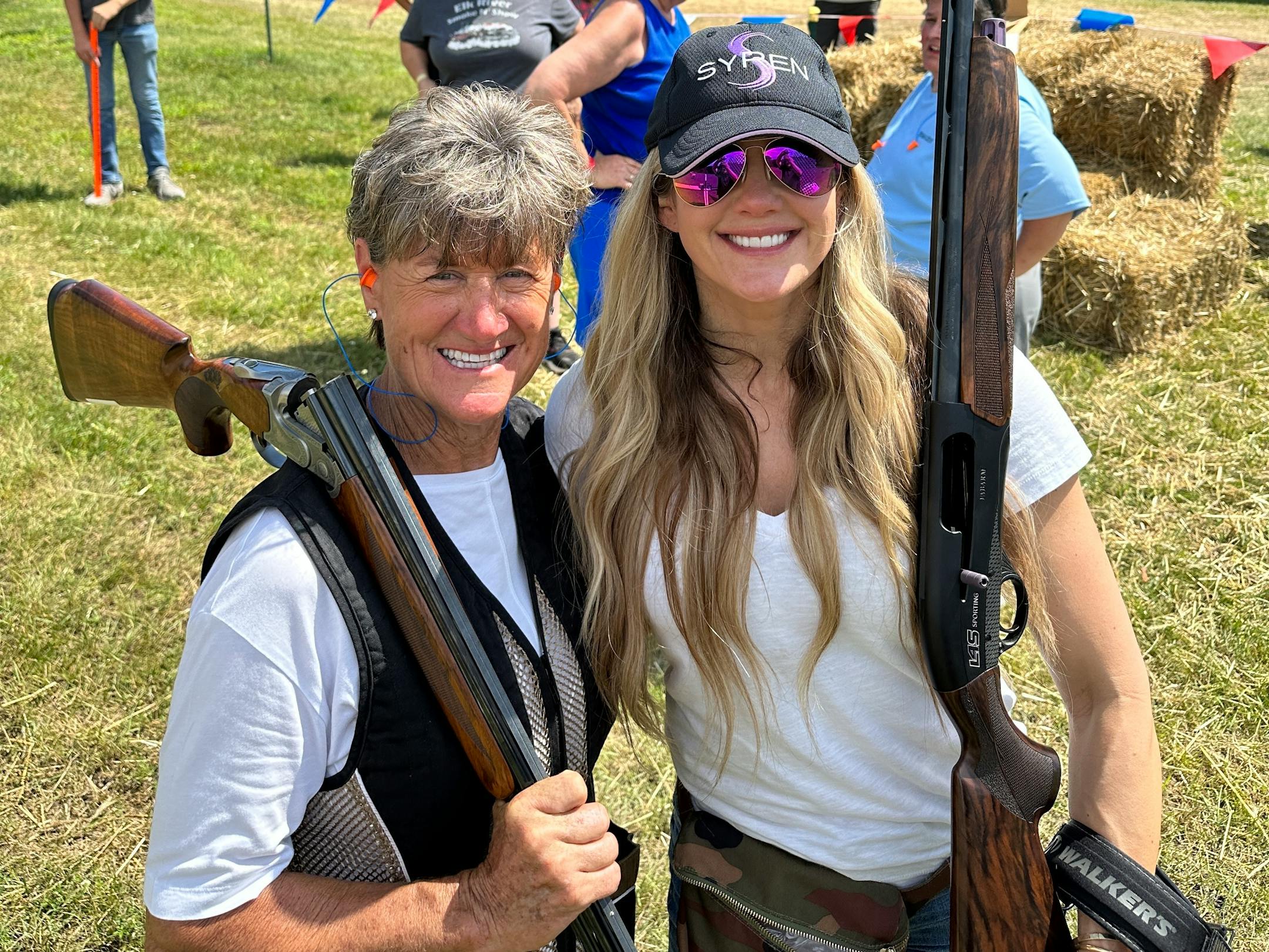
Anderson: All-American trapshooter and Game Fair expert Nora Ross always hits the target

“It might be a man’s sport, but I wanted to show them women belonged.”

Columnist Icon
The Minnesota Star Tribune
August 8, 2025 at 1:34AM
All-American trapshooter Nora Ross, left, with Outdoor Channel and "Minnesota Bound" television host Laura Schara, will lead trapshooting and women's shotgun shooting workshops during Game Fair's six-day run. (Provided)

A 34-time American Trapshooting Association (ATA) All-American, Nora Ross will again lead shooting seminars at Game Fair when the annual outdoor festival opens in Ramsey on Friday.

Ross, 64, was the first woman trapshooter to break 100 straight in doubles and the first woman to win a major championship at the Grand American World Trapshooting Championships when, in 1990, she tied Ray Stafford 100/100 and beat him 119/120 in a doubles shoot-off.

Her longest singles run was 991 straight and she was the youngest person ever inducted into the ATA Hall of Fame in 1999.

A Kentucky native who now lives in Ohio, Ross will lead Game Fair trapshooting clinics at 1 p.m. daily and women’s shotgun shooting workshops with Outdoor Channel and “Minnesota Bound” host Laura Schara at 2:30 p.m. daily.

In the following interview, which has been edited for length and clarity, Ross discusses excelling in a male-dominated sport, the importance of eye dominance in shotgun shooting and hunting ruffed grouse in Wisconsin with her husband.

Q: You lead as many as 40 shooting clinics a year throughout the nation. Is your focus more on teaching competitive trapshooting or introducing girls and women to shotgun shooting?

A: Both. The intent of my trapshooting seminars is to help competitive shooters improve, while my women’s clinics are intended to teach new shooters, women in particular, how to handle and shoot a shotgun — how to feel confident and not be scared of it. That way, if they want, they can go to a trap range or go hunting with a friend or their husband and not be intimidated. Being comfortable with a shotgun gives women another reason to get outdoors. It makes life better.

Q: How old were you when you first fired a shotgun?

A: I first shot when I was a young girl and my dad and I were dove hunting. But my first trapshooting competition was in 1973, when I was 12.

Q: Were you intimidated by all the men involved in trapshooting when you started?

A: Not at all. Though there weren’t many women at that time who shot, everyone was very supportive and wanted to help. As a girl I was a tomboy and just wanted to be outdoors and do something with a gun.

Q: Did your dad hunt a lot?

A: He was primarily a ruffed grouse hunter, mostly in southern Ohio. He bought me a BB gun when I was a very young girl. Later, we hunted grouse a lot together, and I still love it. My husband, Randy, and I spend about 50 days each fall hunting grouse in Wisconsin.

Q: Do you hunt over your own dogs?

A: My dad had English setters when I was young, and my husband and I also hunt over setters. We have two right now.

Q: When you started trapshooting, did you get good quickly?

A: I did not. One reason is that most of the advice I got was from “two-eyed’’ shooters, meaning they kept both eyes open when they shot. But I keep just one eye open. Loral I [Delaney, the late wife of Game Fair promoter Chuck Delaney] was a great shot, and she shot with two eyes open. That’s pretty much the standard, and a lot of people say you can’t be any good if you don’t keep both eyes open. Not me. I might as well shoot from the hip if I do that.

Q: You’re righthanded. Which eye is dominant?

A: My left. So you can see why I didn’t shoot that great when I was told to keep both eyes open.

Q: At your peak as a competitive trapshooter, what was your average?

A: For more than 10 years I averaged more than 99 clays broken out of 100 in singles.

Q: Did you enjoy competition?

A: I loved it, right from the start. I particularly wanted to beat men shooters. It might be a man’s sport, but I wanted to show them women belonged. The only thing men have on women shooters is strength. Because of that, women have to work a little harder to have the stamina to stand out there and stay focused for an entire shoot.

Q: In your clinics do you advocate shooting with one eye open or two?

A: The clay is not going to come out of the trap house any different whether I’m a one-eyed shooter or two. The only difference is where the shooter points the gun when they say, “Pull!” Some people will naturally shoot better with two eyes, others with one. In teaching, it’s important to know which is the more natural for each shooter.

Q: Do you teach men to shoot differently from how you teach women?

A: Generally, no. But there are more natural one-eyed women shooters than there are men. Often I will video a new shooter shouldering a gun and looking down the barrel. Typically when they mount the gun, they have both eyes open. That works for some people. But a concern is that a lot of shooters are right-eye dominant. But when they get tired, the other eye takes over.

Q: Do you see many natural shooters who seem to excel with relatively little practice?

A: Not many. In the end, shooting is like any sport. How good you are depends how much you work at it.

Q: Is there a correlation between being a good trapshooter and a good bird shot?

A: I think skeet [in which clay targets cross in front of the shooter] is the better sport to help improve your bird shooting. Until I shot skeet, in fact, I never knew what “lead” was, because in trap the bird is always flying away from you.

Q: Where do you rank ruffed grouse compared with ducks, geese, quail and doves in terms of birds that are difficult to hit?

A: Doves and ducks are coming toward you. You can see them and get ready. Grouse and quail flush and go away. For me a bird is easier to hit if I can see it coming.

about the writer

about the writer

Dennis Anderson

Columnist

Outdoors columnist Dennis Anderson joined the Star Tribune in 1993 after serving in the same position at the St. Paul Pioneer Press for 13 years. His column topics vary widely, and include canoeing, fishing, hunting, adventure travel and conservation of the environment.

See Moreicon

More from Outdoors

See More

The sport is no stunt, as swimmer Mackenzie Koeck and her support crew learned in the yearlong runup of preparation.

Rising above the treeline (Top of this photo), on the shore of Birch Lake, the Twin Metals Copper Nickel Mine Plant site and Tailings Management site is part of the proposed plan. ] In theory, the copper-nickel mine Twin Metals wants to build in the headwaters of the Boundary Waters Canoe Area Wilderness is a zero-discharge mine — a closed loop that will endlessly recycle millions of gallons of water, including rainwater and the polluted process water it uses to extract ore and
card image