Advertisement

Lucky crowds get a glimpse of a ‘fleeting natural wonder’ at Apostle Islands ice caves

February 22, 2026
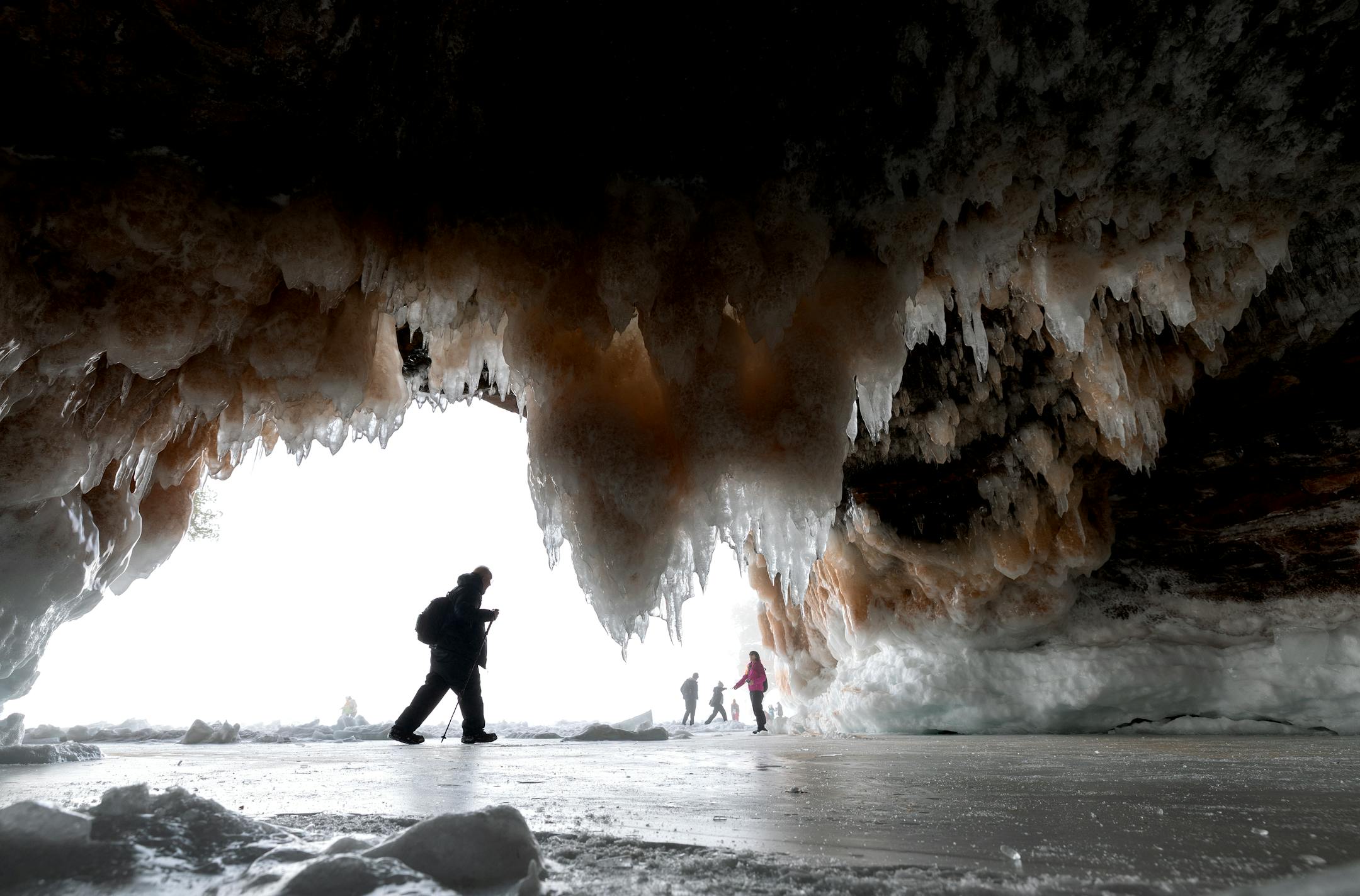
Visitors walk around the ice formations at the Apostle Islands National Lakeshore sea caves near Bayfield, Wis., on Feb. 16. (Carlos Gonzalez/The Minnesota Star Tribune)

An increasingly rare phenomenon had people flocking to the Apostle Islands ice caves for one day. And then it was over.

The Minnesota Star Tribune
Advertisement

APOSTLE ISLANDS NATIONAL LAKESHORE — My calves ached as I walked on frozen Lake Superior, carefully maneuvering around jagged shards of ice, some hidden under a layer of snow.

I had never seen the famed Apostle Islands ice caves along Wisconsin’s northern lakeshore. The last time the caves were open to visitors, in 2015, I watched videos and photos on my social media feed hoping to visit the next year. I didn’t think I’d have to wait 11 years.

So when the National Park Service announced, with just two days’ notice, that the caves would be opening on Feb. 16, I booked a hotel room in Duluth right away. This was my chance to see the mesmerizing, icy wonderland.

The scene along the shore was as spectacular as the photos, maybe even more so. Giant ice shelves rose from the frozen ground, and the ice on the red sandstone cliffs shimmered in the sunlight.

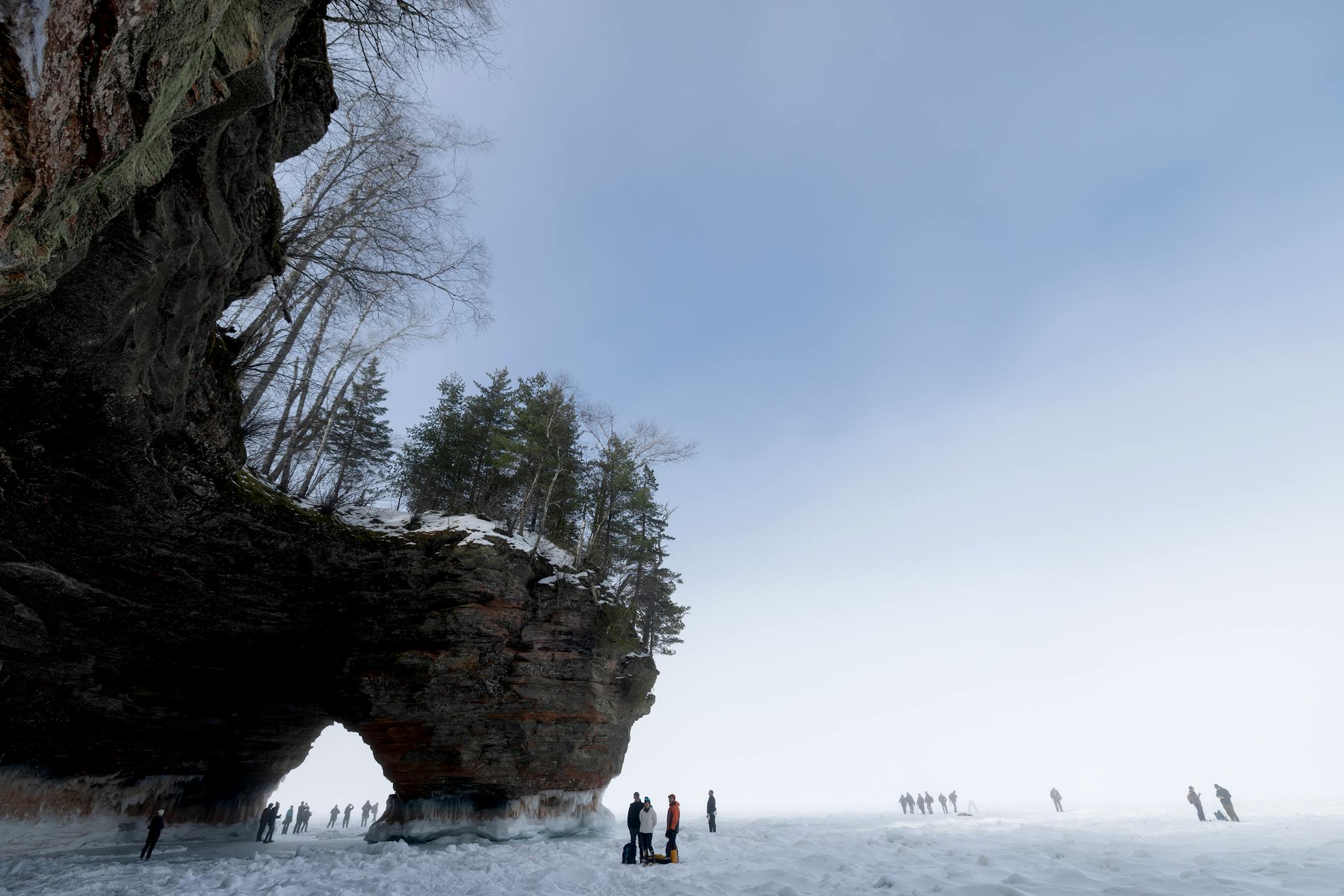
Thousands of visitors explored the network of caves. Some were dressed in light jackets and using trekking poles. Others went out in sweatshirts and hats. A few were on skis.

Children crawled under low-hanging walls and into smaller caves behind those walls, places their parents couldn’t or wouldn’t go.

For decades, people have visited these ice caves, but since the turn of the century, those journeys have become more rare as the ice has dwindled.

The excitement on this February day was palpable. Visitors said they’d shifted appointments, called off work and traveled from as far away as New York and Colorado. Once here, they had waited hours to board the shuttle that dropped them at the access point on Meyers Beach.
Advertisement

Over a 3-mile hike, I traversed uneven terrain and, in some areas, slush and puddles. I passed five large caves and dozens of smaller ones on my way to the largest and most spectacular of all — known as the cathedral.

In a soundscape much like a basilica’s, the chatter of voices echoed, the sound reverberating off columns of frozen water, sandstone cliffs covered in cascading walls of ice and, in some parts, the smooth surface of Lake Superior.

The cave was carved by the lake’s treacherous waves and ice, which eat away the stone. When the subzero temperatures hit and the water calms, an icy path to the famous caves appears, decorated with dreamy icicles that cling to roots, moss and red rock alike.

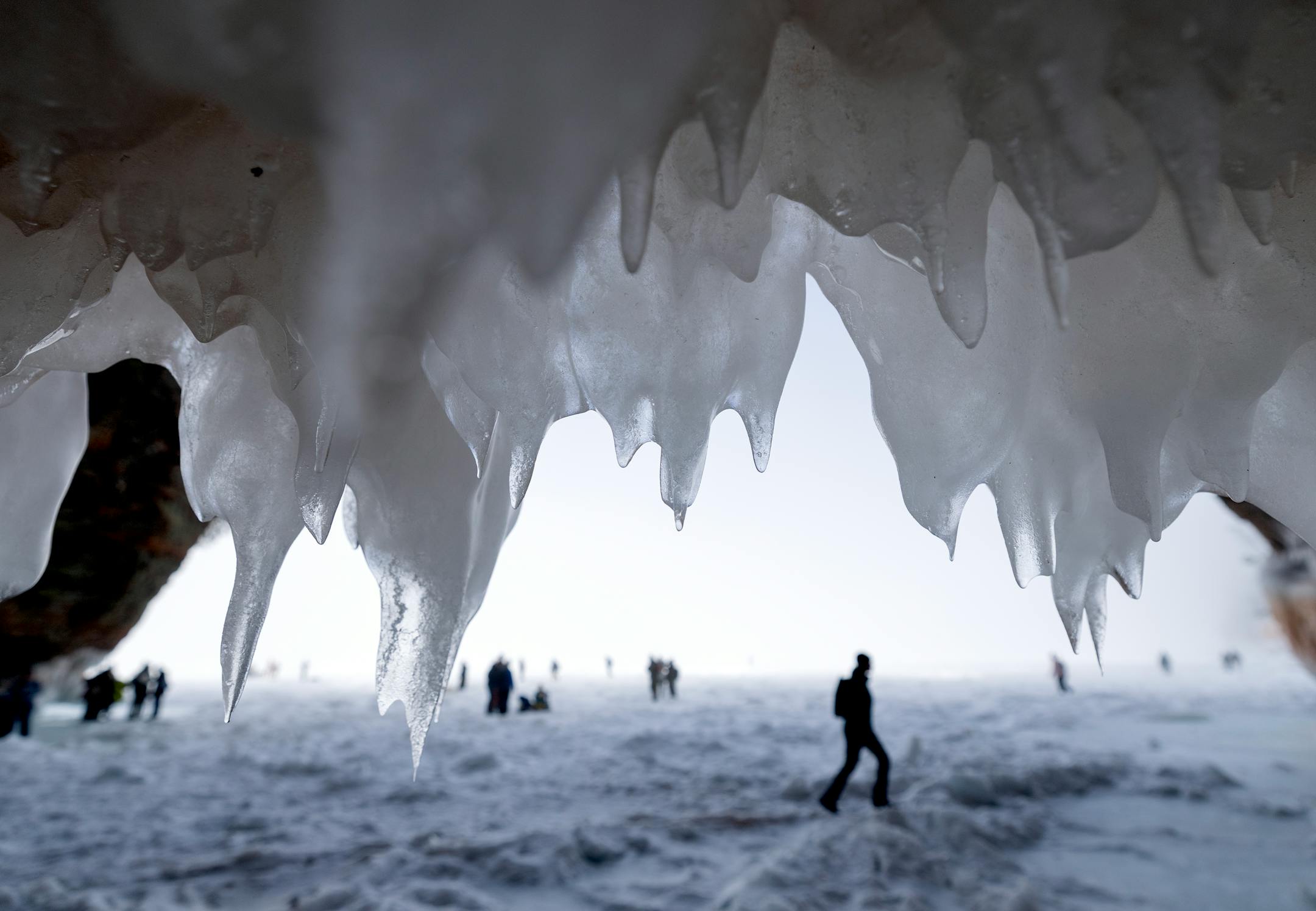
The arch of the cathedral is more than 100 feet high and contains several smaller sea cave. We all gazed in wonder at long, thick icicles, running our fingers over the red sandstone dust lining the glassy, clear ice walls, all while enveloped in an ethereal fog.

Visitors view the Apostle Islands National Lakeshore Mainland Sea Caves near Bayfield, Wis., on Monday, February 16, 2026. (Carlos Gonzalez/The Minnesota Star Tribune)

The storm rolls in

As parents pulled children on sleds and dozens of people snapped photos, Bruce and Marsha Danielson took in the scene.

The couple from Lake City, Minn., weren’t sure they would ever see the caves up close. They went sea kayaking on Lake Superior one summer to see the famed caves, but a passing barge created waves that sent them too close to the unforgiving rocky shore. They decided to turn back.

Advertisement

“It’s amazing how everything is just icicles and the colors, some of them are so blue, then there’s the rust and the orange and the yellow. It’s just awesome,” said Marsha, 63, looking at the caves in their winter incarnation.

She also knew this might be a once-in-a-lifetime visit.

“We thought, if this is going take 10 more years before we can get here again, we don’t know if we could walk.”

The Apostle Island caves form fantastical ice formations in winter.

The caves were last open in winter to the public in 2015. It’s possible it will be another ten years before they open again.

“I estimate that the conditions necessary for the ice caves to be accessible and safe to open may happen on a once-in-a-decade frequency, and perhaps even less frequent,” said Joseph Moore, meteorologist at the National Weather Service in Duluth.

More than 1,200 people had registered to see the caves by mid-morning on the day the caves opened on Feb. 16, according to the Friends of the Apostle Islands, which partners with the National Park Service to preserve the area. That number passed 2,500 by the afternoon.

Advertisement

Jeff Rennicke, executive director of the nonprofit, said he estimates there were ultimately more than 3,000 people out on the ice on opening day.

The fact that it was Presidents’ Day meant some people had the day off. Those who didn’t may have felt some urgency to see the caves before a winter storm, forecast to hit the region the next day.

Even before the end of the first day, the Park Service said it would close the caves for a few days due to the storm.

On Feb. 18, it was apparent the phenomenon would be a “fleeting natural wonder,” as the Park Service called it in a statement.

The miles of thick, stable ice along the shoreline had disappeared, broken up by wind gusts over 50 mph, according to the National Weather Service.

Stalactites of ice loom over the surface of Lake Superior. (Carlos Gonzalez/The Minnesota Star Tribune)

Once in a decade

Before the turn of the century, the Apostle Islands ice caves were a regular winter occurrence.

Advertisement

But this century, the caves have opened to the public in only five years: 2004, 2008, 2009, 2014 and 2015. They have been open a total of 211 days since 2000, counting the single day in 2026.

For people to safely walk on Lake Superior’s surface, the ice shelf needs to extend miles from the shoreline. Ice formation requires prolonged periods of subzero temperatures and light winds that do not disturb the ice.

At one time, Lake Superior’s overall ice concentration — that is, the concentration of ice within the water — frequently surpassed 50% in winter, according to data from the National Oceanic and Atmospheric Administration. But in the past decade, Superior has exceeded 50% ice concentration only once — this year.

The average ice cover on Lake Superior declined by nearly 80% between 1973 and 2010. It is the second-fastest-warming lake on the planet. Water temperatures are increasing twice as fast as atmospheric temperatures, according to the Park Service.

When the caves opened on Feb. 16, there had been a stretch of below-normal temperatures from mid-January into early February, said Moore of the National Weather Service. That allowed miles of ice to form near the caves.

But a strong wind can break it up in a matter of hours, and that’s what happened this year. Winds exceeding 50 mph coupled with temperatures in the high 30s — about 10 degrees above normal — destroyed the ice shelf, Moore said.

About 3,000 people got to visit the ice caves this year, a rare opportunity in this century.

One last chance

There were hundreds of people in front of me and thousands behind while I waited in line for the shuttle to Meyers Beach.

Whether intentionally or not, these travelers are taking part in a modern trend that is on the rise around the globe: last-chance tourism.

It involves visiting destinations vulnerable to climate change before they vanish. It’s described in a 2010 Canadian study as involving the paradox of tourists visiting places like Antarctica to see melting glaciers while emitting greenhouse gases to get there.

I was among those last-chance tourists to the sea caves, driving from my home in the Twin Cities to see what I may never see again.

Dan Keller, who was snapping photos as I interviewed him, said he booked a flight from his home in New York to Wisconsin when he heard the news. Gloria Esguerra, 32, and Kate Rose, 31, of Chicago drove eight hours, starting at around midnight. They took turns sleeping and driving.

Arlene Schneller, 67, of Ironwood, Mich., was just back from a trip to Breckenridge, Colo. She said she jumped off her flight at MSP, drove straight home to the Upper Peninsula, and then right to the caves, waiting in line for the shuttle for about 90 minutes.

Seeing the ice caves again evoked a mix of emotions: nostalgia as she remembered taking her children to the ice caves in the 1990s nearly every year, pulling them in a sled behind her. The adrenaline of making it in time this year. And sadness that it may be the last time she’d get to see the caves.

“It’s the most stressed I’ve been since the grandchildren were born,” said Schneller, who was with a friend. “We said this may be our last time, so we’re coming no matter what.”

about the writer

about the writer

Alex Chhith

Reporter

Alex Chhith is a general assignment reporter for the Minnesota Star Tribune.

See Moreicon

More from Outdoors

See More
Rising above the treeline (Top of this photo), on the shore of Birch Lake, the Twin Metals Copper Nickel Mine Plant site and Tailings Management site is part of the proposed plan. ] In theory, the copper-nickel mine Twin Metals wants to build in the headwaters of the Boundary Waters Canoe Area Wilderness is a zero-discharge mine -- a closed loop that will endlessly recycle millions of gallons of water, including rainwater and the polluted process water it uses to extract ore and
card image
Advertisement