

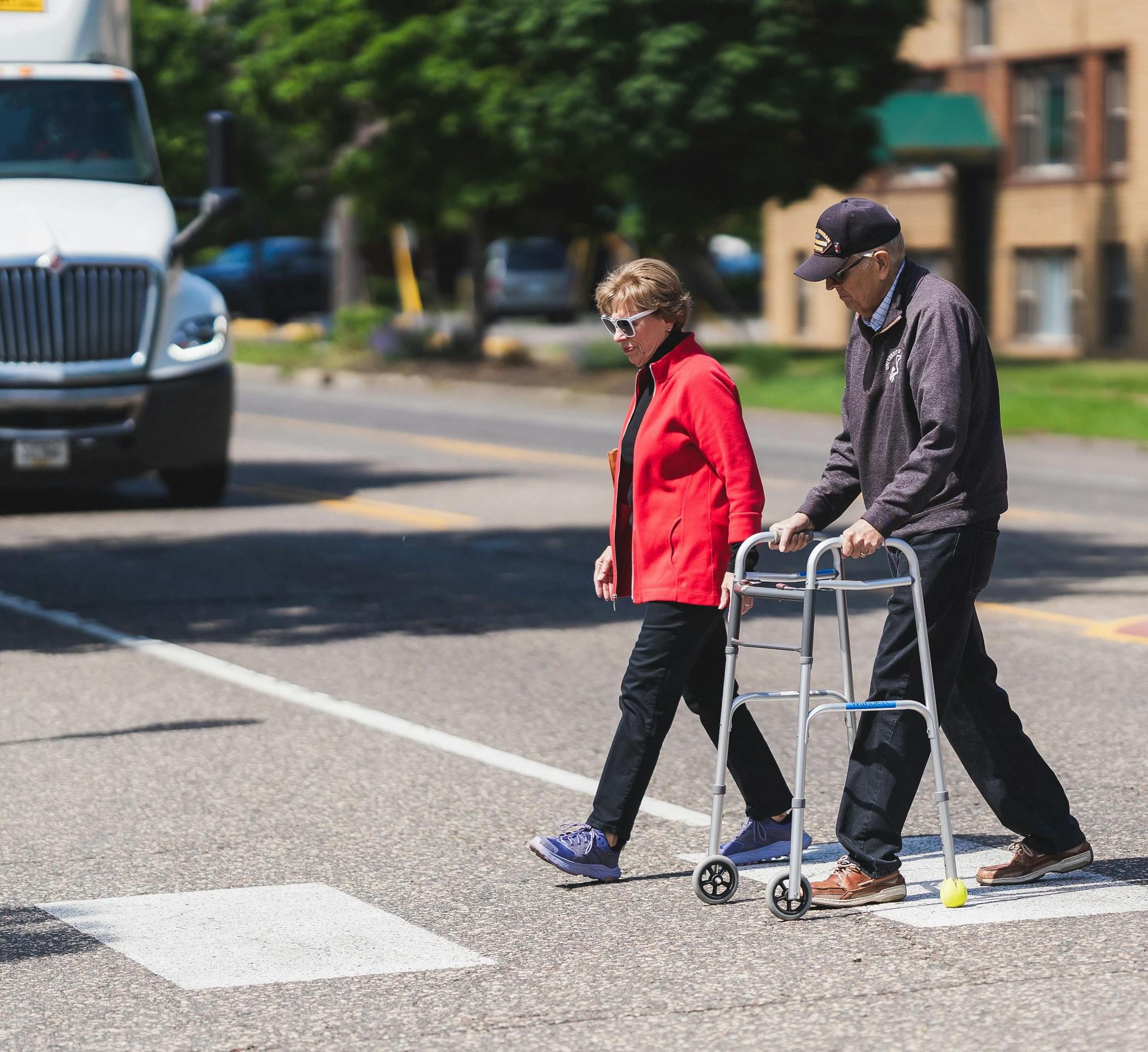
It’s been a tough year for pedestrians in St. Paul, with seven fatalities so far, including five people killed while crossing the street in a crosswalk in just the past few months.
The most recent death happened on Nov. 23, when a motorist turning off Dale Street onto Summit Avenue struck two pedestrians in a crosswalk. A few days later, one of them, Janet Stevens, 75, of St. Paul, died of her injuries.
Earlier in November, Amber Deneen, 30, was killed by a hit-and-run driver while walking with her husband and dogs at St. Anthony Avenue and Aldine Street. Police subsequently made an arrest in that case.
“There has been an uptick in this kind of pedestrian crashes, really sad situations.” said Cmdr. Jeremy Ellison, who heads the St. Paul Police Department’s Traffic & Pedestrian Safety Unit. “We need a renewed focus on what we can do to prevent these.”
Minnesota law requires drivers to stop and yield to pedestrians in all marked and unmarked (unpainted) crosswalks, and those clearly waiting at the curb. But why drivers don’t stop is “a far more dynamic and complex interaction than one that can be boiled down to just knowledge of the crosswalk law,” said Nichole Morris, who has studied roadway safety as director of the University of Minnesota’s Human Factors Safety Laboratory.
Often speed is a factor. The roadway width, number of lanes, traffic volumes and lighting come into play, too, Morris said. Drivers also are sometimes impatient in waiting for pedestrians who cross the roadway, and willfully ignore them.
“Drivers may fail to scan the roadway, often fixating on vehicles in front of them or other upcoming hazards, and only notice the pedestrian when they are too close to stop in time,” Morris added.
At least three times a week, a pedestrian is hit by a vehicle in the capital city, Ellison said. Officers have issued 169 citations to motorists who failed to yield to a pedestrian so far this year compared with 379 last year, city data showed.


