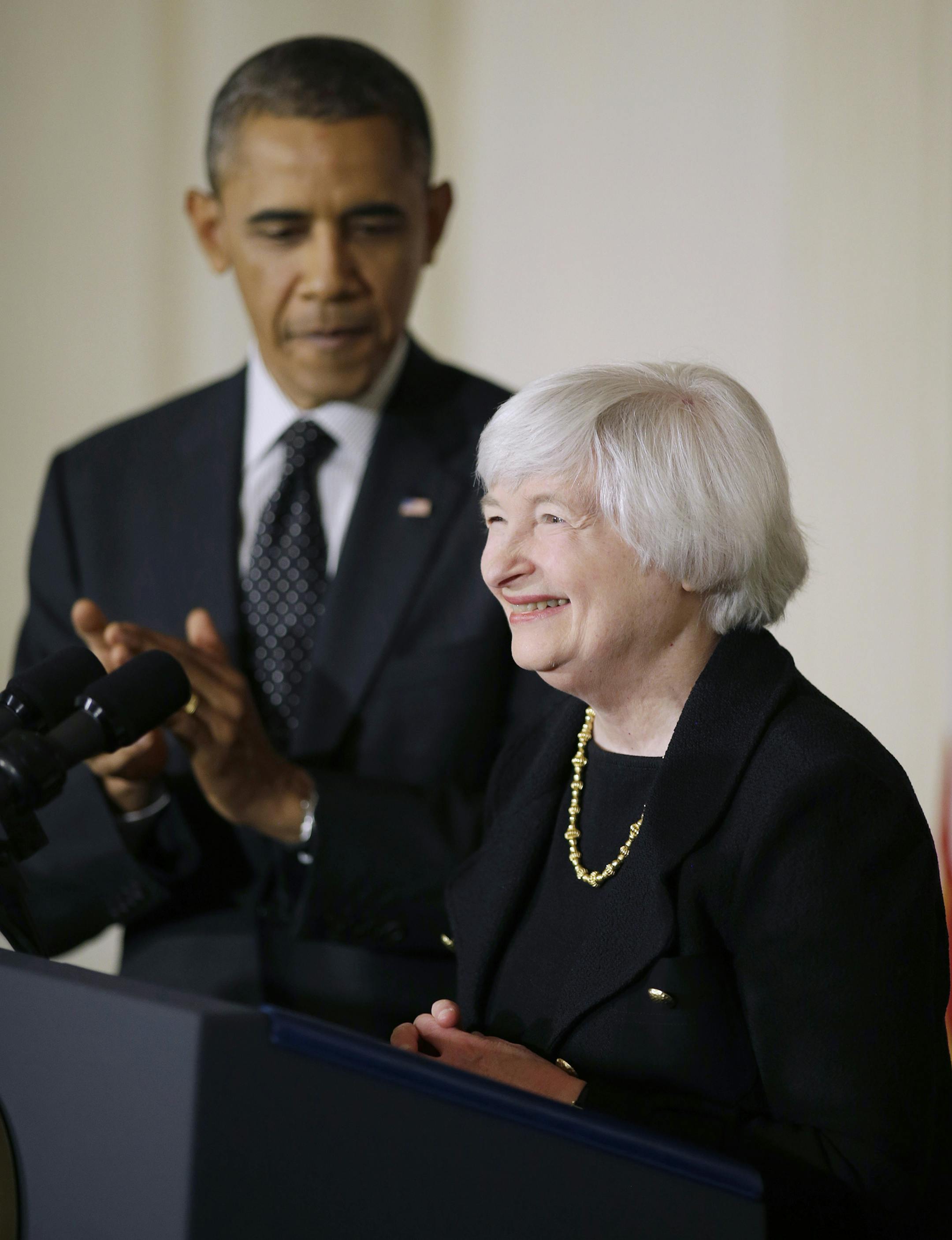
WASHINGTON – As President Obama's choice to head the Federal Reserve, Janet Yellen would come to the post with a career-long focus on the issue that remains at the center of public concern over the economy — jobs and labor markets.
Among Yellen's scholarly works are a number of papers on work, the labor movement and the economy that she wrote while at the University of California, Berkeley with her husband, George Akerlof, who won the Nobel Prize in economics in 2001. Their work laid out a theory, now widely accepted among economists, about why many firms tend not to cut wages during periods of high unemployment — their desire to maintain the productivity of their workers trumps the short-term benefit that lower wages might bring.
The "stickiness" of wages, in turn, helps explain why unemployment can persist and why government intervention in the market can help lessen it.
In a paper published in 1990, Yellen and Akerlof explained upward job mobility and the patterns of unemployment by skill as an economy recovers from a downturn. And as a top Fed official, Yellen has emphasized in recent years the devastating and prolonged effects of the recession on workers — and the need for the central bank to take aggressive action to combat the high jobless rate.
In that vein, Yellen doesn't regard her many years teaching at Berkeley as something apart from the real-life problems of the economy. "Business students are very oriented to playing a role in the real world and accomplishing something, not training themselves to be scholars and contribute to the literature," she told the alumni magazine of Berkeley's Haas School of Business last year. "Teaching in that kind of environment has focused me much more on the real world, how pieces of the theory I know can be applied to real-world situations."
As the No. 2 under Fed Chairman Ben Bernanke, Yellen has been a driving force behind efforts to increase the Fed's transparency and communications with the public. Largely under Yellen's direction, the central bank has pushed the limits in articulating its plans and goals. The Fed has, for example, laid out specific inflation targets and unemployment thresholds for policy changes in the hopes of giving markets and other people a clearer direction of what its policies are intended to accomplish.
Diminutive and soft-spoken, Yellen grew up in Brooklyn and attended a public high school in the city. She developed a passion for economics and international finance in particular while an undergraduate at Brown University.
Her economic views were largely formed at Yale, where she earned a doctorate under the tutelage of the late Nobel laureate James Tobin — a strong proponent of the ideas of John Maynard Keynes, that government can and should take action to mitigate recessions and tackle problems such as high unemployment.